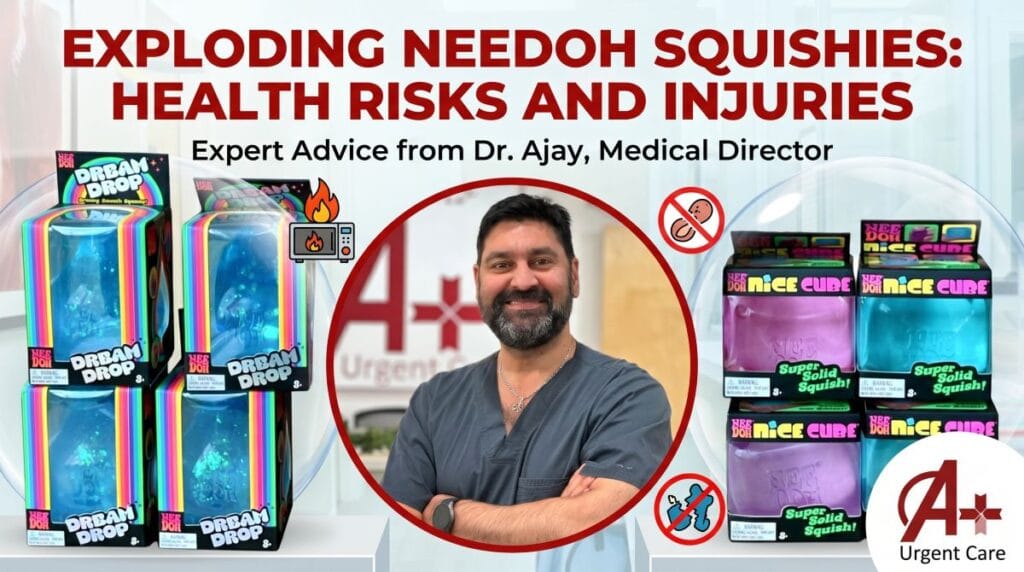
NeeDoh squishies toys are causing severe burns in children from a viral microwave trend and chemical irritation from normal play. Learn the risks and when to seek urgent care.

Key Takeaways:
- Never microwave, boil, or heat NeeDoh squishies—the internal maltose syrup reaches extreme temperatures and has caused second- and third-degree burns requiring hospitalization in children.
- Even during normal play, these toys can rupture and leak acidic gel (pH level of 2) that causes chemical burns, skin peeling, and eye injuries.
- If exposure occurs: Wash skin immediately with soap and water, flush eyes for 15-20 minutes, and visit A+ Urgent Care in Bloomfield or Cresskill for same-day burn evaluation if symptoms develop.
Over the past month, we treated few children at our A+ Urgent Care locations in Bloomfield and Cresskill for injuries related to NeeDoh sensory toys—burns from microwaved toys and skin reactions from ruptured ones.
With these incidents on the rise, parents need to understand what not to do with NeeDoh squishies and how to respond if an injury occurs.
What Are NeeDoh Squishies and Why Are They Dangerous?
NeeDoh sensory toys have become wildly popular with children—soft, squeezable stress balls that feel satisfying to squish. They’re marketed as fidget toys, sensory tools, and stress relievers. What most parents don’t realize is what’s inside them.
The Internal Materials
These toys aren’t filled with simple foam or gel. Depending on the model, NeeDoh squishies contain:
Maltose syrup: Found in models like the “Nice Cube,” this is a thick, sticky sugar extract derived from barley. Consistency similar to thick honey or melted candy.
Polyvinyl alcohol (PVA): Found in “Groovy Glob” and “Groovy Fruit” varieties. A water-soluble synthetic compound also used in glues and pharmaceutical coatings.
Dough-like compounds: Elastic materials designed to retain shape.
Water-soluble dyes: Colorants that can stain skin and clothing.
Why Does This Matter?
The thermoplastic rubber (TPR) outer shell isn’t indestructible. When these toys rupture—whether from misuse, wear and tear, or aggressive play—the internal substances create serious problems.
According to Consumer Reports’ investigation into squishy fidget toys, the contents are notoriously adhesive. Users compare the stickiness to Gorilla Glue—extremely difficult to remove from skin, hair, or clothing.
But stickiness is the least of the concerns. The real dangers involve burns.
The Microwave Trend: Severe Thermal Burns in Children
A viral TikTok trend has led to multiple children suffering severe burns—some requiring hospitalization and skin grafts. The trend? Microwaving NeeDoh toys, particularly the exploding NeeDoh Nice Cube, to make them softer and more pliable.
What Happens When You Microwave a NeeDoh?
The manufacturer explicitly warns against heating or freezing these toys. Here’s why:
The maltose syrup retains extreme heat. Sugar-based substances don’t just get hot—they get superheated and hold that temperature far longer than water. The internal temperature can exceed boiling water by a significant margin.
The TPR shell becomes unstable. Extreme temperatures compromise the structural integrity of the outer rubber, making rupture inevitable.
Pressure builds rapidly. As the internal material heats and expands, pressure increases until the toy explodes.
The Medical Reality
When an exploding NeeDoh Nice Cube ruptures, it releases superheated, thick syrup that adheres immediately to whatever it contacts.
Because of the syrup’s adhesive nature, it sticks directly to skin—you can’t quickly wipe it off or shake it away. The burning continues as long as the material remains in contact.
ABC News reported on a 9-year-old boy who suffered third-degree burns after microwaving a NeeDoh toy. NBC News covered similar incidents, including cases where children required extensive medical treatment.
In at least one documented case, burns were severe enough that a seven-year-old child had to be placed in a medically induced coma.
The Burns Are Particularly Severe
Maltose burn first aid is complicated by several factors:
- Immediate adhesion: The syrup bonds to skin on contact
- Prolonged heat transfer: Sugar holds heat longer than water
- Difficult removal: Attempting to wipe away the substance can spread it and cause additional damage
- Deep tissue damage: The combination of heat retention and adhesion produces burns that penetrate beyond the surface
Children are suffering second- and third-degree thermal burns to faces, arms, and hands—areas most likely to be exposed during microwave removal or observation.
Chemical Irritants During Normal Play
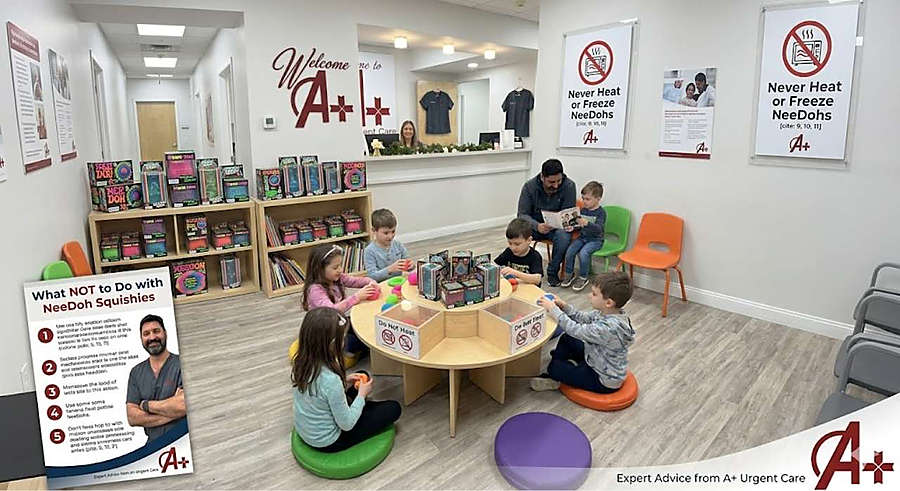
The microwave trend represents intentional misuse. But what about injuries during normal play? Unfortunately, NeeDoh squishies present chemical hazards even at room temperature, even when used as directed.
How Toys Rupture During Normal Use
The TPR shell isn’t designed to last forever. Toys rupture from:
- Aggressive squeezing
- Punching or throwing
- Biting or chewing (common in younger children)
- Normal wear and tear over time
- Manufacturing defects or weak seams
When a toy ruptures, the internal gel leaks out—and direct skin contact begins.
The Acidic Gel Problem
While the manufacturer lists materials as “non-toxic,” Consumer Reports’ investigation found that the PVA gel in certain samples is highly acidic, registering a pH level of 2. For context, that’s similar to undiluted lemon juice or stomach acid.
“Non-toxic” means the material won’t poison you if ingested in small amounts. It doesn’t mean the material is harmless to skin.
NeeDoh Chemical Burn Injuries
Multiple reports detail children suffering from:
- Severe skin irritation
- Significant skin peeling
- “Chemical burn-like” injuries
- Persistent redness and discomfort
- Rashes requiring medical treatment
These injuries occur during standard play—not misuse. A child squeezes too hard, the toy ruptures, the gel contacts skin, and chemical irritation begins.
According to legal analysis of NeeDoh injury cases, reported injuries are increasing as the toys remain popular with children.
Eye Injuries from Ruptured NeeDoh Squishies
Perhaps the most concerning injury pattern involves gel exposure to children’s eyes. When a NeeDoh toy ruptures under pressure, it can project the internal gel outward—sometimes directly into a child’s face.
The Mechanism
A child squeezes a toy forcefully. A weak spot in the shell gives way. The pressurized contents spray outward. If the child is looking at the toy (which most children are), the gel can contact their eyes.
Why Eye Exposure Is Serious
The combination of impact and chemical properties creates a dangerous situation:
- Physical impact: Gel striking the eye at pressure
- Adhesive properties: Material that sticks rather than washing away easily
- Acidic pH: Chemical irritation to sensitive eye tissue
- Difficult removal: The sticky substance resists normal flushing
Documented Eye Injuries
Reports describe children experiencing:
- Severe eye swelling
- Intense irritation
- Redness and tearing
- Vision disturbances
- Medical evaluation requirements
Eye exposure to NeeDoh contents should always be treated as a medical situation requiring professional evaluation.
First Aid for a NeeDoh Squishie Exposure
What should you do if a NeeDoh toy ruptures and your child is exposed to the internal contents? Immediate action can minimize damage.
For Skin Contact (Non-Heated Toys)
Immediate steps:
- Wash the affected area thoroughly with soap and lukewarm water
- Don’t scrub aggressively—this can worsen irritation
- Remove as much of the sticky substance as possible
- Rinse the area completely
- Pat dry with a clean towel
Watch for:
- Developing redness that doesn’t fade
- Skin peeling
- Rash or irritation
- Burning sensation
- Blistering
If any of these develop, seek medical evaluation.
For Thermal Burns (Heated Toys)
Immediate steps:
- Cool the burn immediately. Run cool (not ice cold) water over the affected area for at least 10-20 minutes
- Remove the substance carefully. Don’t pull at stuck material—let the water help release it
- Don’t apply ice directly. This can cause additional tissue damage
- Don’t apply butter, oils, or home remedies. These can trap heat and worsen burns
- Cover loosely with a clean, dry bandage.
Seek immediate medical care if:
- Burns cover a large area
- Burns are on the face, hands, feet, or genitals
- Blisters develop
- The burn appears white, brown, or black (indicating deep tissue damage)
- The child is in significant pain
- The child is very young
For Eye Exposure
Immediate steps:
- Flush the eye immediately with clean, lukewarm water for at least 15-20 minutes
- Hold the eyelid open to ensure water reaches all surfaces
- Don’t rub the eye. This can spread the material and cause additional damage
- Remove contact lenses if present (after initial flushing)
Seek medical evaluation for any eye exposure. Even if symptoms seem mild initially, the acidic nature of the gel can cause delayed irritation.
When to Visit Urgent Care for NeeDoh Squishie Burns
Not every NeeDoh exposure requires medical care—but many do. Here’s how to decide whether your child needs professional evaluation.
Visit Urgent Care If:
For burns:
- Any blistering develops
- The burn covers an area larger than the child’s palm
- Burns affect sensitive areas (face, hands, feet, joints)
- The child is in significant pain despite cooling
- The burn appears deep (white, waxy, or charred appearance)
- Signs of infection develop (increasing redness, pus, fever)
For chemical irritation:
- Skin peeling that doesn’t resolve with washing
- Persistent redness lasting more than a few hours
- Rash that spreads or worsens
- Burning sensation that continues despite washing
- Any reaction in a child with sensitive skin or eczema
For eye exposure:
- Any gel contact with the eyes warrants evaluation
- Redness, swelling, or irritation after flushing
- Vision changes or light sensitivity
- Ongoing discomfort
What We Provide at A+ Urgent Care
Walk-in urgent care Bloomfield and urgent care for child burns Cresskill locations offer:
- Burn assessment and grading: Determining severity and appropriate treatment
- Wound cleaning and debridement: Proper removal of adhered materials
- Pain management: Appropriate medication for pediatric patients
- Sterile dressing application: Professional wound care
- Antibiotic prescription: When infection risk warrants
- Tetanus evaluation: If vaccination status requires
- Specialist referrals: For severe burns requiring advanced care
A+ Urgent Care provides rapid, specialized treatment for acute burns and skin reactions—an efficient alternative to traditional emergency room wait times for non-life-threatening injuries.
Prevention: Keeping Your Kids Safe
Understanding what not to do with NeeDoh toys—and implementing active safety measures—prevents most injuries.
Absolute Safety Rules
Never microwave NeeDoh toys. No exceptions. The manufacturer explicitly warns against this, and the consequences can be life-altering burns.
Never boil or heat NeeDoh toys. Same principle applies to hot water.
Never leave NeeDoh toys in hot vehicles. Summer car temperatures can exceed 150°F, potentially compromising the shell integrity.
Never freeze NeeDoh toys. Extreme cold also degrades the TPR material.
Ongoing Safety Practices
Inspect toys regularly. Check for:
- Worn spots or thinning rubber
- Visible tears or holes
- Minor leaks or sticky residue
- Weak seams or bulging areas
Discard damaged toys immediately. Don’t wait for complete failure. Any sign of compromise means the toy should go in the trash.
Supervise young children. Monitor play to ensure kids aren’t:
- Biting or chewing the toys
- Squeezing with excessive force
- Twisting aggressively
- Throwing or punching the toys
Age-appropriate use. Consider whether your child is developmentally ready to use these toys safely. Very young children who mouth objects may not be appropriate users.
Talk to your kids. Especially older children with social media access—discuss the microwave trend directly. Explain the real consequences (hospitalization, skin grafts, permanent scarring) in age-appropriate terms.
Consider Alternatives
If the risks concern you, safer sensory alternatives exist:
- Foam stress balls (no liquid interior)
- Kinetic sand
- Playdough
- Silicone fidget toys
- Fabric-based sensory items
Frequently Asked Questions
Are NeeDoh Squishies toys toxic?
The manufacturer states the materials are non-toxic, meaning they won’t poison a child if small amounts are ingested. However, “non-toxic” doesn’t mean safe for skin contact. Consumer Reports testing found some internal gels have a pH of 2 (highly acidic), which can cause skin irritation, peeling, and chemical burn-like injuries even at room temperature.
What should I do if my child microwaved a NeeDoh Squishie toy?
If the toy hasn’t exploded yet, do not open the microwave or touch the toy—let it cool completely. If the toy has exploded and your child has burns, immediately cool the affected area with running water for at least 10-20 minutes. Don’t apply ice, butter, or home remedies. Seek medical attention for any significant burns, especially on the face or hands.
Why are NeeDoh Squishies burns so severe?
The maltose syrup inside certain models retains heat far longer than water and reaches temperatures exceeding boiling. When the toy explodes, the superheated syrup adheres directly to skin—you can’t quickly remove it. The combination of extreme heat, prolonged contact, and adhesive properties causes deep tissue damage characteristic of second- and third-degree burns.
Can NeeDoh Squishies toys burst during normal play?
Yes. The thermoplastic rubber shell can rupture from aggressive squeezing, biting, normal wear and tear, or manufacturing defects. When this happens, the internal gel contacts skin and can cause irritation or chemical burns due to the acidic pH of certain formulations.
What are the signs of a chemical burn from NeeDoh gel?
Watch for: persistent redness that doesn’t fade after washing, skin peeling, rash development, burning sensation, and irritation that worsens over time. If your child develops these symptoms after contact with NeeDoh contents, wash the area thoroughly and seek medical evaluation if symptoms persist.
Should I take my child to urgent care or the ER for a NeeDoh burn?
For non-life-threatening burns—small areas, no facial involvement, no breathing issues—urgent care provides appropriate treatment with shorter wait times. Visit the ER for: extensive burns covering large body areas, burns to the face/airway, signs of shock, or any burn in a very young infant. A+ Urgent Care locations in Bloomfield and Cresskill treat pediatric burns and can refer to specialists if needed.
How can I tell if a NeeDoh toy is about to rupture?
Inspect toys regularly for: thinning rubber, worn spots, visible tears or holes, sticky residue indicating minor leaks, weak seams, or bulging areas. Discard any toy showing these signs immediately—don’t wait for complete failure.
How do I contact Schylling to report a NeeDoh injury or safety concern?
You can reach Schylling’s customer service team directly by phone at 1-800-541-2929. For safety concerns specifically, email [email protected]. For general inquiries, contact [email protected]. Reporting injuries helps the manufacturer track safety issues and may lead to improved warnings or product recalls.
About Dr. Ajay Jetley & A+ Urgent Care
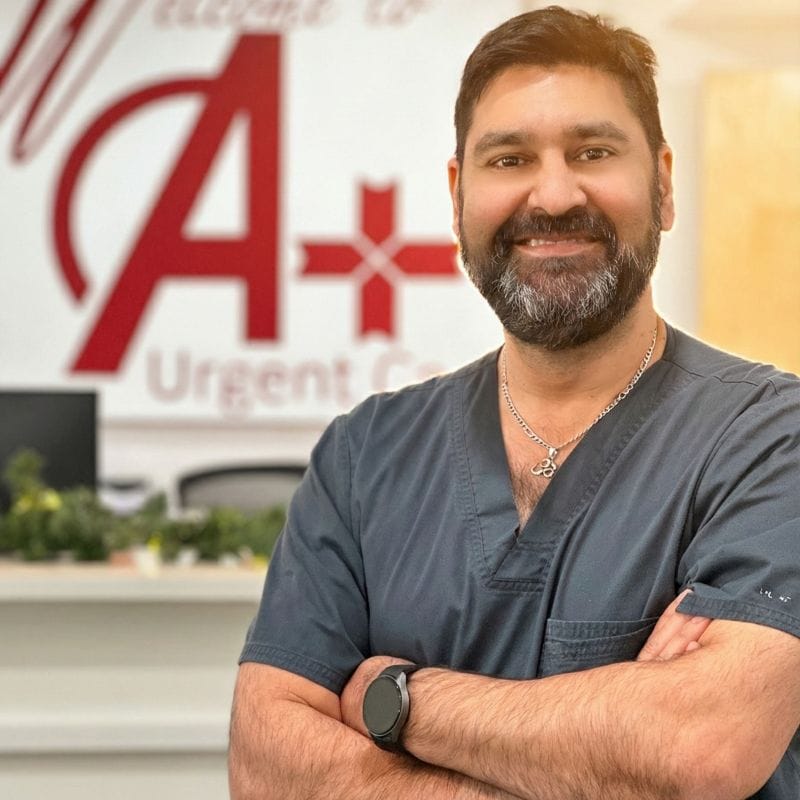
Dr. Ajay Jetley is a board-certified emergency medicine physician with over 15 years of clinical experience treating acute injuries and illnesses across Northern New Jersey.
As Medical Director of A+ Urgent Care, he oversees burn treatment, pediatric urgent care, and comprehensive medical services at locations in both Bloomfield and Cresskill.
Dr. Jetley and his team understand that childhood injuries happen suddenly and unexpectedly—sensory toy burns included.
The brand-new Bloomfield location already holds a 4.8-star rating on Google—see what patients are saying.
If your child has been injured by a NeeDoh toy or any other burn or skin reaction, walk into A+ Urgent Care in Bloomfield or Cresskill for prompt, expert evaluation and treatment.