Heard a pop in your calf on the pickleball court? Learn how to distinguish a calf tear from an Achilles rupture, what to do next, and where to get same-day treatment in Northern NJ

Key Takeaways:
- A popped calf muscle in pickleball and a torn Achilles tendon feel similar at first—both produce sudden pain in the back of the lower leg—but they require different treatment approaches and have very different recovery timelines.
- The Thompson test is a simple physical exam that helps providers distinguish between a calf tear and an Achilles rupture, and it can be performed same-day at an urgent care facility with sports injury experience.
- A+ Urgent Care locations in Bloomfield and Cresskill NJ offer acute immobilization, walking boots, crutches, and orthopedic referrals for lower leg injuries—no ER wait times required.
Table of Contents
- Why Calf and Achilles Injuries Are So Common in Pickleball
- Symptoms of a Popped Calf vs. Symptoms of a Torn Achilles
- What Does a Torn Achilles Feel Like?
- Heard a Pop in My Calf Playing Pickleball—Now What?
- How Urgent Care Diagnoses These Injuries
- Treatment Options: What Happens After Diagnosis
- Recovery Timeline and Return to Play
- Frequently Asked Questions
Why Calf and Achilles Injuries Are So Common in Pickleball
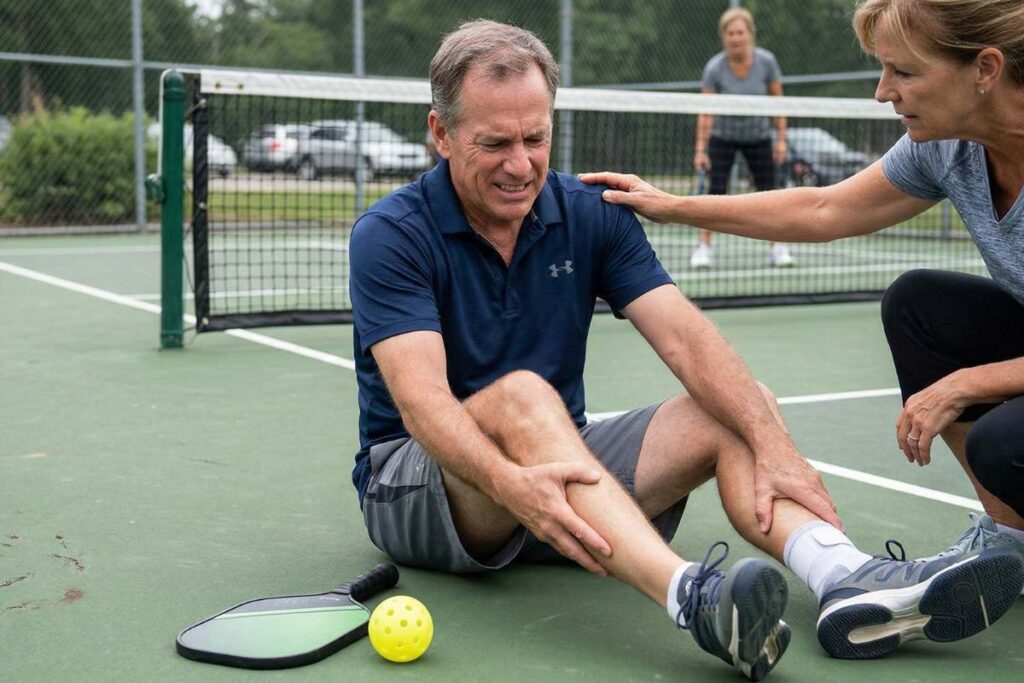
Few injuries strike fear into pickleball players quite like the sudden pop in the back of the leg. One moment you’re lunging for a drop shot, the next you’re on the ground wondering if someone kicked you from behind. But nobody did—your own body just failed you in spectacular fashion.
The Biomechanics of the Problem
Pickleball demands explosive movements from muscles and tendons that many players haven’t conditioned for this type of work. The calf complex—which includes the gastrocnemius muscle and the Achilles tendon—absorbs tremendous force during:
- Sudden acceleration from a standstill
- Quick lateral cuts to reach wide shots
- Deep lunges at the kitchen line
- Push-offs when moving backward for lobs
The gastrocnemius is particularly vulnerable because it crosses two joints (the knee and the ankle), which means it’s under tension from multiple directions simultaneously during dynamic movements.
Who’s Most at Risk?
While anyone can suffer a calf or Achilles injury, certain factors increase vulnerability:
- Tight calf muscles from inadequate warm-up or chronic shortness
- Previous injury to the same area (scar tissue is less elastic)
- Sudden increase in playing frequency without gradual conditioning
- Dehydration which affects muscle pliability
- Playing on cold muscles early in the morning or after sitting
Dr. Ajay Jetley, Medical Director at A+ Urgent Care, has seen this injury pattern repeatedly among pickleball players. As an avid player himself, he’s witnessed the moment of injury happen on court—and he’s treated players who tore both calves within a six-month span playing the same sport.
Symptoms of a Popped Calf vs. Symptoms of a Torn Achilles
Here’s the problem: both injuries happen suddenly, both cause pain in the back of the lower leg, and both often involve hearing or feeling a “pop.” So how do you tell them apart?
Popped Calf Muscle (Gastrocnemius Tear)
Location of pain: Mid-calf, in the meaty part of the muscle belly
What it feels like:
- Sudden sharp pain, like being struck or kicked
- Immediate tightness or cramping sensation
- Bruising often appears within 24-48 hours
- Swelling in the calf muscle itself
- Walking is painful but usually still possible
- Rising onto toes is difficult and painful
The pop: Usually described as a “snap” or “rip” felt deep in the muscle
Torn Achilles Tendon (Achilles Rupture)
Location of pain: Lower, closer to the heel—specifically where the tendon connects to the heel bone
What it feels like:
- Sudden severe pain at the back of the ankle/heel
- A feeling that someone kicked you in the heel
- Immediate weakness—pushing off with that foot feels impossible
- Swelling at the back of the ankle
- A visible gap or indentation may appear in the tendon
- Walking is extremely difficult; rising onto toes is impossible
The pop: Often louder and more distinct, sometimes audible to nearby players
Quick Comparison Table
| Factor | Calf Tear | Achilles Rupture |
| Pain location | Mid-calf muscle belly | Back of ankle/heel |
| Can you walk? | Usually, with pain | Barely, if at all |
| Can you rise on toes? | Difficult, painful | Impossible |
| Visible gap in tissue? | No | Often yes |
| Bruising location | Calf muscle | Around ankle/heel |
| Typical recovery | 4-8 weeks | 6-12 months |
What Does a Torn Achilles Feel Like?
People search this question constantly after injuring themselves on the court, and they deserve a direct answer. A torn Achilles feels like a sudden, violent strike to the back of your heel—except no one hit you.
The Moment of Injury
Most players describe the same sequence of events:
- They pushed off explosively or changed direction quickly
- They heard a loud pop (sometimes described as a “gunshot” or “whip crack”)
- They felt immediate, severe pain at the back of the ankle
- They looked around expecting to see someone who kicked them
- They realized they couldn’t push off or walk normally
The sensation is so distinct that many players immediately know something serious has happened. Unlike a muscle cramp or minor strain, there’s no ambiguity—your body tells you right away that the injury is significant.
What You’ll Notice in the Following Minutes
After the initial shock wears off:
- Weakness: Attempting to push off with the affected foot produces almost no force
- Swelling: The area around the heel begins to puff up rapidly
- The gap: In many cases, you can feel (or even see) an indentation where the tendon should be
- Altered gait: Walking flat-footed might be possible, but anything resembling normal push-off is not
The Difference from a “Bad Calf Cramp”
Some players initially convince themselves it’s just a severe cramp. Here’s how to tell the difference: a cramp releases. You can massage it, stretch it, wait it out—and eventually the muscle relaxes. A torn Achilles doesn’t release. The weakness and inability to rise on your toes persists because the structural connection between your calf muscle and your heel has been severed.
If your back of heel hurts after pickleball and you can’t rise onto your toes at all, take that seriously.
Heard a Pop in My Calf Playing Pickleball—Now What?
You heard the pop. You’re on the ground or limping to the bench. Your playing partners are asking if you’re okay. What should you do in the next few minutes, and where should you go?
Immediate Steps (First 5 Minutes)
Stop playing. This sounds obvious, but the adrenaline can trick you into thinking you’re fine. You’re not. Any attempt to continue will worsen the injury.
Get off the court. Have someone help you if needed. Don’t hop on one foot if you can avoid it—use a partner’s shoulder for support.
Sit or lie down with the leg elevated. Getting the injured leg above heart level helps limit swelling.
Apply ice if available. A cold pack or even a bag of ice from someone’s cooler can help. Wrap it in a towel—don’t put ice directly on skin.
What NOT to Do
- Don’t try to “walk it off.” You cannot stretch or massage your way out of a muscle tear or tendon rupture.
- Don’t remove your shoe if you suspect an Achilles injury. The shoe provides some compression and support.
- Don’t drive yourself if it’s your right leg. Have someone else drive you or call for a ride.
- Don’t assume it’s “just a cramp” if the weakness persists after 10-15 minutes.
Where to Go: Urgent Care for Torn Calf Muscle
For suspected soft tissue strains and tears, urgent care is the right first stop. A walk-in sports clinic like A+ Urgent Care can:
- Perform physical examination to assess severity
- Conduct the Thompson test to check Achilles integrity
- Provide acute immobilization with a walking boot
- Supply crutches for non-weight-bearing
- Arrange orthopedic referral if surgery may be needed
Can urgent care diagnose Achilles tear? Yes. The Thompson test and physical exam are highly reliable for identifying complete ruptures. While imaging (MRI or ultrasound) may be ordered to confirm the diagnosis or assess partial tears, the initial evaluation and stabilization happen same-day at urgent care.
How Urgent Care Diagnoses These Injuries
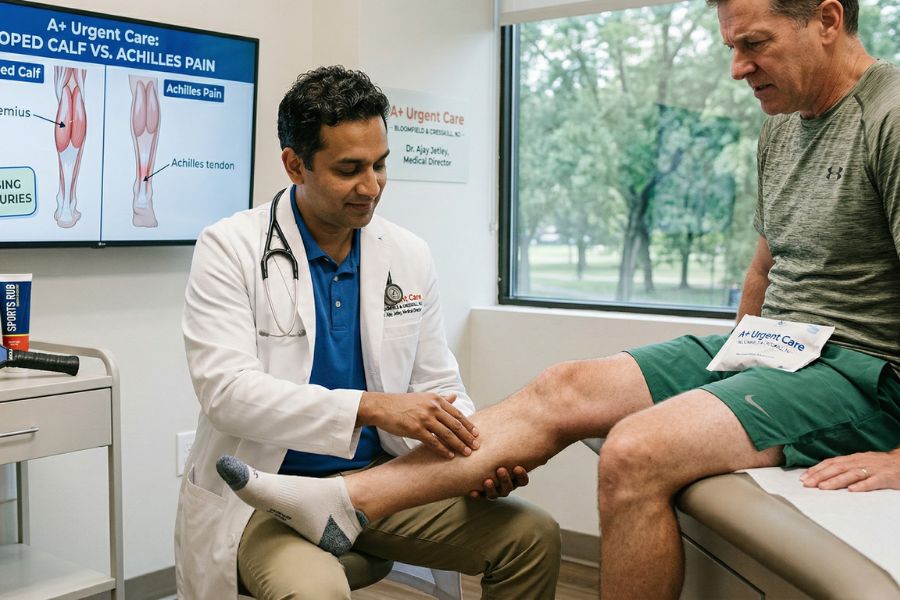
What happens when you limp into urgent care with a popped calf? The provider follows a systematic approach to figure out exactly what’s going on.
Patient History
First, the provider asks about the mechanism of injury:
- What were you doing when it happened?
- Did you hear or feel a pop?
- Where exactly does it hurt?
- Can you bear any weight?
- Have you injured this leg before?
Your answers help narrow the diagnosis before any physical examination begins.
Physical Examination
The provider will examine your lower leg looking for:
- Point tenderness: Pressing along the calf and Achilles to identify the exact location of pain
- Swelling and bruising: Where it’s located and how severe
- Palpable defects: Feeling for gaps in the muscle or tendon
- Range of motion: How well the ankle moves passively and actively
- Strength testing: Can you push down against resistance?
The Thompson Test
This is the gold standard physical exam for Achilles tendon integrity. Here’s how it works:
- You lie face down on the exam table with your feet hanging off the edge
- The provider squeezes your calf muscle firmly
- Normal response: The foot points downward (plantar flexes) when the calf is squeezed
- Positive test (indicates rupture): The foot doesn’t move when the calf is squeezed
A positive Thompson test strongly suggests the Achilles tendon is torn. Combined with your symptoms and physical findings, this allows the provider to make a confident diagnosis.
When Imaging Is Needed
X-rays don’t show muscle or tendon tears, but they can rule out fractures—which sometimes occur alongside severe sprains. If there’s concern about a bony avulsion (where the tendon pulls off a piece of bone), X-ray helps identify that.
For detailed soft tissue evaluation, ultrasound or MRI may be ordered. Urgent care will provide the referral; the orthopedic specialist typically orders and reviews advanced imaging.
A+ Urgent Care locations in Bergen County offer X-ray capability for ruling out fractures, plus immediate stabilization and referral coordination for suspected tendon injuries.
Treatment Options: What Happens After Diagnosis
Once the provider determines whether you’re dealing with a gastrocnemius tear or an Achilles rupture, treatment paths diverge significantly.
Treatment for Calf Muscle Tears
Most calf tears heal without surgery. Treatment follows a predictable pattern:
Acute phase (first 1-2 weeks):
- Rest and elevation
- Ice for 15-20 minutes several times daily
- Compression wrap to control swelling
- Crutches and limited weight-bearing
- Possible heel lift insert to reduce tension on the muscle
Recovery phase (weeks 2-8):
- Gradual return to weight-bearing
- Physical therapy for range of motion and strengthening
- Progressive stretching once acute pain subsides
- Gradual return to walking, then sport-specific activities
Severe tears (where significant muscle fiber disruption occurred) may require a walking boot for several weeks and a longer physical therapy protocol.
Treatment for Achilles Tendon Ruptures
Complete Achilles ruptures require more aggressive intervention. Two main approaches exist:
Surgical repair:
- Recommended for active individuals and athletes
- The torn tendon ends are sutured back together
- Followed by immobilization in a cast or boot for 6-8 weeks
- Then extensive physical therapy for several months
- Total recovery: typically 6-12 months
Non-surgical (conservative) treatment:
- The foot is immobilized in a pointed-down position to allow tendon ends to heal together naturally
- Serial casting or booting with gradual adjustment of foot position over 8-12 weeks
- Physical therapy follows immobilization
- May have slightly higher re-rupture rate than surgery
The choice between surgical and conservative treatment depends on multiple factors including age, activity level, overall health, and patient preference. The orthopedic surgeon will discuss options based on your specific situation.
What Urgent Care Provides
Regardless of which injury you have, urgent care delivers critical first-step treatment:
- Acute immobilization with a walking boot or posterior splint
- Crutches fitted to your height
- Pain management prescription
- Clear weight-bearing instructions
- Orthopedic referral arranged before you leave
Same-day sports injury treatment in NJ means you leave with a diagnosis, a stabilized limb, and a plan—not just advice to “see someone when you can.”
Recovery Timeline and Return to Play
How long until you’re back on the pickleball court? The honest answer depends entirely on which injury you sustained and how severe it was.
Calf Muscle Tear Recovery
| Grade | Description | Typical Recovery |
| Grade 1 (mild) | Minor fiber damage, mild pain | 2-3 weeks |
| Grade 2 (moderate) | Partial tear, significant pain and weakness | 4-8 weeks |
| Grade 3 (severe) | Complete or near-complete tear | 8-16 weeks |
Milestones to watch for:
- Walking without pain: 1-4 weeks depending on severity
- Light jogging: 4-8 weeks
- Lateral movements: 6-10 weeks
- Return to competitive play: 8-16 weeks
Achilles Rupture Recovery
Achilles injuries require much longer timelines:
- Immobilization phase: 6-12 weeks in boot/cast
- Early rehabilitation: 12-20 weeks post-injury
- Strengthening phase: 20-36 weeks
- Return to sport: 9-12 months minimum
Some players return sooner; others take longer. Rushing back increases re-injury risk significantly.
Signs You’re Pushing Too Hard
- Pain that increases during or after activity
- Swelling that returns after exercise
- Limping or favoring the leg
- Tightness that doesn’t resolve with warm-up
- Fear or hesitation during movements you should be able to do
Listen to your body and your physical therapist. Coming back at 80% is better than re-tearing at 100%.
Preventing Recurrence
Once you’ve had one calf or Achilles injury, you’re at higher risk for another. Reduce that risk by:
- Warming up properly before every session (dynamic stretching, light movement)
- Maintaining calf flexibility through regular stretching
- Strengthening the entire posterior chain (calves, hamstrings, glutes)
- Progressing gradually when increasing play frequency or intensity
- Wearing appropriate footwear with good heel support
Frequently Asked Questions
Can urgent care diagnose an Achilles tear?
Yes. Urgent care providers can perform the Thompson test and physical examination to diagnose a complete Achilles rupture with high accuracy. While MRI or ultrasound may be ordered to confirm the diagnosis or evaluate partial tears, the initial assessment and stabilization happen same-day at urgent care without needing an ER visit.
What does a torn Achilles feel like compared to a pulled calf?
A torn Achilles produces pain lower in the leg—at the back of the ankle and heel—along with an inability to rise onto your toes or push off when walking. A pulled calf hurts higher, in the muscle belly itself, and while painful, usually still allows some ability to walk and rise on toes with difficulty.
Should I go to urgent care or the ER for a popped calf muscle?
Urgent care is the appropriate choice for suspected calf tears and most Achilles injuries. Providers can examine the injury, perform diagnostic tests like the Thompson test, supply a walking boot and crutches, and arrange orthopedic referral. The ER is only necessary if you have additional trauma, open wounds, or signs of circulation problems in the foot.
How long does a popped calf take to heal?
Recovery time depends on severity. Mild strains (Grade 1) may heal in 2-3 weeks. Moderate tears (Grade 2) typically require 4-8 weeks. Severe tears (Grade 3) can take 8-16 weeks or longer. Physical therapy helps restore strength and flexibility and reduces re-injury risk.
Is there urgent care near Hillsdale NJ that treats calf injuries?
A+ Urgent Care in Cresskill is conveniently located for Hillsdale residents and offers same-day evaluation for calf and Achilles injuries, including physical examination, acute immobilization, and orthopedic referral. The Bloomfield location provides the same services for patients in that area.
Can I walk on a torn Achilles?
Barely, if at all. Most people with complete Achilles ruptures cannot perform a normal heel-to-toe walking pattern because they can’t push off with the affected foot. Flat-footed shuffling may be possible, but anything resembling normal gait is not. If you can’t rise onto your toes at all, suspect an Achilles injury.
What is the Thompson test?
The Thompson test is a physical examination used to check Achilles tendon integrity. The patient lies face down while the provider squeezes the calf muscle. Normally, squeezing the calf causes the foot to point downward. If the foot doesn’t move when the calf is squeezed, the Achilles tendon is likely ruptured.
Do I need surgery for a popped calf muscle?
Most calf muscle tears heal without surgery through rest, immobilization, and physical therapy. Surgery is rarely needed unless the tear is extremely severe or involves other structures. Achilles tendon ruptures, however, often do require surgical repair—especially for active individuals who want to return to sport.
About Dr. Ajay Jetley & A+ Urgent Care
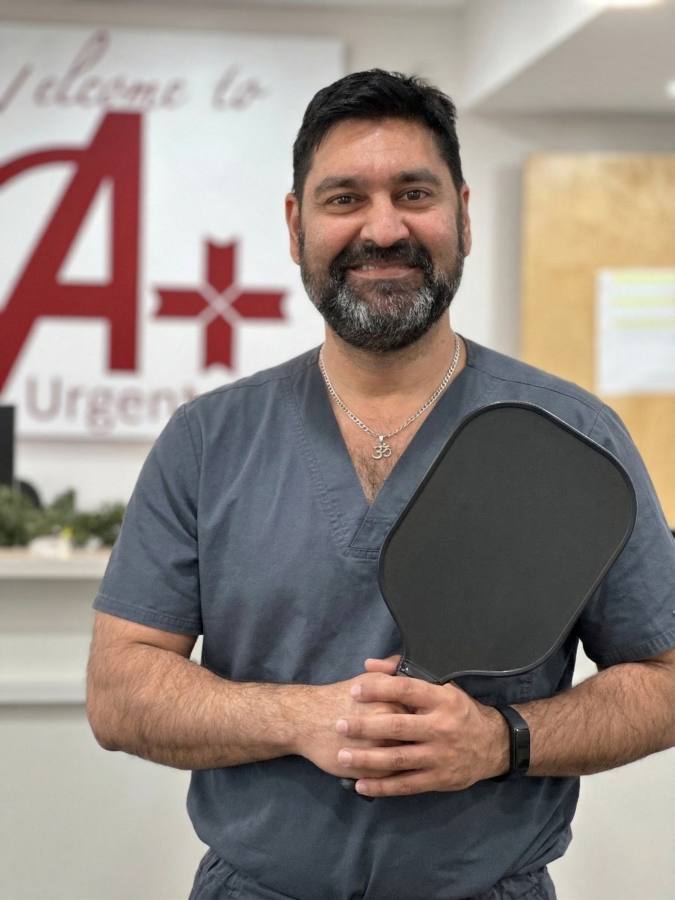
Dr. Ajay Jetley is a board-certified emergency medicine physician with over 15 years of clinical experience—and an avid pickleball player who has treated calf and Achilles injuries on the court as they happen.
He’s performed countless Thompson tests and seen firsthand how quickly a friendly game can turn into a medical situation.
As Medical Director of A+ Urgent Care, he oversees locations in both Bloomfield and Cresskill NJ, where same-day sports injury treatment includes physical examination, acute immobilization with walking boots, crutches, and coordinated orthopedic referrals.
The brand-new Bloomfield location already holds a 4.8-star rating on Google—see what patients are saying. If you heard a pop on the pickleball court and need urgent care for a calf injury in Bergen County, skip the ER wait and get evaluated today.