Back-to-school season means forms, deadlines, and that one requirement parents always leave to the last minute: the sports physical. Learn exactly what New Jersey requires, which official form you need, the rules that trip families …


Key Takeaways
- New Jersey requires a sports physical for all students in grades 6-12 who play interscholastic or intramural sports, completed on the official NJDOE Preparticipation Physical Evaluation (PPE) form — no substitutes accepted. It must be done within 365 days of the first day of official practice.
- Two rules trip families up most: the physical must be on the current official form, and if it was completed more than 90 days before the first practice, a Health History Update Questionnaire is also required. Getting either wrong can delay your child’s participation.
- A sports physical is faster and more focused than an annual checkup, and walk-in urgent care handles them the same day. When the pediatrician is booked through the start of the season, urgent care fills the gap so your child doesn’t miss tryouts.
Table of Contents
- What Is a Sports Physical?
- What New Jersey Requires
- The Official NJ Form (and Why It Matters)
- The 365-Day Rule and the 90-Day Rule
- Sports Physical vs. Annual Physical: What’s the Difference?
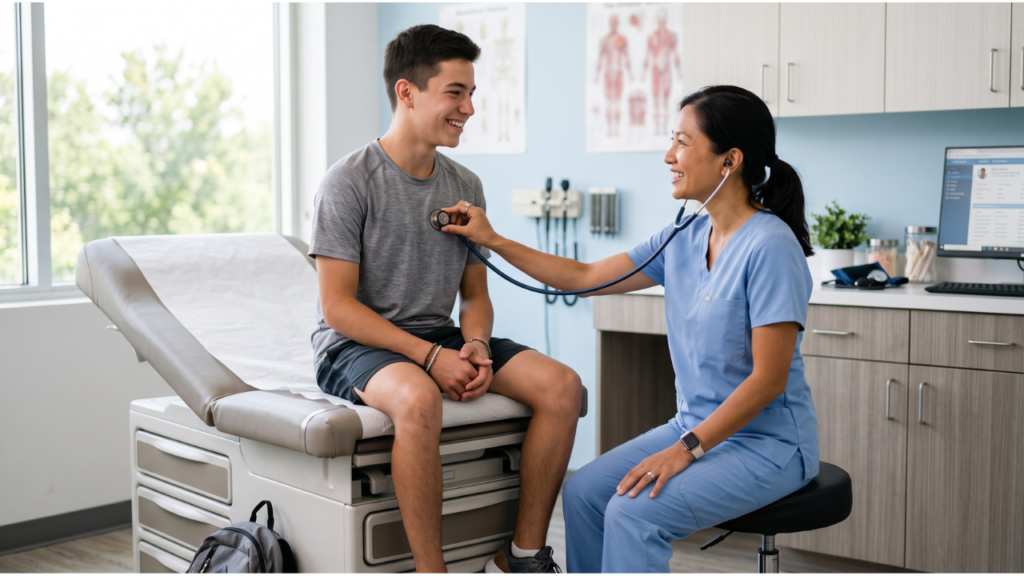
- What Happens During a Sports Physical
- Your Pre-Visit Checklist: What to Bring
- Do Urgent Cares Do Sports Physicals?
- How Much Does a Sports Physical Cost?
- When to Schedule to Avoid Delays
- What If a Health Issue Comes Up?
- Frequently Asked Questions
- Get a Same-Day Sports Physical in Bloomfield and Cresskill
Every August, the same scramble plays out in New Jersey households. School paperwork piles up, tryout dates loom, and somewhere in the stack is the form that can’t be done at the last minute: the sports physical. Then comes the call to the pediatrician, the discovery that the next appointment is three weeks out, and the realization that the first day of practice is sooner than that.
It doesn’t have to be stressful. New Jersey’s requirements for student-athlete physicals are specific, but once you know them, the whole thing is straightforward — and you have more options than just waiting for a pediatrician slot. Walk-in urgent care handles sports physicals the same day, on the exact form the state requires, often in under an hour.
This guide covers everything New Jersey parents need: what the state actually requires, which official form you need (this trips up a lot of families), the timing rules that can delay participation if you miss them, what happens during the exam, and where to get one fast. Get the sports physical NJ student-athletes need handled early, and your child walks into tryouts cleared and ready.
What Is a Sports Physical?
A sports physical — known formally as a Preparticipation Physical Evaluation, or PPE — is a focused medical exam that confirms a student is healthy enough to safely play sports.
The Purpose
The exam exists to catch anything that could put a young athlete at risk during competition, with a particular focus on heart health and injury history. It’s designed to answer one question: can this student safely participate in their sport? The goal is keeping kids safe on the field, not providing comprehensive medical care.
What It’s Officially Called
You’ll hear several terms used interchangeably, which causes some confusion:
- Sports physical — the casual term parents and coaches use
- Preparticipation Physical Evaluation (PPE) — the formal, clinical term
- School sports physical or athletic physical — other common variations
They all refer to the same thing: the exam New Jersey requires before a student can practice or compete.
Who Needs One
In New Jersey, the requirement applies to students in grades 6 through 12 who participate on a school-sponsored interscholastic or intramural athletic team or squad — and that includes cheerleading. If your child is trying out for or joining a school sports team, they need a current PPE on file before they can practice or play.
What New Jersey Requires
New Jersey has specific, legally mandated requirements for student-athlete physicals, and they’re stricter than many parents realize. Knowing them upfront prevents last-minute problems.
The Core Requirements
Under New Jersey law, a student-athlete’s physical must:
- Use the official NJDOE Preparticipation Physical Evaluation form — no substitute forms are accepted
- Be completed within 365 days of the first day of official practice for the season
- Be conducted by a licensed physician, advanced practice nurse (APN), or physician assistant (PA)
- Be performed by a provider who has completed New Jersey’s Student-Athlete Cardiac Assessment professional development module
- Include a Medical Eligibility Form signed by the provider, which is the document submitted to the school
The Cardiac Assessment Requirement
One detail many families don’t know: New Jersey law requires that the provider performing the physical has completed a state-specific cardiac assessment training module. This reflects the state’s emphasis on screening for the heart conditions that, while rare, can cause sudden cardiac events in young athletes. When choosing where to get the physical, it’s worth confirming the provider meets this requirement — established urgent care centers that routinely perform NJ sports physicals will.
What Gets Submitted to the School
A helpful clarification: under the updated rules, only the Medical Eligibility Form goes to the school. The detailed History Form and Physical Examination Form stay on file with the healthcare provider who performed the exam. This protects your child’s detailed medical information while still giving the school the clearance documentation it needs.
The Official NJ Form (and Why It Matters)
This is the single most common reason a sports physical gets rejected: the wrong form. New Jersey accepts only its official, current PPE form.
Use the Current Official Form
The PPE form was updated (in 2019 and again in 2023), and New Jersey adopted the updated version. Older versions of the form are no longer accepted for new physicals. Using an outdated form, or a generic sports physical form from another source, can mean your child’s physical is rejected and has to be redone — a frustrating delay right before a season starts.
Where to Get the Right Form
The official forms are available on the New Jersey Department of Education’s Information for Student Athletes page. Your child’s school typically distributes the correct form as well, often through the athletics department or school nurse. When in doubt, the school’s athletic office or nurse can confirm you have the current version.
The Parts of the Form
The PPE packet generally includes:
- History Form — completed by the parent and student, covering medical and family history
- Physical Examination Form — completed by the provider during the exam
- Medical Eligibility Form — the provider’s clearance determination, submitted to the school
Completing the parent/student history portion before the visit saves significant time and helps the provider do a thorough assessment. A provider who routinely does NJ sports physicals — like the team at A+ Urgent Care — will have the current forms and know exactly how to complete them.

The 365-Day Rule and the 90-Day Rule
Two timing rules cause more confusion and last-minute scrambles than anything else. Understanding both prevents your child from being sidelined.
The 365-Day Rule
A sports physical in New Jersey is valid for one calendar year — specifically, it must be completed within 365 days before the first day of official practice for the athletic season. A useful detail: if the physical hasn’t expired by the first day of practice, it carries the student through that entire season, even if it would technically expire mid-season.
The 90-Day Rule
Here’s the one that surprises people. If the physical was completed more than 90 days before the first day of official practice, New Jersey requires an additional document: the Health History Update Questionnaire (often called the “90-day update form”). This short form, completed and signed by the parent, confirms whether anything has changed in the student’s health since the physical — new injuries, concussions, illnesses, or medical advice to limit activity.
Why the 90-Day Rule Exists
A lot can change in a few months of a young athlete’s life. The update questionnaire ensures that a physical done in, say, June is still accurate when football practice starts in late August. It’s reviewed by the school nurse and, where applicable, the athletic trainer. Missing this form when it applies can hold up participation just as surely as missing the physical itself.
The Practical Takeaway
The timing sweet spot is getting the physical done within 90 days of the season’s first practice, which avoids needing the update form altogether. For fall sports with August practices, that means a physical in late spring or summer. We cover ideal timing later in this guide.
Sports Physical vs. Annual Physical: What’s the Difference?
Parents often ask whether a sports physical replaces the yearly checkup, or vice versa. They’re different exams with different purposes, and most kids need both.
The Two Exams Compared
| Feature | Sports Physical (PPE) | Annual Well-Child Exam |
| Purpose | Clear a student to play sports safely | Comprehensive health and development |
| Focus | Heart health, injury history, fitness to compete | Growth, development, mental health, full care |
| Form | Official NJ PPE form required | No specific form |
| Vaccines | Reviewed, not the focus | Reviewed and updated |
| Length | Focused, ~20-30 minutes | More thorough |
| Where | Pediatrician or urgent care | Pediatrician |
What the Annual Exam Covers That a Sports Physical Doesn’t
The yearly well-child visit with a pediatrician is broader. It includes developmental and behavioral screening, mental health screening, vaccination updates, vision and hearing checks, guidance on nutrition and sleep, confidential time for teens, and the ongoing relationship that helps a doctor track your child’s health over time. A sports physical doesn’t replace any of this.
Which One Does Your Child Need?
For most student-athletes, the answer is both — but at the right time and place for each. The sports physical clears them for the season and can be done quickly at urgent care when the deadline looms. The annual exam is the comprehensive visit best done with the pediatrician who knows your child. New Jersey schools recommend the annual well-child exam in addition to the required sports PPE. Our guide on same-day camp physicals covers a similar distinction for summer camp requirements.
What Happens During a Sports Physical
Knowing the flow helps both you and your child arrive prepared and relaxed.
Medical History Review
The provider reviews the history portion of the form, asking about:
- Past injuries, surgeries, or hospitalizations
- Previous concussions
- Heart-related symptoms (chest pain, fainting, palpitations during exercise)
- Family history of heart conditions or sudden cardiac death
- Current medications and allergies
- Breathing issues like asthma or exercise-induced symptoms
The cardiac and family history questions get particular attention, since screening for heart risk is a central purpose of the exam.
Vital Signs and Measurements
The provider records:
- Height and weight
- Blood pressure
- Pulse
- Vision screening
- Sometimes hearing
The Physical Examination
The hands-on portion typically includes:
- Heart and lung exam — listening carefully for any irregular rhythms or murmurs
- Abdominal exam
- Musculoskeletal assessment — joints, flexibility, strength, and range of motion, since old injuries and joint issues matter for sports
- Posture and gait evaluation
- General physical checks of eyes, ears, nose, and throat
The Clearance Decision
At the end, the provider completes the Medical Eligibility Form with one of a few determinations: cleared for all sports without restriction, cleared with recommendations for further evaluation, or not cleared pending evaluation of a specific issue. The large majority of student-athletes are cleared without restriction. You leave with the signed form ready to submit to the school.
Your Pre-Visit Checklist: What to Bring
Showing up prepared is the biggest factor in a fast, smooth visit. Here’s what to pack before heading to the clinic.
The Sports Physical Checklist
- The official NJ PPE form with the parent/student history sections completed and signed
- Insurance card (or be ready for self-pay pricing)
- Photo ID for the parent or guardian
- Glasses or contacts if your child wears them, for the vision screening
- A list of current medications, including doses
- A list of known allergies
- Relevant medical records if your child has a chronic condition (asthma action plan, prior injury notes, cardiology records)
- Information about past concussions or significant injuries
- Your child dressed in comfortable clothing that allows movement for the musculoskeletal exam
Complete the History Form in Advance
This is the single biggest time-saver. The PPE form’s history section is meant to be filled out by the parent and student before the visit. Arriving with it blank means working through every question during the appointment, which lengthens the visit considerably. A few minutes the night before — with your child’s medical history and any family heart history handy — makes the actual exam quick and lets the provider focus on the assessment.
The Family Heart History Matters
Because cardiac screening is central to the NJ sports physical, take time on the family history questions about heart conditions, unexplained fainting, seizures, or sudden unexpected deaths in relatives. This information genuinely matters for identifying the rare but serious heart risks the exam is designed to catch.
Do Urgent Cares Do Sports Physicals?
Yes — sports physicals are one of the most common services urgent care provides, especially in late summer. For families racing a tryout deadline, walk-in care is often the most practical option.
Why Urgent Care Works Well
- No appointment needed — walk in when it’s convenient
- Same-day completion — leave with the signed form in hand
- Short wait times, typically 15-45 minutes
- Evening and weekend hours that work around school and work
- Current NJ forms and providers who do these routinely
- Often faster than waiting weeks for a pediatrician opening
Confirming the NJ Requirements Are Met
When using urgent care, you can be confident an established NJ clinic will use the correct official form and have providers who meet the state’s cardiac assessment training requirement. A+ Urgent Care performs NJ sports physicals at both locations, on the current state form, completed by qualified providers.
When the Pediatrician Is Still Ideal
If your child has a complex medical history, a known heart condition, or ongoing care for a chronic issue, the pediatrician who knows them well may be the better choice for the sports physical, since they have full context. For healthy student-athletes who just need the form completed before the season, urgent care is fast, convenient, and fully compliant. Many families use both — the pediatrician for the annual exam and complex needs, urgent care for the quick sports clearance when timing is tight.
How Much Does a Sports Physical Cost?
Cost is a common question, and the answer depends on your insurance.
With Insurance
Many insurance plans cover sports physicals, sometimes as part of preventive care, though coverage varies. If the physical is billed as an office visit, you may have a copay, typically in the $25-$75 range. Some plans cover one preventive physical per year, so a separate sports physical might or might not be fully covered — worth a quick call to your insurer to confirm.
Without Insurance (Self-Pay)
For families paying out of pocket, sports physicals are among the more affordable medical visits. Self-pay sports physicals typically run in the range of $50-$150, far less than most other visit types. A+ Urgent Care offers transparent self-pay pricing — the front desk can give you the exact cost when you call or arrive. Details on accepted plans are on the insurance and payment options page.
HSA and FSA Eligibility
Sports physicals are generally eligible expenses under Health Savings Accounts (HSA) and Flexible Spending Accounts (FSA), giving you another tax-advantaged way to cover the cost.
The Value of Convenience
When weighing cost, factor in the value of avoiding a missed season. A same-day walk-in physical that keeps your child eligible for tryouts is worth the modest fee, especially when the alternative is scrambling for a pediatrician appointment that may not come in time.
When to Schedule to Avoid Delays
Timing is everything with sports physicals, and a little planning prevents the August panic.
The Ideal Timing
For fall sports with August practices, the sweet spot is getting the physical done in early-to-mid summer — recent enough to stay within the helpful 90-day window (avoiding the update form), but early enough to handle any follow-up if an issue comes up. Late spring through July works well for most fall athletes.
Why Earlier Is Better
Scheduling early has real advantages:
- Avoids the late-August rush when every athlete needs one at once
- Leaves time to address any health issue the exam uncovers
- Prevents the stress of racing a tryout deadline
- Reduces the risk of needing the 90-day update form
Don’t Wait Until the Last Minute
The most common mistake is waiting until days before tryouts, when pediatrician schedules are full and any complication leaves no time to resolve. If your child plays a fall sport and you haven’t scheduled the physical yet, now is the time. Walk-in urgent care is the safety net when the calendar gets tight — you can reach both A+ Urgent Care locations through the contact page to check current wait times.
For Multi-Season Athletes
If your child plays sports across multiple seasons, one physical completed within 365 days generally covers them for the year — but remember the 90-day update form may be needed for later seasons if the original physical was done well before a given season’s practice start. When in doubt, the school nurse can clarify what’s needed for each season.
What If a Health Issue Comes Up?
Most sports physicals end in straightforward clearance, but occasionally the exam flags something worth a closer look.
Conditions That May Need Follow-Up
A provider may recommend further evaluation for findings like:
- A heart murmur or irregular rhythm that needs cardiology assessment
- High blood pressure
- A history of concussion needing clearance
- An unresolved injury affecting safe participation
- Breathing issues like poorly controlled asthma
What “Cleared with Recommendations” Means
Sometimes a student is cleared to play but with a recommendation for further evaluation or treatment of a specific issue. This isn’t necessarily a barrier to participation — it often means addressing something alongside the season. The provider explains exactly what’s needed.
When Referral Is Needed
For findings that need specialist input — particularly cardiac concerns — the provider will recommend follow-up with the pediatrician or a specialist before final clearance. This is exactly why scheduling early matters: it leaves time to handle any referral without missing the season. These situations are uncommon, but when they arise, addressing them promptly keeps your young athlete safe.
Chronic Conditions and Sports
Kids with well-managed chronic conditions like asthma, diabetes, or a prior concussion can usually participate in sports with appropriate management. Bring relevant records and any specialist input to the physical so the provider has the full picture. Most chronic conditions, when controlled, are fully compatible with athletic participation.
Frequently Asked Questions
What is required for a sports physical in NJ?
New Jersey requires students in grades 6-12 playing interscholastic or intramural sports to complete the official NJDOE Preparticipation Physical Evaluation (PPE) form, performed within 365 days of the first practice by a licensed physician, APN, or PA who has completed the state’s cardiac assessment module. Only the Medical Eligibility Form is submitted to the school.
How long is a sports physical good for in NJ?
A NJ sports physical is valid for 365 days from the date it’s completed. If it hasn’t expired by the first day of official practice, it covers the student through that entire season, even if it would expire mid-season. If the physical was done more than 90 days before practice starts, a Health History Update Questionnaire is also required.
What’s the difference between a sports physical and a regular physical?
A sports physical is a focused exam clearing a student to safely play sports, with emphasis on heart health and injury history, completed on a required NJ form. An annual physical (well-child exam) is comprehensive, covering growth, development, mental health, vaccines, and overall care. Most student-athletes need both — they serve different purposes.
Do urgent cares do sports physicals?
Yes. Sports physicals are one of the most common urgent care services, especially in summer. A+ Urgent Care performs NJ sports physicals at both locations on the current official state form, with no appointment needed and same-day completion. For healthy athletes needing quick clearance, it’s often faster than waiting for a pediatrician appointment.
What form do I need for a NJ school sports physical?
You need the official NJDOE Preparticipation Physical Evaluation (PPE) form — no substitutes are accepted. The current version (updated in 2023) is available on the NJ Department of Education’s student athlete page or through your child’s school. Using an outdated or generic form can result in the physical being rejected.
What is the 90-day rule for NJ sports physicals?
If a student’s sports physical was completed more than 90 days before the first day of official practice, New Jersey requires a Health History Update Questionnaire (the “90-day update form”), completed and signed by a parent, confirming any health changes since the physical. It’s reviewed by the school nurse. Getting the physical within 90 days of practice avoids needing this form.
What should my child bring to a sports physical?
Bring the official NJ PPE form with the parent/student history sections filled out, your insurance card or be ready for self-pay, a photo ID, glasses or contacts if worn, a list of medications and allergies, and any relevant medical records (asthma plan, injury or cardiology notes). Have your child wear comfortable clothing for the movement portion of the exam.
How much does a sports physical cost in NJ?
With insurance, you’ll typically pay a copay around $25-$75 if it’s billed as an office visit. Self-pay sports physicals usually run $50-$150, among the more affordable visit types. A+ Urgent Care offers transparent self-pay pricing — call ahead for the exact cost. Sports physicals are also typically HSA/FSA eligible.
Can my child get a sports physical and a camp physical at the same visit?
Often yes. The exams are similar, and a provider can sometimes complete multiple forms during one visit if you bring all the paperwork. Mention it at check-in so the front desk allows appropriate time. Note that each form has its own requirements, so confirm the provider can complete both for your specific situation.
Who can perform a sports physical in New Jersey?
A NJ sports physical must be performed by a licensed physician (MD or DO), advanced practice nurse (APN), or physician assistant (PA) who has completed the state’s Student-Athlete Cardiac Assessment professional development module. Established urgent care centers that routinely perform NJ sports physicals meet this requirement.
What if my child doesn’t pass the sports physical?
It’s uncommon, but if the exam flags an issue, the student may be “cleared with recommendations” (able to play while addressing something) or referred for further evaluation before clearance — most often for cardiac findings. Scheduling early leaves time to handle any referral without missing the season. Most findings, once evaluated, don’t prevent participation.
Where can I get a same-day sports physical in Northern NJ?
A+ Urgent Care provides walk-in sports physicals at both Bloomfield (Essex County) and Cresskill (Bergen County) locations, on the current official NJ form, seven days a week. Most patients are seen within 15-45 minutes and leave with the signed form ready to submit. No appointment needed.
Get a Same-Day Sports Physical in Bloomfield and Cresskill
A sports physical shouldn’t be the thing standing between your child and the season they’ve been looking forward to. New Jersey’s requirements are specific — the official form, the 365-day window, the 90-day update rule — but once you know them, getting cleared is quick and simple. The biggest favor you can do is starting early, which leaves room to handle the rare follow-up without racing a deadline.
If tryouts are around the corner and you still need the form done, you don’t have to wait weeks for a pediatrician opening. Walk in for a sports physical, completed on the correct NJ form by a qualified provider, and your child can leave cleared and ready to compete — usually within the hour.
About A+ Urgent Care
Parents across Bloomfield, Cresskill, and the surrounding Northern New Jersey towns rely on A+ Urgent Care for the care that doesn’t fit a pediatrician’s schedule — sports and camp physicals, sudden illnesses, minor injuries, and everything in between.
Founded by Dr. Ajay Jetley, a board-certified emergency medicine physician with over 15 years of experience, the practice operates seven days a week with extended weekday hours at both Bloomfield and Cresskill locations. With on-site testing and a full menu of walk-in services, most families get what they came for in a single visit. No appointment required.