
Leaves of three, let it be” is a start, but identifying poison ivy, oak, and sumac in New Jersey takes more than a rhyme. Learn what each plant actually looks like across the seasons, where …

Key Takeaways
- Learning how to identify poison ivy and its cousins is the single best way to avoid the itchy rash they cause. All three plants — poison ivy, poison oak, and poison sumac — produce the same culprit: an oily resin called urushiol.
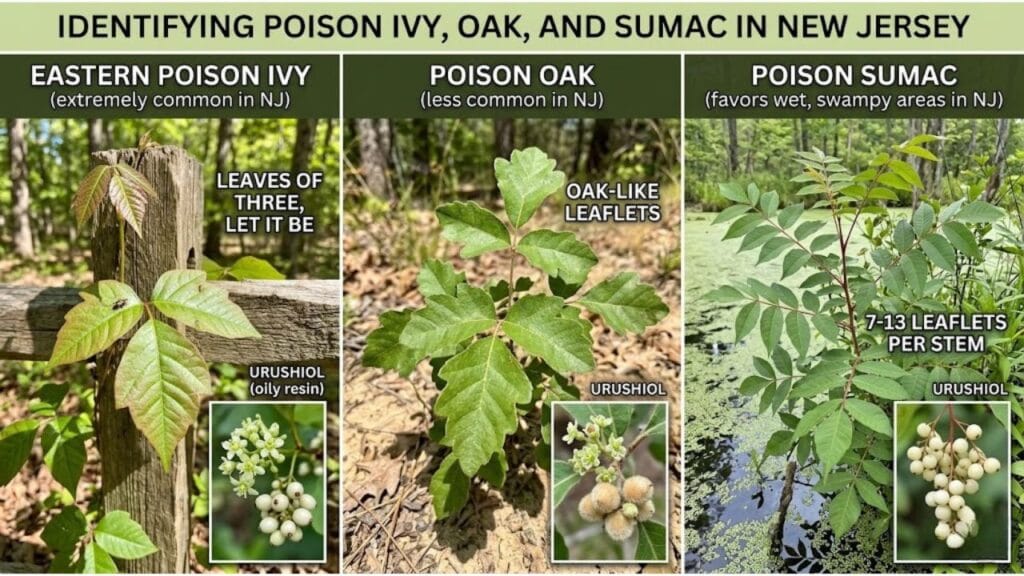
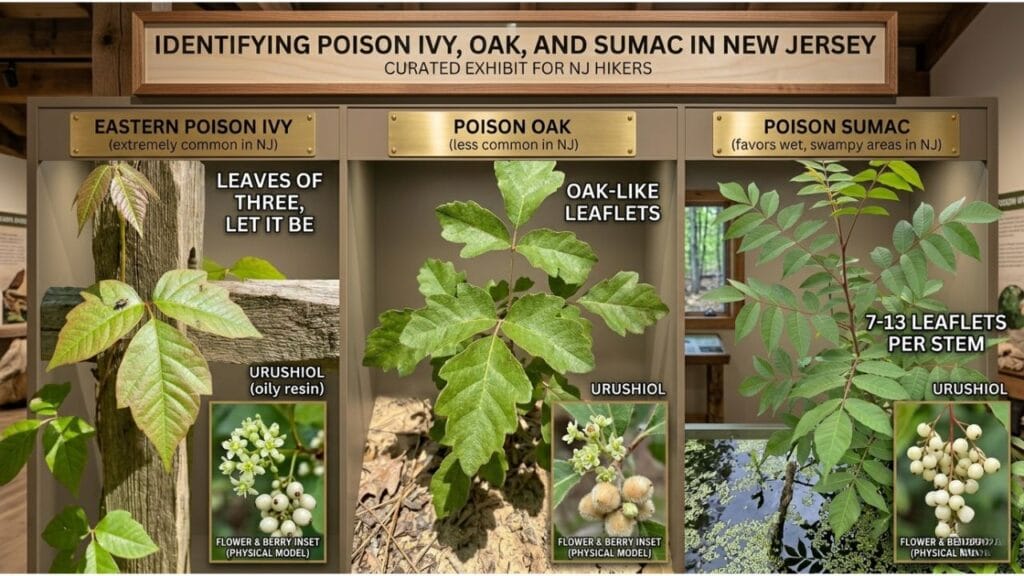
- The old rhyme “leaves of three, let it be” works for poison ivy and poison oak, but not poison sumac, which has 7-13 leaflets per stem. Each plant has distinct features that help you tell it apart from harmless look-alikes.
- Eastern poison ivy is extremely common throughout New Jersey, while poison sumac favors wet, swampy areas and poison oak is far less common here. Knowing where each grows helps you stay alert in the right places.
Table of Contents
- Why Identification Matters: The Urushiol Problem
- How to Identify Poison Ivy
- How to Identify Poison Oak
- How to Identify Poison Sumac
- Poison Ivy Look-Alikes in New Jersey
- Where These Plants Grow in NJ
- How the Plants Change Through the Seasons
- How to Avoid Exposure
- What to Do If You Touch One
- Frequently Asked Questions
- Get Walk-In Rash Treatment in Bloomfield and Cresskill
Every spring and summer in New Jersey, the same scene plays out. Someone clears brush from the edge of their yard, takes the dog for a walk through a wooded trail, or pulls weeds along a fence line.
A day or two later, the itching starts, followed by the red, streaky rash that means they crossed paths with poison ivy.
Almost all of it is avoidable. The rash comes from a single plant compound, and the plants that produce it have recognizable features once you know what to look for.
The trouble is that poison ivy, oak, and sumac are masters of disguise — they change appearance through the seasons, grow in several different forms, and have plenty of harmless look-alikes that confuse even experienced gardeners.
This guide breaks down exactly what each plant looks like, where they grow across the Garden State, and how to tell them apart from the safe plants they resemble.
The better you get at spotting them, the less likely you are to need treatment for the rash. And if you do end up with a reaction, knowing what caused it helps you and your provider treat it faster.
Walk-in clinic Essex County and Bergen County residents can get same-day care, but prevention through identification is always the easier path.
Why Identification Matters: The Urushiol Problem
Before getting into the visual details, it helps to understand what makes these plants worth identifying in the first place.
Poison ivy, poison oak, and poison sumac all produce urushiol, a colorless, odorless oily resin found in the leaves, stems, roots, and berries of the plants.
When the oil gets on the skin, most exposed people have an allergic reaction (contact dermatitis). The rash that follows — red, raised, blistering, and intensely itchy — is your immune system reacting to the urushiol.
How Common Is Sensitivity?
Most people react to urushiol, though not everyone. According to the Merck Manual, about 50 to 70% of people are sensitive to the plant oil urushiol contained in poison ivy, poison oak, and poison sumac.
Sensitivity can also develop over time, so someone who never reacted as a child may suddenly start reacting as an adult. Reactions often grow stronger with repeated exposures.
Urushiol Is Remarkably Persistent
Two facts about urushiol explain why identification matters so much:
- It penetrates skin within minutes. Once you contact the plant, the clock starts immediately, which is why prompt washing is so important.
- It survives on surfaces for years. Urushiol can stay active on clothing, garden tools, doorknobs, and pet fur for a very long time unless physically removed with water or rubbing alcohol.
That persistence means you can get a rash without ever touching a plant directly — from petting a dog that ran through a patch, grabbing contaminated gardening gloves, or handling tools from last season. Recognizing the plants in your environment is the first line of defense.
The CDC’s guidance on poisonous plants reinforces just how easily exposure happens for anyone who spends time outdoors.
How to Identify Poison Ivy
Poison ivy (Toxicodendron radicans) is by far the most common of the three in New Jersey. The NJ Department of Environmental Protection notes that poison ivy is a common plant found in New Jersey.
Learning its features is the highest-value identification skill for anyone in the state.
The Classic Features
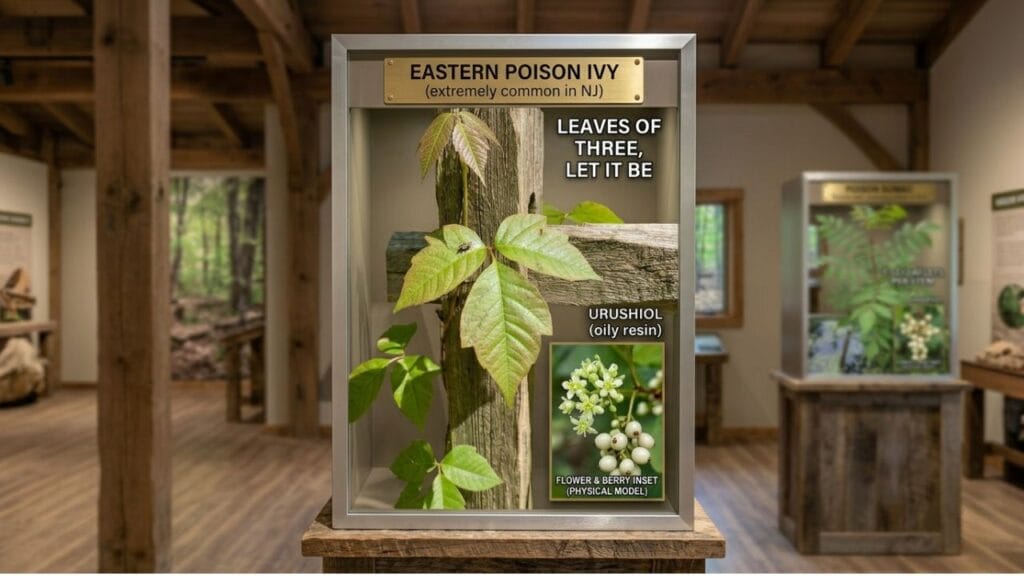
The famous saying gets you started: “Leaves of three, let it be.” Each poison ivy leaf is made up of three leaflets. Beyond that, look for:
- Three leaflets per cluster, with the middle leaflet sitting on a noticeably longer stalk than the two side leaflets
- A reddish stem where the leaflets join, often with reddish new growth
- Leaf edges that can be smooth, toothed, or lobed — sometimes giving a mitten-like shape
- Glossy upper surface on mature leaves, with a more muted underside
- Almond or teardrop-shaped leaflets, commonly 2-8 inches long
- Greenish-white berries (drupes) when present
- No thorns — poison ivy never has thorns or spines
The Many Forms of Poison Ivy
Part of what makes poison ivy tricky is that it doesn’t grow in just one shape. In New Jersey, you might encounter it as:
- A low ground cover sprawling through grass and along trail edges
- A small shrub standing on its own
- A climbing vine winding up tree trunks, fences, and poles
The climbing vines are especially worth recognizing. Mature poison ivy vines look hairy or fuzzy, covered in dense aerial rootlets that cling to bark.
Even in winter, when the leaves are gone, these hairy leafless vines can still cause a rash if you touch them.
The Middle-Leaflet Tell
If you remember one detail beyond “leaves of three,” make it this: the center leaflet has a longer stem than the two side leaflets, which attach almost directly to the main stalk.
This asymmetry is one of the most reliable ways to separate poison ivy from harmless three-leaflet plants.
The NJ DEP Fish & Wildlife division offers a helpful illustrated poison ivy guide for residents who want a closer look.
How to Identify Poison Oak
Poison oak is much less common in New Jersey than poison ivy, but it’s worth recognizing. The variety found in our region is Atlantic poison oak (Toxicodendron pubescens), described by regional botanists as an uncommon plant of dry, sandy ground that can be easily overlooked amid the abundance of poison ivy.
Distinguishing Features
Poison oak also follows the “leaves of three” rule, but with some differences from poison ivy:
- Three leaflets per cluster, like poison ivy
- Lobed, rounded edges that resemble the leaves of an oak tree — hence the name
- A fuzzy or hairy texture, particularly on the leaf undersides
- Less glossy appearance than poison ivy
- Shrub-like growth in our region — it grows as a low shrub rather than climbing
Telling Poison Oak From Poison Ivy
The key difference is in the leaf edges. Poison ivy leaflets tend to have more pointed teeth, while poison oak leaflets have more rounded, lobed edges that genuinely look oak-like.
Poison oak also tends toward a fuzzier surface and a denser, more shrubby growth habit. In New Jersey specifically, if you spot a three-leaflet plant, poison ivy is statistically far more likely than poison oak — but the treatment for a rash from either is identical, so the distinction matters more for botanical curiosity than for medical purposes.
How to Identify Poison Sumac
Poison sumac (Toxicodendron vernix) looks completely different from its two cousins, which is exactly why it fools people. The “leaves of three” rule does not apply here at all.
Distinctive Features
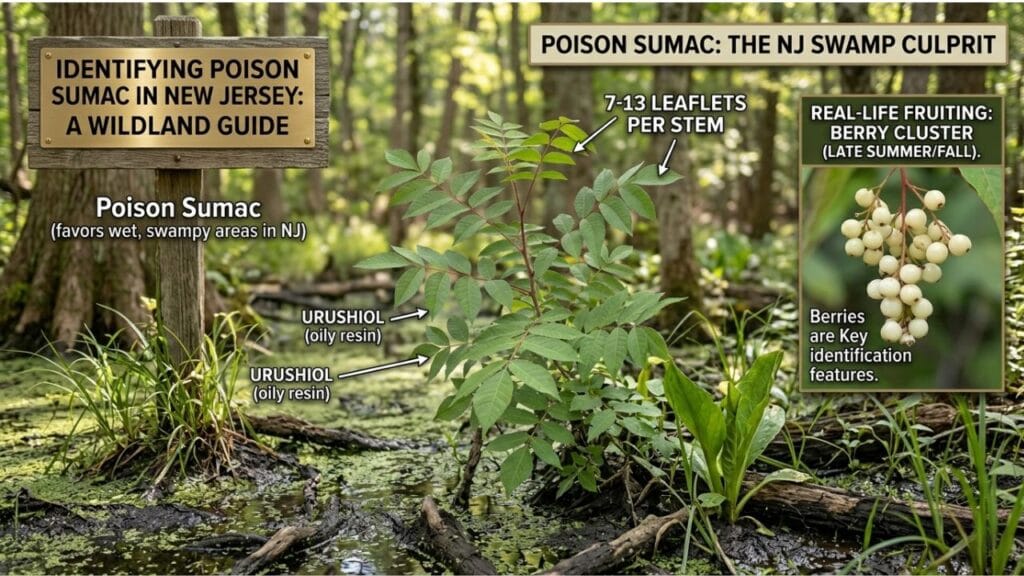
According to the CDC, poison sumac is a woody shrub that has stems with 7–13 leaves arranged in pairs. Look for:
- 7-13 leaflets per stem, arranged in pairs along a central stem with a single leaflet at the tip
- Smooth-edged leaflets with pointed tips and a smooth surface
- A reddish central stem connecting the leaflets
- Growth as a tall shrub or small tree, sometimes reaching up to 20 feet
- Glossy, pale yellow, or cream-colored berries that hang in loose clusters
Where Poison Sumac Hides
Poison sumac is the least common of the three in New Jersey, but it does grow here, almost exclusively in wet, swampy areas — bogs, marshes, and the edges of ponds and streams.
If you’re hiking through wetlands in NJ, this is the plant to watch for. Because it favors environments most people don’t spend much time in, encounters are relatively rare compared to poison ivy.
Poison Sumac vs. Harmless Sumac
This is the most important distinction with sumac. New Jersey has several harmless, native sumac species — like staghorn sumac and fragrant sumac — that people sometimes confuse with the poison variety.
The key difference is the berries: poison sumac has whitish, cream, or pale yellow berries that droop downward, while harmless sumacs (like staghorn) have bright red, upright, fuzzy berry clusters.
Harmless sumacs also tend to grow in dry ground, while poison sumac sticks to wetlands. When in doubt, the red upright berries signal a safe plant; the pale drooping berries signal poison sumac.
Poison Ivy Look-Alikes in New Jersey
Several harmless plants get mistaken for poison ivy, leading to unnecessary worry — or worse, a false sense of security when someone misidentifies the real thing as a look-alike.
Common Three-Leaflet Confusers
- Virginia creeper — often confused with poison ivy, but it has five leaflets, not three. A useful saying: “Leaves of five, let it thrive.” It’s a climbing vine like poison ivy and the two often grow together.
- Boxelder — young boxelder seedlings have three to five leaflets and can resemble poison ivy, but the leaves grow in opposite pairs along the stem, whereas poison ivy leaves alternate.
- Fragrant sumac — has three-lobed leaves vaguely similar to poison ivy, but the leaves are stiffer with rounded margins, and the plant produces red berries.
- Raspberry and blackberry brambles — have three or five leaflets but also have thorns, which poison ivy never has.
The Safest Rule
When you can’t be sure, treat any unfamiliar three-leaflet plant as if it might be poison ivy. The cost of avoiding a harmless plant is nothing; the cost of brushing against the real thing is weeks of itching.
As the American Academy of Dermatology emphasizes, recognition and avoidance remain the most effective protection against these rashes.
Where These Plants Grow in NJ
Knowing the typical habitats helps you stay alert in the right environments rather than scanning every plant you pass.
Poison Ivy Habitats
Poison ivy is genuinely everywhere in New Jersey, but it concentrates in certain spots:
- Wooded areas and forest edges — especially where sunlight reaches the forest floor
- Trail edges and pathways — it thrives in disturbed, transitional zones
- Fence lines and stone walls — climbing or sprawling along the base
- Riverbanks, lakefronts, and the Jersey Shore — it tolerates a range of moisture levels
- Backyards and gardens — particularly neglected or overgrown corners
- Roadsides and vacant lots — anywhere with disturbed soil
Botanical surveys describe Eastern poison ivy as a very common plant in most New Jersey habitats, usually favoring wetter soils.
Poison Sumac and Poison Oak Habitats
These two are more specialized:
- Poison sumac sticks to wetlands — swamps, bogs, and the edges of standing water. If you’re not in a wet area, you’re very unlikely to encounter it.
- Atlantic poison oak prefers dry, sandy ground and is uncommon enough in NJ that most residents will never knowingly encounter it.
The High-Risk Activities
Most poison ivy exposures in New Jersey happen during predictable activities: gardening and yard work, hiking, clearing brush, walking dogs through wooded areas, and children playing in overgrown spaces.
If you do any of these regularly, identification skills pay off quickly.
How the Plants Change Through the Seasons
One of the biggest reasons people misidentify poison ivy is that it looks dramatically different depending on the time of year. The same plant can fool you in spring and again in fall.
Spring
New poison ivy leaves emerge reddish or bronze-tinted, then gradually turn green as they mature. The reddish new growth is actually a helpful identification clue in spring. The plant may also produce small greenish-white flowers.
Summer
Through summer, the leaves are fully green and at their glossiest. This is peak season for both the plant’s growth and for human exposure, since people spend the most time outdoors. The greenish-white berries develop during this period.
Fall
Autumn is deceptive. Poison ivy leaves turn brilliant shades of red, orange, and yellow — genuinely beautiful, and easy to mistake for harmless ornamental foliage.
People raking leaves or admiring fall color sometimes get exposed without realizing the colorful leaves are poison ivy. The berries turn whitish during this season.
Winter
Even after the leaves drop, poison ivy remains a hazard. The bare, hairy climbing vines on tree trunks still contain urushiol and can cause a rash if touched. Firewood gatherers and people doing winter yard cleanup are at risk.
This is also why you should never burn vines of unknown origin — burning poison ivy releases urushiol into the smoke, which is dangerous to inhale.
How to Avoid Exposure
Identification is most useful when paired with simple prevention habits. Together they dramatically cut your risk of a rash.
Before You Go Outdoors
- Learn the plants in your specific yard and the trails you frequent
- Wear long sleeves, long pants, and closed shoes when working in or walking through potentially infested areas
- Use gloves when gardening or clearing brush, and wash them afterward
- Consider a barrier cream containing bentoquatam, applied before known exposure, which can help block urushiol absorption
During Outdoor Activity
- Stay on cleared trails and avoid brushing against vegetation at the edges
- Keep pets leashed on wooded trails so they don’t run through patches and carry urushiol home on their fur
- Don’t touch unfamiliar vines on tree trunks, even leafless ones
After You Come Inside
- Wash exposed skin with soap and cool water as soon as possible
- Clean tools, gloves, shoes, and clothing that may have contacted the plants — urushiol survives on these surfaces
- Bathe pets with shampoo and water (wearing gloves) if they may have been in a patch
- Wash contaminated clothing separately from the rest of your laundry
The Rutgers Cooperative Extension offers a detailed fact sheet on poison ivy and brush control for New Jersey homeowners who want to manage or remove the plant from their property safely.
What to Do If You Touch One
Even careful people get exposed sometimes. Quick action makes a real difference in how bad the rash gets — or whether you get one at all.
Act Fast
Urushiol penetrates skin within minutes, so speed matters:
- Wash with soap and cool water as soon as possible, ideally within 10-30 minutes of contact
- Scrub thoroughly, including under your fingernails
- Use rubbing alcohol on the skin and on contaminated objects to help break down the oil
- Avoid hot water, which opens pores and can spread the oil
- Wash everything the plant may have touched — clothes, tools, gear
Washing within the first 10-15 minutes can significantly reduce the severity of the rash or prevent it entirely. Even washing later still helps remove residual oil and prevent further spread.
If a Rash Develops
Most mild to moderate rashes can be managed at home with cool compresses, calamine lotion, over-the-counter hydrocortisone cream, and oral antihistamines.
The rash typically clears within 1-3 weeks. For a full breakdown of home care versus when to seek medical help, see our guide on poison ivy treatment at home vs. urgent care.
When to Seek Treatment
Some reactions need more than drugstore products. Seek walk-in care if the rash covers a large area, appears on your face or genitals, shows signs of infection, or simply itches beyond what you can tolerate.
Urgent care providers can prescribe oral steroids like prednisone that significantly shorten severe reactions — medications you can’t get over the counter.
A+ Urgent Care offers same-day evaluation at both Bloomfield and Cresskill locations, with most patients seen within 15-45 minutes.
Frequently Asked Questions
How do I tell poison ivy from other three-leaf plants?
Look for the longer stalk on the middle leaflet, the reddish stem where leaflets join, the absence of thorns, and the glossy upper leaf surface.
Compare against common look-alikes: Virginia creeper has five leaflets, boxelder grows in opposite pairs, and brambles have thorns. When uncertain, treat any unfamiliar three-leaflet plant as if it could be poison ivy.
Does the “leaves of three” rule work for all three plants?
No. “Leaves of three, let it be” applies to poison ivy and poison oak, both of which have three leaflets per cluster. Poison sumac is different — it has 7-13 leaflets arranged in pairs along a central stem.
For sumac, the key identifier is the pale, drooping berries versus the red, upright berries of harmless sumac species.
Where is poison ivy most common in New Jersey?
Poison ivy grows throughout New Jersey in wooded areas, forest edges, trail edges, fence lines, riverbanks, the Jersey Shore, backyards, and roadsides.
It favors disturbed soil and transitional zones and tolerates a wide range of moisture. It’s the most common of the three poisonous plants in the state.
Can I get a rash from poison ivy in winter?
Yes. Even after the leaves fall, poison ivy vines still contain urushiol and can cause a rash if touched.
The bare, hairy climbing vines on tree trunks are particularly risky for people gathering firewood or doing winter yard work.
Never burn unidentified vines, as burning poison ivy releases urushiol into the smoke.
What does poison ivy look like in the fall?
In autumn, poison ivy leaves turn bright red, orange, and yellow, making them easy to mistake for harmless ornamental foliage. The berries turn whitish during this season.
People raking leaves or enjoying fall color sometimes get exposed without realizing the colorful leaves are poison ivy.
Are there poison ivy look-alikes that are harmless?
Yes. Virginia creeper (five leaflets), boxelder seedlings (opposite leaf arrangement), fragrant sumac (stiffer leaves with red berries), and raspberry or blackberry brambles (thorns) all get mistaken for poison ivy.
None of these cause the urushiol rash, but when you can’t be certain, it’s safest to avoid the plant.
How soon after touching poison ivy should I wash?
As soon as possible — ideally within 10-15 minutes, since urushiol penetrates skin within minutes. Use soap and cool water, scrub under your fingernails, and consider rubbing alcohol to break down the oil.
Washing even hours later still helps remove residual oil and prevent further spread to other parts of your body or other people.
Where can I get poison ivy rash treatment in Northern NJ?
A+ Urgent Care provides walk-in evaluation and same-day treatment for poison ivy rashes at both Bloomfield (Essex County) and Cresskill (Bergen County) locations. For severe or widespread reactions, providers can prescribe oral steroids and other treatments not available over the counter. No appointment needed.
Get Walk-In Rash Treatment in Bloomfield and Cresskill
Knowing how to identify poison ivy, oak, and sumac is the most reliable way to avoid the rash they cause. Once you can spot the three-leaflet clusters, the longer middle stalk, the hairy vines, and the wetland-loving sumac with its pale drooping berries, you’ll catch these plants before they catch you.
Pair that knowledge with simple prevention habits — protective clothing, prompt washing, cleaning contaminated gear — and you cut your risk dramatically.
But even careful people get caught sometimes. If you end up with a rash that’s spreading, lands on your face, shows signs of infection, or itches beyond what home remedies can handle, you don’t have to suffer through it.
Walk in for evaluation, and you can leave with prescription treatment that brings relief in days instead of weeks.
About A+ Urgent Care
A+ Urgent Care has become a trusted name for walk-in medical care across Northern New Jersey, with clinics in Bloomfield and Cresskill serving Essex and Bergen County residents seven days a week.
Medical Director Dr. Ajay Jetley — board-certified in emergency medicine with 15+ years treating acute illness and injury — built the practice around what patients actually need: short waits, thorough evaluation, and same-day answers.
From poison ivy and rashes to infections, sprains, and pediatric care, the team handles the conditions that send most people to urgent care, without the cost or wait of an emergency room.
The Bloomfield location’s 4.8-star Google rating reflects the community’s response to that approach.