
A mild urinary tract infection can quickly escalate into a dangerous kidney infection if left untreated. Learn how to recognize the warning signs, such as lower back pain and fever, and find out why immediate …


Key Takeaways
- A UTI to kidney infection progression can happen within 24-48 hours of bacteria reaching the kidneys. The classic warning signs — lower back pain, fever, chills, nausea — mark the shift from a routine bladder infection to a serious systemic illness called pyelonephritis.
- Lower back pain with a UTI is one of the earliest red flags that an infection is spreading. Pain typically appears on one side, in the flank area between the lowest rib and the hip, and feels deeper and more constant than typical muscle soreness.
- Mild kidney infections with stable vital signs can often be treated at urgent care with stronger antibiotics and IV fluids. Severe cases — vomiting, debilitating pain, signs of sepsis — need the ER. Knowing the difference saves time and prevents hospitalization.
Table of Contents
- How a UTI Becomes a Kidney Infection
- How Long Does It Take for a UTI to Become a Kidney Infection?
- What Are the First Signs of a Kidney Infection?
- Lower Back Pain With a UTI: What Does It Mean?
- Untreated UTI Risks Beyond the Kidneys
- Can Urgent Care Treat a Kidney Infection?
- When to Go to the ER for a Kidney Infection
- What Happens During a Walk-In Kidney Infection Evaluation
- Frequently Asked Questions
You felt a UTI coming on a few days ago. Maybe you tried to ride it out, drank extra water, told yourself it would pass. Now something feels different — a dull ache in your lower back, a low-grade fever, fatigue that hits harder than you expected. The burning is still there, but the new symptoms are scarier.
This is the moment most kidney infections get diagnosed. Not at the first burn, but at the point where the infection has moved upward and started affecting more than just the bladder.
The good news: catching it now still gives you excellent treatment options. Most mild-to-moderate kidney infections respond well to stronger oral antibiotics and IV fluids — often handled at a walk-in clinic without a hospital visit. The risk only grows when symptoms continue to be ignored. Below, we walk through how the progression happens, the specific warning signs that distinguish a kidney infection from a routine UTI, when urgent care can manage it, and when the ER is the right call.
How a UTI Becomes a Kidney Infection
Understanding the progression helps explain why timing matters so much.
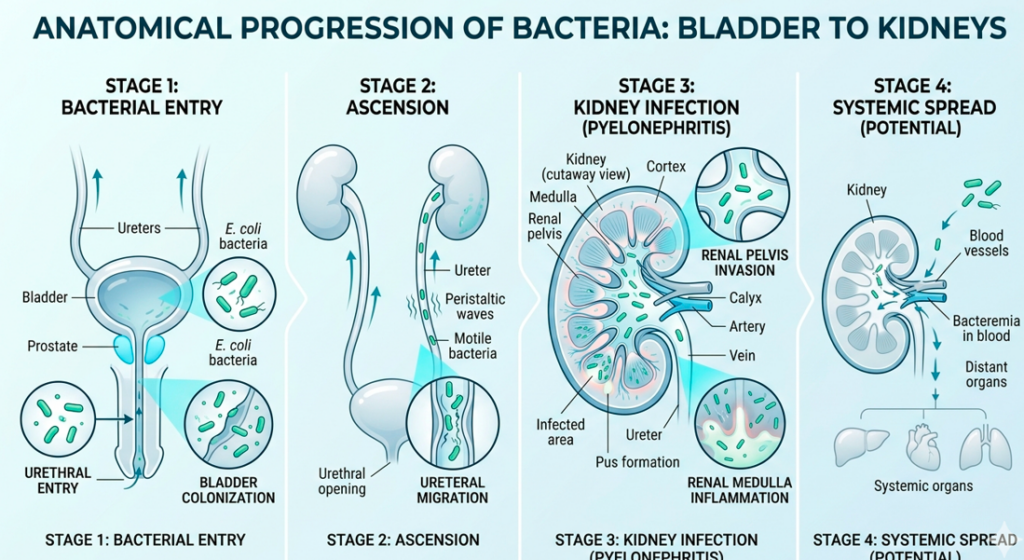
A typical UTI starts in the lower urinary tract — the urethra and bladder. Bacteria, most commonly E. coli from the gastrointestinal tract, travel up the urethra and establish a colony in the bladder lining. The immune system responds with inflammation, which produces the classic burning and urgency that send most people looking for treatment.
If the bacteria stay in the bladder, treatment is straightforward. A short course of oral antibiotics typically clears the infection within days.
The Ascent
When bacteria aren’t stopped at the bladder, they can travel further up the urinary tract:
- Bacteria multiply in the bladder, building higher concentrations
- Some travel up the ureters — the tubes connecting bladder to kidneys
- Once in the kidneys, they infect the renal pelvis and surrounding tissue
- The clinical name for this is pyelonephritis (kidney infection)
Several factors influence whether this ascent happens. Anatomy matters — shorter urethras (women) and any structural abnormalities increase risk. Vesicoureteral reflux, where urine flows backward from the bladder into the ureters, dramatically raises the chance of bacteria reaching the kidneys. Diabetes, immunosuppression, kidney stones, and pregnancy all increase susceptibility.
Why the Kidneys React So Strongly
The bladder lining handles bacterial exposure relatively well — it’s evolved to deal with constant microbial traffic. The kidneys haven’t. They’re filtering organs, normally sterile, and bacteria there trigger a much more aggressive immune response.
That response produces the systemic symptoms — fever, chills, fatigue, nausea — that distinguish a kidney infection from a bladder infection. It’s not just localized irritation anymore; your whole body is fighting the infection.
How Long Does It Take for a UTI to Become a Kidney Infection?
The timeline varies, but the window is shorter than most people realize.
Typical Progression
For most untreated UTIs:
- Days 1-2: Bacteria establish in the bladder; classic UTI symptoms begin
- Days 2-5: If untreated, bacteria multiply and may begin ascending
- Days 3-7: Kidney involvement possible; early pyelonephritis symptoms appear
- Beyond 7 days: Risk of severe kidney infection and systemic spread increases significantly
This isn’t a strict schedule. Some patients progress to pyelonephritis within 24 hours of UTI onset. Others may go a week or more with bladder symptoms only. The variability is exactly why waiting to see how things go is risky.
Factors That Speed Up Progression
Certain conditions accelerate the timeline:
- Diabetes — high blood sugar feeds bacterial growth and impairs immune response
- Pregnancy — anatomical and hormonal changes increase risk
- Immunosuppression — reduced ability to contain infection
- Kidney stones — provide a surface for bacteria to colonize and block urine flow
- Recent urinary procedures — catheters, cystoscopies, surgeries
- Structural abnormalities — anything affecting normal urine flow
- Recurrent UTIs — repeated infections weaken local defenses
If any of these apply to you, the safe move is treating UTIs at first signs rather than waiting.
The Predictability Problem
The frustrating truth is that you cannot reliably predict your own progression. Two people with identical-seeming UTIs can have completely different outcomes — one clears it spontaneously, the other ends up hospitalized. That’s why prompt evaluation matters more than trying to gauge severity from home.
What Are the First Signs of a Kidney Infection?
The shift from bladder infection to kidney infection usually announces itself with a distinct set of symptoms that feel different from the original UTI.
The Classic Warning Triad
Three symptoms together strongly suggest pyelonephritis:
- Fever (often 101°F or higher) — frequently with shaking chills
- Flank or lower back pain — usually one-sided, in the area below the ribs
- Nausea and/or vomiting — sometimes severe enough to prevent eating
When all three appear alongside the original burning and urgency, the infection has almost certainly reached the kidneys. This isn’t a “wait and see” situation.
Additional Symptoms to Watch For
Other features that point toward kidney involvement:
- Severe fatigue — feeling wiped out, “hit by a truck”
- Rapid heart rate even when resting
- Shaking chills that come and go in waves
- Worsening urinary symptoms alongside the new systemic symptoms
- Cloudy, dark, or bloody urine more pronounced than the original UTI
- Mental fogginess or confusion (particularly in elderly patients)
What’s Different From a Regular UTI
A useful way to distinguish: regular UTIs make you uncomfortable; kidney infections make you sick. The systemic illness aspect — feeling feverish, exhausted, nauseated — is what separates pyelonephritis from a simple bladder infection. If you’ve had UTIs before and this one feels qualitatively different, take that signal seriously.
Lower Back Pain With a UTI: What Does It Mean?
Lower back pain in the context of a UTI is one of the most reliable early warnings that an infection is spreading. Understanding what kidney pain feels like helps you act on it quickly.
Where Kidney Pain Shows Up
Your kidneys sit toward the back, just below the rib cage on each side of your spine. Pain from a kidney infection typically appears in the area called the flank — between the lowest rib and the hip, off to one side of the spine.
Most patients describe:
- One-sided pain rather than central or both-sided
- Deep, constant aching rather than sharp or stabbing
- A sense of pressure or fullness rather than muscular tightness
- Pain that doesn’t improve with stretching or position changes
- Tenderness when the area is tapped lightly with a fist
How It Differs From Muscle Pain
Ordinary muscle pain in the back has different qualities:
| Feature | Muscle Pain | Kidney Pain |
| Pattern | Affected by movement | Constant, position-independent |
| Location | Often central or both sides | Usually one-sided, in the flank |
| Quality | Sharp, achy, tight | Deep, dull, pressure-like |
| Response to stretching | Often improves | No change |
| Associated symptoms | Usually isolated | Fever, UTI symptoms, fatigue |
| Tenderness to tapping | Localized to muscle | Sharp pain over the kidney area |
When back pain shows up alongside urinary symptoms, especially with any fever or chills, the working assumption should be a kidney infection until proven otherwise.
The Costovertebral Tap Test
Clinicians have a quick bedside test for kidney involvement called costovertebral angle (CVA) tenderness. The provider taps gently with the side of a fist on your lower back over the kidney area.
Sharp pain in response is a strong indicator of pyelonephritis. You can roughly perform this on yourself — if a firm but light tap over the area below your rib produces unexpectedly sharp pain on one side, that’s worth getting evaluated promptly.
Untreated UTI Risks Beyond the Kidneys
Kidney infection is the most common complication of an untreated UTI, but it’s not the only one. The cascade can continue if the infection progresses further.
Urosepsis
When bacteria from infected kidneys enter the bloodstream, the resulting systemic infection is called urosepsis. It’s life-threatening. Symptoms include:
- Very high or very low body temperature
- Dangerously low blood pressure
- Rapid heart rate and breathing
- Confusion or disorientation
- Organ dysfunction (kidney failure, liver involvement)
- Skin changes — pale, cool, or mottled appearance
Urosepsis requires intensive care, IV antibiotics, and sometimes vasopressor medications to support blood pressure. Even with treatment, mortality rates run between 20-40% depending on patient factors.
Catching the infection at the kidney stage — before it spreads systemically — is the goal.
Permanent Kidney Damage
Severe or repeated kidney infections can leave behind scarring in the renal tissue. Over time, this scarring can affect kidney function, contributing to chronic kidney disease in some patients. The risk is highest with delayed treatment of severe infections, repeated episodes, or infections in patients with underlying kidney problems.
Pregnancy-Related Complications
Pregnant patients face elevated risks at every stage of UTI progression. An untreated UTI in pregnancy can lead to:
- Preterm labor and delivery
- Low birth weight
- Maternal pyelonephritis (which is more common during pregnancy)
- Sepsis affecting both mother and fetus
- Increased risk of pre-eclampsia in some studies
Pregnant patients with any UTI symptoms should never wait — and pregnant patients with possible kidney involvement need immediate evaluation, typically at the ER or with their OB.
Recurrent Infection Patterns
Patients who develop pyelonephritis once are more likely to experience repeated kidney infections in the future, especially if anatomical factors contributed to the initial episode.
Establishing a clear treatment relationship and preventive plan after a first kidney infection helps reduce that risk.
For more on how mild UTIs are managed before they reach this stage, our guide on UTI urgent care vs. the ER covers the initial treatment decisions.
Can Urgent Care Treat a Kidney Infection?
Yes — for mild to moderate cases. This often surprises patients who assume any kidney infection automatically means a hospital visit. Severe cases do need the ER, but a significant portion of pyelonephritis can be safely treated at a well-equipped urgent care.
What Urgent Care Can Handle
Mild kidney infections with stable vital signs, controlled pain, and the ability to tolerate fluids by mouth often respond well to outpatient treatment. At A+ Urgent Care, this typically includes:
- Clinical evaluation by an emergency-medicine-trained provider
- Urinalysis on-site with results in 5-10 minutes
- Urine culture sent to the lab to identify the bacteria and confirm antibiotic sensitivity
- Blood work when indicated to assess infection severity
- IV fluids to support hydration and help flush the urinary tract
- Stronger oral antibiotics — often fluoroquinolones (ciprofloxacin, levofloxacin) or extended-release options
- Initial IV antibiotic dose when appropriate, followed by oral course
- Detailed follow-up instructions with clear criteria for when to seek further care
For severe UTI treatment Cresskill and Bloomfield residents need, this in-office approach is often faster and far less expensive than the ER.
The Triage Decision
Urgent care providers assess several factors to decide whether outpatient management is appropriate:
- Vital signs (temperature, blood pressure, heart rate, respiratory rate)
- Ability to keep fluids down
- Pain severity and control with oral medications
- Underlying conditions (diabetes, pregnancy, immunosuppression)
- Signs of sepsis or systemic illness
- Access to follow-up care
When these factors look reassuring, treatment at urgent care saves you hours in an ER waiting room and thousands of dollars in costs. When they don’t, the urgent care team can stabilize you and arrange direct transfer to the appropriate hospital.
A+ Urgent Care’s Triage Protocol
Specifically: if you arrive with mild fever, lower back pain, and stable vital signs — but you can still drink fluids, your pain is manageable, and you’re not vomiting — urgent care kidney infection NJ care can typically handle your treatment.
You’ll get the stronger antibiotics and IV fluids needed without a hospital admission.
If you’re vomiting persistently, can’t keep liquids down, have severe debilitating pain, very high fever (104°F+), confusion, or signs of dehydration, the ER is the right call.
The urgent care team will help facilitate that transfer if you arrive and we determine higher-level care is needed.
When to Go to the ER for a Kidney Infection
A few red flag scenarios skip urgent care entirely and warrant going directly to the emergency room.
Clear ER Indications
Head to the ER if you experience any of these alongside UTI symptoms:
- Persistent vomiting that prevents you from keeping fluids or medications down
- Severe, debilitating pain not controlled by over-the-counter analgesics
- High fever above 104°F with shaking chills
- Signs of dehydration — dizziness when standing, very dark urine, dry mouth, weakness
- Confusion, disorientation, or altered mental status
- Difficulty breathing or rapid breathing
- Very rapid heart rate even at rest
- Low blood pressure if you can measure it (under 90/60 with symptoms)
- Pregnancy with possible kidney infection symptoms
- Immunocompromised status — chemotherapy, transplant, advanced HIV
- History of kidney problems or single kidney
Why These Symptoms Need Hospital-Level Care
Each of these features suggests either severe infection, sepsis risk, or the need for treatments that require hospital resources:
- IV antibiotics around the clock
- Continuous monitoring of vital signs
- Imaging studies (CT scans to rule out obstructions or abscesses)
- Specialist consultations (urology, nephrology)
- Surgical intervention if a kidney stone or abscess is causing obstruction
The ER has these resources immediately available. Urgent care does not.
The Bottom Line on Triage
Use this simple framework:
- Burning and urgency only? Walk-in clinic Bloomfield NJ urgent care handles this quickly.
- Back pain, fever, but you’re holding up okay? Urgent care is still the right first stop in most cases.
- Vomiting, severe pain, can’t function? Head straight to the ER.
When in doubt, calling the urgent care first lets you describe symptoms and get a quick recommendation on whether walking in or going to the ER is more appropriate.
What Happens During a Walk-In Kidney Infection Evaluation
Knowing what to expect helps reduce anxiety when you’re already feeling miserable.
Check-in and rapid triage. Front desk staff at A+ Urgent Care prioritize patients with possible kidney infections — fever and back pain move you up the queue rather than waiting through routine visits.
Initial vital signs. A nurse or medical assistant takes temperature, blood pressure, pulse, oxygen saturation, and pain score. These numbers help the provider gauge severity right away.
Provider evaluation. A physician or nurse practitioner reviews your symptoms, examines your abdomen and back (including the CVA tap test for kidney tenderness), and assesses hydration status.
Urinalysis on-site. A clean-catch urine sample is tested for nitrites, leukocyte esterase, blood, and other markers. Results in 5-10 minutes confirm the infection and give early information about severity.
Urine culture and possible blood work. A portion of the urine sample is sent for culture to identify the specific bacteria and which antibiotics will be most effective. Blood tests may be ordered to check kidney function and infection markers if needed.
IV fluids if indicated. Mild dehydration often improves significantly with a liter or two of IV fluids during the visit. This also helps flush the urinary tract.
Antibiotic decision. Based on the assessment, you’ll receive a prescription for a stronger antibiotic regimen — often 7-14 days rather than the short course used for simple bladder infections. The first dose may be given by IV or injection while you’re still in the office to start treatment immediately.
Clear follow-up plan. You’ll leave with specific instructions: what symptoms should improve and by when, what new symptoms should prompt a return visit or ER trip, and when to follow up for a recheck.
Transfer if needed. If during evaluation the team determines your case needs ER-level care, they coordinate the transition directly — sometimes with a phone call to the receiving hospital so you’re expected when you arrive.
The whole visit typically runs 60-90 minutes — longer than a simple UTI evaluation, but far faster than spending half a day in an emergency room. Bergen County urgent care UTI care at our Cresskill location follows the same protocol.
Frequently Asked Questions
Can a kidney infection kill you?
Untreated severe kidney infections can progress to urosepsis, which is life-threatening. With prompt treatment, however, the mortality rate is very low — typically under 1% for uncomplicated cases caught early.
The risk increases significantly when treatment is delayed or when patients have underlying health conditions. This is why recognizing the warning signs and seeking care quickly matters so much.
Can a kidney infection heal on its own?
It’s possible in very mild cases for the immune system to clear the infection, but the risk is significant. Even when self-resolution occurs, it often involves longer suffering and higher chance of permanent kidney damage compared to prompt antibiotic treatment. The medical consensus is clear: kidney infections should be treated with antibiotics.
How long does a kidney infection take to heal with antibiotics?
Most patients notice meaningful improvement within 48-72 hours of starting appropriate antibiotics. Fever typically breaks first, followed by reduction in back pain and nausea over the next few days.
Full recovery generally takes 1-2 weeks. Antibiotic courses for kidney infections run 7-14 days — much longer than the 3-5 day course typical for bladder infections.
Can urgent care give me IV antibiotics for a kidney infection?
A+ Urgent Care can administer initial IV antibiotic doses when appropriate for stable patients with mild-to-moderate kidney infections. This jumpstarts treatment immediately while oral antibiotics begin working. For patients who need multiple days of IV antibiotics, transfer to a hospital is appropriate.
Is back pain always a sign of kidney infection during a UTI?
Not always, but it’s a meaningful warning sign that warrants prompt evaluation. Other causes of back pain — muscle strain, kidney stones without infection, menstrual cramping — can occur alongside an unrelated UTI.
The combination of one-sided flank pain, fever, and UTI symptoms strongly suggests pyelonephritis. A provider can distinguish kidney infection from other causes with examination and testing.
Do I need to see a urologist after a kidney infection?
Not always. Single uncomplicated kidney infections in healthy patients typically don’t require specialist follow-up beyond completing the antibiotic course and confirming resolution.
Urology referral becomes appropriate for recurrent kidney infections, kidney infections associated with stones or anatomical abnormalities, or kidney infections in men (which are uncommon and often signal underlying issues).
What’s the difference between a UTI and pyelonephritis?
A UTI is the general term for an infection anywhere in the urinary tract. Lower UTIs (cystitis) involve the bladder and urethra and cause burning, urgency, and frequency.
Upper UTIs — pyelonephritis — involve the kidneys and add systemic symptoms like fever, back pain, and nausea. Pyelonephritis is a more serious type of UTI requiring more aggressive treatment.
Where can I get same-day kidney infection treatment in Bergen or Essex County?
A+ Urgent Care provides same-day evaluation and treatment for mild-to-moderate kidney infections at both Bloomfield (Essex County) and Cresskill (Bergen County) locations.
For severe cases requiring hospital admission, our team coordinates direct transfer to the appropriate facility. Walk in during operating hours — no appointment required.
Don’t Wait It Out — Get Evaluated Today
A UTI that started as routine burning can become something much more serious in a matter of days.
The early signs of a kidney infection — one-sided back pain, fever, chills, fatigue — are your body’s clear signal that bacteria have moved beyond the bladder.
Acting on those signals promptly often means the difference between an oral antibiotic course at urgent care and several days in a hospital bed.
If you’ve been dealing with UTI symptoms and now feel back pain, fever, or worsening fatigue, walk in for evaluation today.
The visit is fast, the testing is on-site, and treatment starts immediately. Waiting another day to see if it gets better risks letting the infection escalate to a point where the only option is the ER.
About A+ Urgent Care & Dr. Ajay Jetley
Dr. Ajay Jetley, MD is the founder and Medical Director of A+ Urgent Care, with board certification in emergency medicine and more than 15 years of hands-on clinical experience across hospital emergency departments and walk-in care settings.
His background in emergency medicine shapes the clinic’s approach — rapid triage, comprehensive on-site diagnostics, and a low threshold for escalating cases that need hospital-level care.
Patients at the Bloomfield and Cresskill locations benefit from this depth of experience whether they walk in for a minor concern or something more serious.
The Bloomfield practice has earned a 4.8-star rating on Google since opening —see what patients are saying about their visits.