Worried about a surprise bill? Urgent care is dramatically cheaper than the ER for non-emergencies, but the final cost depends on your insurance, the visit complexity, and any tests or X-rays you need. Here’s a …

Key Takeaways
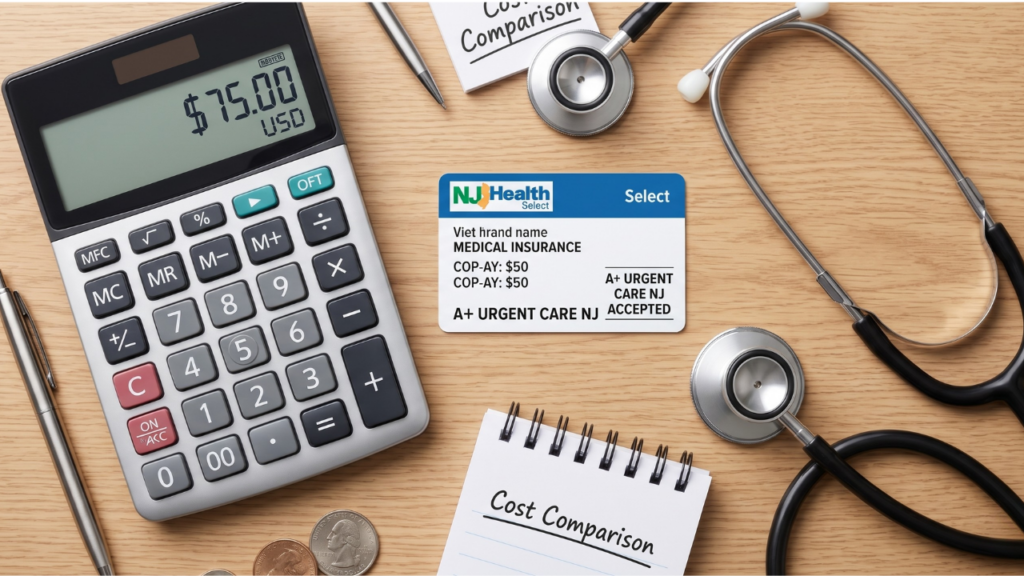
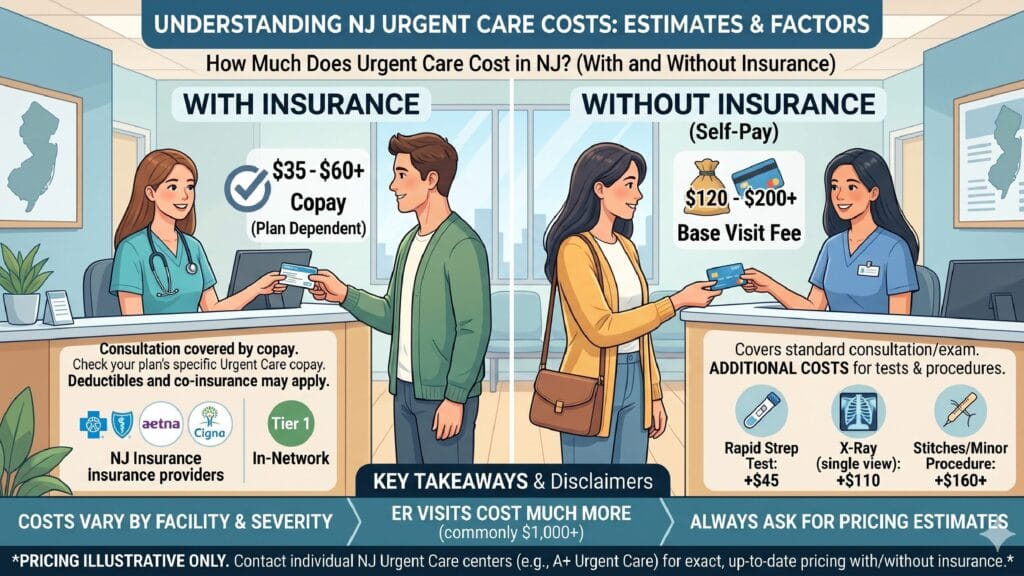
- Most people want a straight answer to how much does urgent care cost — for a basic visit in New Jersey, expect roughly $100-$280 without insurance, or a copay around $20-$75 with insurance. Tests, X-rays, and procedures add to that.
- Urgent care costs a fraction of the ER for the same non-emergency problem. An uninsured ER visit commonly runs $1,000-$3,000+, while the equivalent urgent care visit lands in the low hundreds.
- The base visit fee usually doesn’t include extras. X-rays, lab work, and rapid tests are billed on top, which is why two people with the same complaint can walk out with different bills. Knowing what drives the cost helps you avoid surprises.
Table of Contents
- The Short Answer on Urgent Care Cost
- Urgent Care Cost Without Insurance
- Urgent Care Cost With Insurance
- What Drives the Price Up: Tests, X-Rays, and Procedures
- Urgent Care vs. ER Cost: Why the Gap Is So Big
- Why You Sometimes Get a Bill After Your Visit
- Does Urgent Care Take Insurance?
- Self-Pay Discounts and How to Ask
- How to Keep Your Urgent Care Bill Low
- What A+ Urgent Care Costs in Bloomfield and Cresskill
- Frequently Asked Questions
- Get Affordable Walk-In Care in NJ
Nobody likes walking into a medical visit unsure what it’ll cost. And urgent care has a reputation for being the affordable, no-surprises option — which is mostly true, but the full picture has a few moving parts worth understanding before you go.
The honest answer is that an urgent care visit in New Jersey usually costs far less than the emergency room and roughly in line with a specialist copay. But the exact number depends on three things: whether you have insurance, how complex your visit is, and whether you need any tests or imaging. A simple sore-throat visit and a visit that includes an X-ray and lab work produce very different bills.
This guide breaks down the real numbers — what you’ll pay with insurance, what you’ll pay without it, what the common add-ons cost, and why the ER costs so dramatically more for the same care. It also covers how to avoid the surprise bill that occasionally shows up days later. For affordable urgent care Bergen County and Essex County families can count on, knowing the cost structure ahead of time takes the anxiety out of walking in.
The Short Answer on Urgent Care Cost
If you just want the headline numbers, here they are.
For a standard urgent care visit in New Jersey:
- With insurance: a copay of roughly $20-$75, depending on your plan
- Without insurance: roughly $100-$280 for the base visit, with most landing in the $150-$250 range
Those figures cover the basic provider evaluation — seeing a physician, nurse practitioner, or physician assistant, getting diagnosed, and getting a treatment plan or prescription. What they generally don’t cover is the extras: X-rays, lab tests, rapid tests, and procedures all get added on top.
Why There’s a Range, Not a Fixed Price
Urgent care pricing isn’t one flat number because visits vary so much. A few factors move the price within that range:
- Visit complexity — a quick rash check costs less than a multi-symptom evaluation
- Tests needed — each rapid test, lab, or X-ray adds to the total
- Your insurance plan — copay, deductible, and coinsurance all shape the final number
- Whether you’ve met your deductible for the year
The good news is that even at the higher end, urgent care remains far cheaper than the emergency room for the same non-emergency complaint — which is the comparison that matters most.
Urgent Care Cost Without Insurance
For uninsured patients, urgent care is one of the most affordable ways to get same-day medical care, and the pricing tends to be more transparent than almost anywhere else in the healthcare system.
The Base Visit
A self-pay urgent care visit in New Jersey typically runs $100-$280 for the basic evaluation, with most standard visits landing between $150 and $250. This covers your time with the provider, the diagnosis, and a treatment plan. Conditions like sore throats, ear infections, UTIs, and minor injuries usually fall within this range when no extra testing is needed.
Common Add-Ons
Where the bill grows is with diagnostics and procedures. Typical self-pay add-on costs include:
| Service | Typical Self-Pay Cost |
| Base visit (evaluation only) | $100-$280 |
| Visit + one rapid test (strep, flu, COVID, urinalysis) | $175-$350 |
| X-ray | $100-$250 |
| Lab test (each) | $20-$200 |
| Minor laceration repair (stitches) | $150-$250+ |
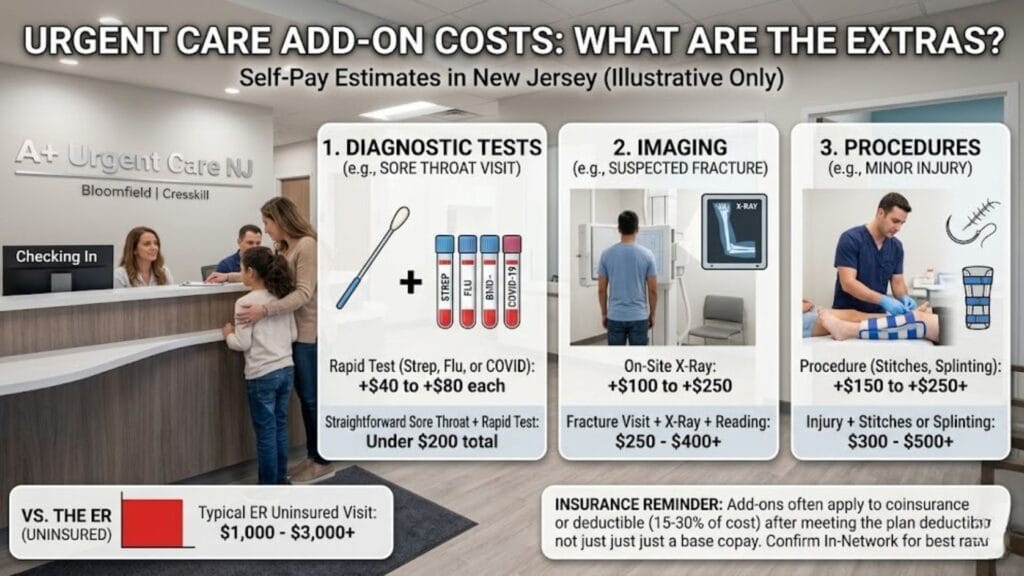
So a straightforward visit for a sore throat with a rapid strep test might total under $200, while a visit for a possible fracture that needs an X-ray could run $250-$400 or more. Asking about pricing at check-in helps you anticipate the total.
The Bottom Line for Uninsured Patients
Even at the higher end with multiple add-ons, a self-pay urgent care visit typically stays in the low-to-mid hundreds — a world apart from an uninsured ER visit for the same complaint, which commonly runs $1,000-$3,000 or more. For anyone paying out of pocket, urgent care is almost always the more sensible financial choice for a non-emergency.
Urgent Care Cost With Insurance
If you have health insurance, your out-of-pocket cost at urgent care is usually limited to a copay, though the details depend on your specific plan.
The Typical Copay
Most insurance plans treat urgent care similarly to a specialist or primary care visit. Common copays fall in the $20-$75 range for in-network urgent care. Some plans charge a flat copay; others apply coinsurance (a percentage of the cost) after you’ve met your deductible.
What Affects Your Insured Cost
A few plan details shape what you actually pay:
- Copay — the flat fee per visit, if your plan uses one
- Deductible — if you haven’t met it, you may pay more out of pocket until you do
- Coinsurance — a percentage you owe after meeting the deductible, often 15-30%
- In-network vs. out-of-network — staying in-network keeps costs lower and avoids surprise charges
- Add-on services — X-rays, labs, and procedures may have their own cost-sharing
The Importance of In-Network
Going to an in-network urgent care is one of the biggest factors in keeping your cost predictable. Out-of-network visits can mean paying the full cost or facing balance bills. A+ Urgent Care accepts most major insurance plans — the insurance and payment options page lists accepted providers, and it’s worth a quick call to confirm your specific plan before your visit.
What Drives the Price Up: Tests, X-Rays, and Procedures
Understanding what gets added to the base visit fee is the single best way to avoid an unexpectedly high bill. The base evaluation is just the starting point.
Diagnostic Tests
Rapid tests done on-site are common cost drivers:
- Rapid strep test — to confirm strep throat
- Rapid flu test — during flu season
- COVID-19 test — rapid antigen or PCR
- Urinalysis — for UTIs and other concerns
Each of these adds to the base fee. A visit that requires two or three tests naturally costs more than one that needs none.
Imaging (X-Rays)
On-site X-ray is one of urgent care’s biggest advantages over a regular doctor’s office, and it typically adds $100-$250 to a self-pay visit. The fee usually covers both the image and the reading. Some clinics bundle imaging into a flat visit fee; others bill it separately. Either way, an X-ray for a suspected fracture or sprain is far cheaper at urgent care than at a hospital.
Lab Work
Some lab tests are done in-house; others get sent to an outside laboratory like Quest or LabCorp. In-house labs are usually included or modestly priced, but tests sent to an external lab are billed separately by that lab — sometimes arriving as a separate bill days or weeks later. This is one of the most common sources of surprise charges, so it’s worth asking whether any lab work will be sent out.
Procedures
Hands-on treatments add to the total as well:
- Laceration repair (stitches) — $150-$250+, depending on size and complexity
- Splinting for a sprain or fracture
- Wound care and dressing
- Incision and drainage for an abscess
None of these are hidden — a quick question at check-in about likely costs for your specific situation usually gets you a reasonable estimate.
Urgent Care vs. ER Cost: Why the Gap Is So Big
The price difference between urgent care and the emergency room is one of the most striking in all of healthcare, and it’s worth understanding why.
The Numbers
For the same non-emergency complaint:
- Urgent care (self-pay): roughly $100-$280 base, low-to-mid hundreds with add-ons
- ER (self-pay): commonly $1,000-$3,000+, sometimes much higher
That’s often a 5-10x difference for treating the identical problem — a UTI, an ear infection, a minor laceration.
Where the ER’s Cost Comes From
The ER charges more because it maintains capabilities you only need in a true emergency:
- Facility fees — a charge just for using the emergency department, often before any treatment
- Separate billing — hospital ERs frequently send a facility bill and a separate physician bill
- 24/7 specialist readiness — trauma surgeons, cardiac teams, and advanced imaging on standby around the clock
- High overhead — intensive care capacity and surgical readiness cost money whether or not you use them
Urgent care runs more like a doctor’s office, with lower overhead and usually a single, predictable bill.
When the ER Is Still Worth It
None of this means avoiding the ER when you actually need it — a true emergency is exactly what that cost structure exists for. For deciding which is appropriate for your situation, our guide on urgent care vs. the ER breaks down which conditions belong where. The cost savings of urgent care only apply to genuinely non-emergency situations.
Why You Sometimes Get a Bill After Your Visit
Few things are more frustrating than thinking you’ve paid, then getting a bill weeks later. Understanding why it happens helps you prevent it.
The Usual Culprits
A few common reasons for a post-visit bill:
- Outside lab work — samples sent to Quest, LabCorp, or another lab get billed separately by that lab, often arriving later
- Insurance processing — your insurer may cover less than expected, leaving a balance after they process the claim
- Deductible not met — if you haven’t hit your annual deductible, you may owe more than just a copay
- Out-of-network charges — visiting an out-of-network facility can trigger higher cost-sharing
- Add-on services — occasionally a test or procedure is billed after the fact
How to Prevent the Surprise
A little proactivity at the visit goes a long way:
- Ask whether any lab work will be sent to an outside lab, and what it might cost
- Confirm the clinic is in-network for your plan before being seen
- Ask for an estimate of the total if you’re paying out of pocket
- Keep your receipt and any paperwork in case you need to reconcile a later bill
If a bill does arrive larger than expected, most urgent care centers will set up a payment plan rather than send it to collections — but you usually have to ask.
Does Urgent Care Take Insurance?
Yes. The large majority of urgent care centers, including A+ Urgent Care, accept most major insurance plans. Urgent care is generally covered similarly to a primary care or specialist visit under most plans.
What’s Typically Accepted
A+ Urgent Care accepts major insurers including plans from companies like UnitedHealthcare, Aetna, Blue Cross Blue Shield, Humana, and others. The full list is on the insurance and payment options page. Because plan details vary widely, confirming your specific coverage ahead of time is always smart.
What to Bring
To make sure your insurance is applied correctly:
- Your insurance card
- A photo ID
- Knowledge of your copay or deductible status, if you have it
- A secondary insurance card, if applicable
If You’re Between Plans or Uninsured
No insurance? You’re not turned away. A+ Urgent Care offers self-pay options, and as covered above, the out-of-pocket cost for a non-emergency visit is far lower than an ER alternative. Just let the front desk know you’re paying out of pocket so they can walk you through pricing.
Self-Pay Discounts and How to Ask
One of the least-known facts about urgent care: many centers offer discounts for patients who pay at the time of service, but those discounts often aren’t advertised.
The Discount That’s Worth Asking About
Many urgent care clinics offer self-pay or cash-pay discounts, sometimes in the range of 10-30% off, for uninsured patients who pay at the time of the visit. The catch is that you usually have to ask at the front desk — it’s rarely posted or offered automatically.
Questions Worth Asking Before Your Visit
A few questions that can save you money:
- “Do you offer a discount for paying at the time of service?”
- “What’s the estimated total for my type of visit?”
- “Will any tests be sent to an outside lab, and what would that cost?”
- “Is there a payment plan option if the bill is larger than expected?”
Other Low-Cost Options
For patients on tight budgets, it’s also worth knowing about alternatives. Federally Qualified Health Centers (FQHCs) offer sliding-scale fees based on income, and telehealth visits — for issues that don’t need a physical exam — typically run $50-$100. For anything requiring hands-on evaluation, testing, or a procedure, though, in-person urgent care remains the practical choice.
How to Keep Your Urgent Care Bill Low
A handful of simple habits help you get the care you need at the lowest reasonable cost.
Before You Go
- Confirm the clinic is in-network for your insurance plan
- Check your deductible status so you know what to expect
- Call ahead to ask about pricing and current wait times
- Consider whether telehealth could handle your issue if no exam is needed
At the Visit
- Bring your insurance card and ID so coverage is applied correctly
- Ask about self-pay discounts if you’re uninsured
- Ask whether labs will be sent out to avoid a surprise external bill
- Request an estimate for any recommended tests or procedures
Choosing the Right Level of Care
The biggest cost-saver of all is matching the setting to the situation. Using urgent care instead of the ER for a non-emergency can save you hundreds or thousands of dollars. Using telehealth or primary care for issues that can wait saves even more. Reserving the ER for true emergencies — where its cost is fully justified — keeps your overall healthcare spending sensible. For sorting out which is which, the urgent care vs. ER guide is a helpful reference.
What A+ Urgent Care Costs in Bloomfield and Cresskill
For Northern New Jersey families specifically, here’s how cost works at A+ Urgent Care.
Insurance-Based Visits
A+ Urgent Care accepts most major insurance plans at both the Bloomfield and Cresskill locations. For insured patients, your cost is typically your plan’s copay, which most commonly falls in the $20-$75 range. Confirming your specific plan ahead of time gives you the clearest picture — the insurance and payment options page is the place to start, or call the clinic directly.
Self-Pay Visits
For patients without insurance, A+ Urgent Care offers transparent self-pay pricing in line with the regional ranges covered in this guide — far less than an ER visit for the same complaint. Because the exact total depends on your specific visit and any tests needed, the front desk can give you pricing when you call or arrive. Both locations are reachable through the contact page.
The Value Beyond Cost
Cost is only part of the equation. A+ Urgent Care visits typically take 15-45 minutes from check-in to departure, with on-site X-rays, labs, and rapid testing that let most patients get diagnosed and treated in a single visit. Both locations are open seven days a week, including evenings and weekends — covering the hours when a regular doctor’s office is usually closed and the only other option would be a far more expensive ER trip.
Frequently Asked Questions
How much does urgent care cost without insurance?
In New Jersey, a self-pay urgent care visit typically runs $100-$280 for the base evaluation, with most landing in the $150-$250 range. Tests, X-rays, and procedures add to that — a visit with a rapid test might total $175-$350, and one needing an X-ray could reach $250-$400 or more. It’s far cheaper than an uninsured ER visit for the same complaint.
How much does urgent care cost with insurance?
With insurance, most patients pay only their plan’s copay, commonly $20-$75 for in-network urgent care. If you haven’t met your deductible, you may owe more until you do. Add-on services like X-rays and labs may carry their own cost-sharing. Staying in-network keeps your cost lowest and most predictable.
Is urgent care cheaper than the ER?
Significantly. For the same non-emergency condition, urgent care typically costs a fraction of the ER — often 5-10 times less. An uninsured ER visit commonly runs $1,000-$3,000+, while the equivalent urgent care visit lands in the low-to-mid hundreds. The ER’s higher cost reflects capabilities needed only for true emergencies.
Does urgent care take insurance?
Yes. Most urgent care centers, including A+ Urgent Care, accept most major insurance plans, and urgent care is generally covered like a primary care or specialist visit. Bring your insurance card and photo ID, and confirm your specific plan is in-network ahead of time to keep costs predictable.
How much does an X-ray cost at urgent care?
At urgent care, a self-pay X-ray typically adds $100-$250 to your visit, usually covering both the image and the reading. That’s substantially less than a hospital or ER X-ray for the same body part, which can exceed $300 due to facility fees. On-site X-ray is one of urgent care’s biggest cost advantages.
Why did I get a bill after my urgent care visit?
The most common reason is outside lab work — samples sent to an external lab like Quest or LabCorp are billed separately by that lab, often arriving days or weeks later. Other causes include insurance processing leaving a balance, an unmet deductible, or out-of-network charges. Asking whether labs will be sent out helps you anticipate this.
Do urgent care centers offer discounts for paying cash?
Many do — often 10-30% off for patients who pay at the time of service — but these discounts are frequently unadvertised. You usually have to ask at the front desk. If you’re uninsured, it’s always worth asking about self-pay or cash-pay pricing before you register.
What’s included in the base urgent care visit fee?
The base fee covers the provider evaluation — your time with the physician, nurse practitioner, or PA, plus diagnosis and a treatment plan or prescription. It generally does not include X-rays, lab tests, rapid tests, or procedures, which are billed on top. This is why two visits for different complaints can produce different totals.
Can I get urgent care if I can’t pay the full amount upfront?
Most urgent care centers require payment at the time of service, but many will arrange a payment plan if a bill turns out larger than expected — particularly after insurance processes or an external lab bills you. It’s best to ask about payment options before the balance becomes overdue rather than after.
Is telehealth cheaper than urgent care?
For issues that don’t need a physical exam — a prescription refill, mild cold symptoms, a simple question — telehealth visits typically run $50-$100 and can be cheaper than an in-person visit. But anything requiring hands-on evaluation, testing, an X-ray, or a procedure needs in-person urgent care, where those services are available in a single visit.
Does insurance cover urgent care visits fully?
Usually not fully — most plans apply a copay or coinsurance, so you’ll typically owe something even with good coverage. The amount depends on your copay, deductible status, and whether the clinic is in-network. Even so, the insured cost of urgent care is far lower than an insured ER visit for a comparable complaint.
How much does urgent care cost in Bloomfield or Cresskill specifically?
A+ Urgent Care accepts most major insurance plans at both locations, so insured patients typically pay their plan’s copay (commonly $20-$75). Self-pay pricing is transparent and in line with regional ranges — much less than an ER visit. Because the total depends on your specific visit and any tests, the front desk can give you exact pricing when you call or arrive.
Get Affordable Walk-In Care in NJ
Urgent care earns its reputation as the affordable option for non-emergency care — a basic visit costs a fraction of the ER, and even with X-rays or lab work added, the total usually stays in the low-to-mid hundreds for self-pay patients, or just a copay for those with insurance. The key to avoiding surprises is understanding that the base visit fee is the starting point, not the whole bill, and asking a few simple questions about tests, labs, and discounts before you’re seen.
When you need care that can’t wait for your regular doctor but isn’t an emergency, walking into a clinic gets you treated quickly without the financial hit of a hospital visit. A little preparation — confirming your insurance, asking about pricing — means you can focus on feeling better instead of worrying about the bill.
About A+ Urgent Care
When a medical issue comes up and the ER feels like overkill,A+ Urgent Care offers walk-in care for the whole family across Northern New Jersey. Both the Bloomfield (Essex County) and Cresskill (Bergen County) locations provide the same comprehensive range of services: illness and injury treatment, on-site X-rays and labs, physicals, and vaccinations.
Founded by Dr. Ajay Jetley, a board-certified emergency medicine physician with 15+ years of experience, the practice accepts most major insurance plans — see the full list o finsurance options — and offers transparent self-pay pricing for families without coverage.