Not sure if your pickleball injury needs urgent care or the ER? Learn how to triage sprains, eye scratches, and suspected fractures—and where to get same-day treatment in Northern NJ.
April 14, 2026
When to Visit Urgent Care for a Pickleball Injury: Triage Tips

Key Takeaways:
- Urgent care for pickleball injuries is the right choice for most court-related trauma—sprains, strains, eye scratches, and suspected minor fractures can all be diagnosed and treated same-day without ER wait times.
- Knowing how to triage your injury on the spot helps you make faster decisions about where to go, which speeds up treatment and improves recovery outcomes.
- A+ Urgent Care locations in Bloomfield and Cresskill NJ have on-site digital X-rays and a board-certified emergency medicine physician who understands pickleball injuries firsthand.
Table of Contents
- Why Triage Matters After a Pickleball Injury
- Urgent Care vs ER for Sports Injuries: How to Decide
- Injuries That Belong at Urgent Care
- Red Flags That Require the Emergency Room
- Does Urgent Care Do X-Rays for Sports Injuries?
- What to Expect During Your Urgent Care Visit
- How to Speed Up Your Recovery After Treatment
- Frequently Asked Questions
Why Triage Matters After a Pickleball Injury
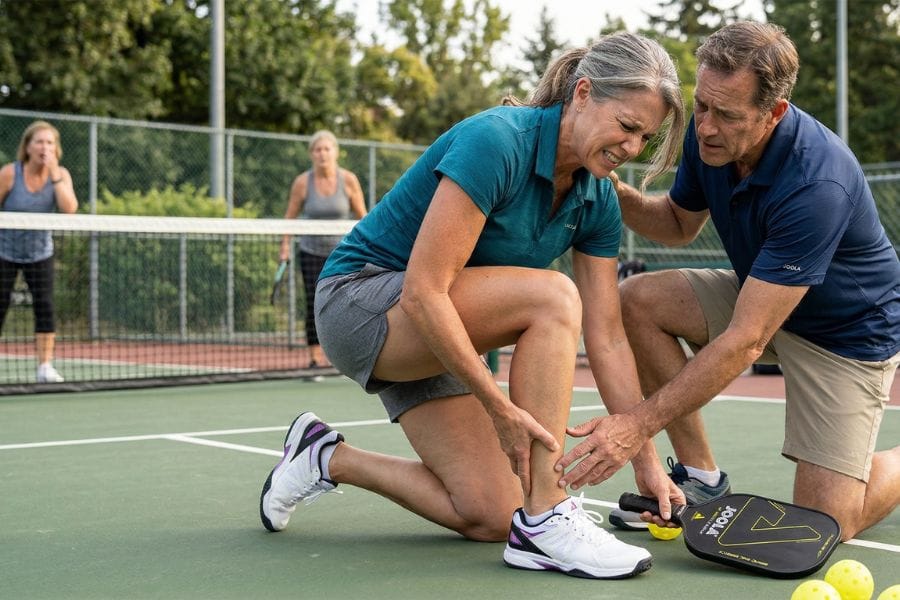
You just rolled your ankle chasing a drop shot. Or maybe you took a ball to the face and your eye won’t stop watering. The adrenaline is pumping, your playing partners are hovering, and someone’s already asking if you need to go to the hospital. But do you? And if so, where—the ER or a walk-in clinic?
The Cost of Getting It Wrong
Making the wrong call about where to seek treatment has real consequenses. Go to the ER for a sprained ankle and you might wait four hours surrounded by actual emergencies, only to receive the same treatment you would’ve gotten at urgent care in 45 minutes. Skip medical care entirely for what you think is “just a pulled muscle” and you might be walking on a stress fracture that becomes a complete break.
Pickleball injury triage isn’t complicated, but it does require knowing a few key distinctions. What symptoms indicate something serious? What can wait until tomorrow? What needs attention right now but doesn’t warrant an ambulance?
The Middle Ground Most People Miss
Here’s what many players don’t realize: there’s a massive gap between “I’m fine, I’ll ice it at home” and “I need an emergency room.” That middle ground—non-life-threatening trauma that still requires professional evaluation—is exactly what urgent care exists for.
A sports injury walk-in clinic can handle the vast majority of pickleball injuries. We’re talking sprains, strains, suspected fractures, lacerations, eye irritation, and acute inflammation. The key is knowing which situations fall into that category and which ones don’t.
Urgent Care vs ER for Sports Injuries: How to Decide
Should I go to urgent care or ER for a sprained ankle? Can urgent care treat a torn calf? These are the questions people type into Google while sitting on the sideline with an ice pack, and they deserve straight answers.
The 30-Second Decision Framework
Ask yourself three questions:
- Is there obvious deformity? A bone visibly out of place, a joint bent the wrong direction, or a limb at an unnatural angle means ER.
- Am I experiencing systemic symptoms? Chest pain, difficulty breathing, dizziness, or loss of consciousness means ER.
- Is this localized pain and swelling without the above? Urgent care can handle it.
That’s really the core of it. Most pickleball injuries fall into category three.
What Makes Urgent Care Different from the ER
| Factor | Urgent Care | Emergency Room |
| Wait time | Typically 15-45 minutes | Often 2-6 hours |
| Cost (uninsured) | $150-$300 average | $1,000-$3,000+ average |
| X-ray capability | Yes (on-site digital imaging) | Yes |
| Fracture treatment | Splinting, bracing, referral | Casting, surgery if needed |
| Best for | Non-life-threatening trauma | Severe or life-threatening injury |
The ER Isn’t Always Better
Some people default to the emergency room because they assume it’s more thorough. But for a rolled ankle or pickleball elbow, the treatment protocol is identical—the ER just takes longer and costs more. Emergency departments are designed for heart attacks, strokes, and major trauma. A sprained knee doesn’t jump the queue ahead of those cases, which is why you end up waiting.
Same-day sports injury treatment in Bergen County is available at walk-in clinics specifically equipped for this type of care. You’re not getting a lesser version of medicine—you’re getting the appropriate level of care for your injury.
Injuries That Belong at Urgent Care
Let’s get specific. What pickleball injuries can a walk-in clinic actually treat? More than most players realize.
Sprains and Strains
The bread and butter of sports medicine. Whether you’ve rolled an ankle, tweaked your knee, or pulled a calf muscle, urgent care can:
- Perform physical examination to assess severity
- Order X-rays to rule out fractures
- Provide bracing, wrapping, or air casts
- Prescribe anti-inflammatories and pain management
- Give you weight-bearing instructions and referrals if needed
Can urgent care treat a torn calf? Yes—they can diagnose the tear, immobilize the leg, provide crutches, and refer you to orthopedics for follow-up. The initial stabilization is critical, and waiting days for a primary care appointment only delays healing.
Eye Scratches and Minor Eye Trauma
Urgent care for eye scratch treatment is absolutely appropriate. After taking a ball or paddle to the face, a provider can:
- Perform a fluorescent dye test to check for corneal abrasions
- Prescribe antibiotic drops to prevent infection
- Assess for more serious damage and expedite ophthalmology referral if needed
One important note: if you have visible blood in the eye, sudden vision loss, or see flashing lights, that’s beyond urgent care scope. Those symptoms require emergency evaluation.
Pickleball Elbow Flare-Ups
Urgent care for pickleball elbow makes sense when the pain has become acute and you need intervention beyond ice and rest. A provider can confirm the diagnosis, prescribe prescription-strength NSAIDs to break the inflammation cycle, and fit you with a counterforce brace.
Lacerations Needing Stitches
Slid on the court and opened up your knee? Caught the edge of a paddle and split your eyebrow? If the wound is bleeding heavily but the bleeding can be controlled with pressure, urgent care can clean, suture, and dress it. Deep wounds with uncontrollable bleeding or wounds that expose bone or tendon need the ER.
Suspected Minor Fractures
“Suspected” is the key word here. You don’t know if it’s broken until someone takes an image. Urgent care facilities with on-site digital imaging can X-ray your ankle, wrist, or finger, determine whether there’s a fracture, splint it appropriately, and arrange orthopedic follow-up.
Red Flags That Require the Emergency Room
Urgent care is great for most situations, but it has limits. Certain symptoms indicate you need a higher level of care—and recognizing them quickly matters.
Go to the ER Immediately If:
- Obvious bone deformity. The limb is bent where it shouldn’t be, or bone is visible through the skin.
- Inability to bear any weight combined with severe swelling. This could indicate a complete ligament rupture or serious fracture.
- Blood visible in the eye (hyphema). This is a medical emergency that can cause permanent vision loss.
- Sudden vision loss or flashing lights after eye trauma. Possible retinal detachment requires immediate specialist intervention.
- Loss of consciousness, even briefly.
- Chest pain or difficulty breathing, regardless of the apparent injury.
- Numbness or tingling spreading down a limb, which could indicate nerve damage.
- Signs of compartment syndrome: severe pain disproportionate to the injury, pain with passive stretching, and tight/swollen muscle compartments.
When You’re Unsure
If you genuinely can’t decide, call ahead. Both ER and urgent care facilities can do a quick phone triage to help you determine the right destination. A+ Urgent Care staff in Bloomfield and Cresskill are happy to answer these calls—it’s better to ask than to show up at the wrong place.
The “It Can Wait Until Tomorrow” Myth
One common mistake: assuming that if something isn’t an emergency, it can wait indefinitely. Delaying treatment for a moderate injury doesn’t just prolong discomfort—it can worsen outcomes.
A sprain that isn’t properly immobilized can become a chronic stability problem. An untreated corneal abrasion can get infected. A hairline fracture you walk on for a week can displace and require surgery instead of just a boot.
Same-day treatment matters even for non-emergencies.
Does Urgent Care Do X-Rays for Sports Injuries?
Yes. And this is one of the most important reasons to choose urgent care over waiting for a primary care appointment.
On-Site Digital Imaging Changes Everything
Not all urgent care facilities are created equal. Some are essentially glorified doctor’s offices without diagnostic equipment. Others—like A+ Urgent Care locations in Northern NJ—have on-site digital X-rays that provide results in minutes.
Why does this matter? Because the difference between a sprain and a fracture often can’t be determined by physical exam alone. You need imaging. And if your urgent care clinic doesn’t have it, they’ll send you somewhere else, which adds hours or days to your diagnosis.
What X-Rays Can and Can’t Show
X-rays are excellent for:
- Bone fractures (complete and hairline)
- Joint dislocations
- Bone chips
- Arthritis changes
- Foreign bodies (like glass in a wound)
X-rays are limited for:
- Soft tissue injuries (ligament tears, muscle strains)
- Cartilage damage
- Tendon ruptures
For soft tissue evaluation, you may need an MRI or ultrasound, which urgent care will refer you for. But ruling out a fracture first is still the critical initial step—and that happens same-day at a walk-in clinic with X-ray capability.
The Process Is Fast
At most urgent care facilities with digital imaging, the workflow looks like this:
- Check in and brief triage (5-10 minutes)
- Provider examination (10-15 minutes)
- X-ray if indicated (5-10 minutes)
- Results review and treatment plan (10-15 minutes)
Total time: often under an hour. Compare that to an ER visit where imaging alone might take two hours due to queue volume.
What to Expect During Your Urgent Care Visit
Never been to urgent care for a sports injury before? Here’s what the process typically looks like so you know what to expect.
Before You Arrive
If possible, apply basic first aid before leaving the court:
- R.I.C.E. method for sprains/strains: Rest, Ice, Compression, Elevation
- Direct pressure for bleeding wounds
- Don’t remove objects embedded in wounds
- Don’t attempt to “pop” a dislocated joint back in place
Bring your insurance card and ID. If you have relevant medical history—previous injuries to the same area, blood thinners, allergies to medications—be ready to share that information.
The Examination
A board-certified emergency medicine physician or experienced provider will:
- Ask about the mechanism of injury (how it happened)
- Assess range of motion and stability
- Check for point tenderness over bones
- Evaluate circulation, sensation, and motor function
- Determine whether imaging is necessary
For eye injuries, expect a visual acuity check and possibly a fluorescent dye examination to look for scratches.
Treatment and Discharge
Depending on your injury, you might leave with:
- Splint, brace, or air cast for immobilization
- Crutches if you shouldn’t bear weight
- Prescription medications (NSAIDs, muscle relaxants, antibiotics)
- Wound care instructions for lacerations
- Referral paperwork for orthopedics, ophthalmology, or physical therapy
- Return precautions explaining what symptoms should prompt a follow-up visit
Most visits are complete within 60-90 minutes, start to finish.
How to Speed Up Your Recovery After Treatment
Getting proper initial treatment is step one. What you do in the following days and weeks determines how quickly you return to the court—and whether you come back at full strength or with lingering problems.
Follow the Weight-Bearing Instructions
This sounds obvious but it’s where most players go wrong. “Limited weight-bearing” doesn’t mean “walk on it when I feel like I can tolerate it.” If you were given crutches and told to use them for two weeks, use them for two weeks. Cheating on these instructions extends recovery time, sometimes dramatically.
Don’t Skip the Follow-Up
Urgent care provides acute stabilization—the immediate diagnosis and treatment. But some injuries require ongoing management:
- Fractures need orthopedic follow-up to ensure proper healing
- Significant sprains benefit from physical therapy to restore strength and stability
- Eye injuries may need ophthalmology evaluation to rule out delayed complications
The referrals you receive aren’t suggestions. Skipping them is how minor injuries become chronic problems.
Phase Your Return to Play
Coming back too soon is the fastest way to reinjure yourself. A general framework:
| Phase | Activity Level | Duration |
| Acute | Rest, ice, elevation, no play | 3-14 days depending on injury |
| Early recovery | Light movement, range of motion exercises | 1-3 weeks |
| Strengthening | Progressive loading, sport-specific drills | 2-6 weeks |
| Return to play | Gradual reintroduction, starting with practice games | When cleared by provider |
Listen to your body. Pain is information. A twinge during recovery drills means you’re not ready for competitive play yet.
Address the Root Cause
Why did you get injured in the first place? If you rolled your ankle, are your court shoes appropriate? If you developed pickleball elbow, is your grip size correct? If you tore a calf muscle, did you warm up properly?
Returning to the exact same conditions that caused the injury is a recipe for recurrence. Use the recovery period to identify and fix the underlying issue.
Frequently Asked Questions
Should I go to urgent care or ER for a sprained ankle?
Urgent care is the right choice for most sprained ankles. Providers can examine the joint, X-ray to rule out fractures, wrap or brace the ankle, and give you weight-bearing instructions. Reserve the ER for situations where the ankle is visibly deformed, you can’t bear any weight at all, or you have numbness/tingling suggesting nerve involvement.
Can urgent care treat a torn calf muscle?
Yes. Urgent care can diagnose calf tears through physical examination, differentiate between strains of varying severity, provide immobilization with a walking boot, supply crutches, prescribe appropriate pain management, and refer you to orthopedics or physical therapy for follow-up care.
Does urgent care do X-rays for sports injuries?
Many urgent care facilities have on-site digital X-ray capability—but not all. A+ Urgent Care locations in Bloomfield and Cresskill NJ both offer on-site digital imaging, which means you get results within minutes rather than waiting days for an outside imaging appointment.
How do I know if my eye injury needs the ER instead of urgent care?
Urgent care can handle corneal abrasions (eye scratches) and minor irritation from impact. Go to the ER if you have visible blood pooling in the eye, sudden vision loss, flashing lights, or a sensation that something is seriously wrong with your vision. These symptoms could indicate hyphema or retinal detachment, which require immediate specialist care.
What’s the average wait time at urgent care vs the ER for a sports injury?
Urgent care visits typically take 45-90 minutes total, including examination and any imaging. ER visits for non-life-threatening injuries often run 3-6 hours because you’re triaged behind more severe cases. For a rolled ankle or strained muscle, urgent care is significently faster.
Is urgent care cheaper than the ER for pickleball injuries?
Generally, yes—often by a factor of 5-10x. An urgent care visit with X-ray might cost $200-400 out of pocket, while the same evaluation at an ER could run $1,500-3,000 or more. Insurance copays also tend to be lower for urgent care visits.
Can I go to urgent care if I’m not sure whether something is broken?
Absolutely. “I’m not sure if it’s broken” is one of the most common reasons people visit urgent care. Providers will examine you, order X-rays if indicated, and give you a definitive answer—usually within an hour.
Is there an urgent care near Hillsdale NJ that does sports injury X-rays?
A+ Urgent Care in Cresskill is conveniently located for Hillsdale residents and offers on-site digital X-rays along with comprehensive sports injury treatment. The Bloomfield location serves the broader Northern NJ area with the same capabilities.
About Dr. Ajay Jetley & A+ Urgent Care
Dr. Ajay Jetley is a board-certified emergency medicine physician with over 15 years of clinical experience—and he’s also an avid pickleball player who has treated injuries on the court as they happen.
He understands pickleball injury triage not just as a clinician but as someone who’s seen teammates go down with rolled ankles and torn calves.
As Medical Director of A+ Urgent Care, he oversees locations in both Bloomfield and Cresskill NJ, where on-site digital X-rays allow for rapid diagnosis and same-day sports injury treatment.
The brand-new Bloomfield location already holds a 4.8-star rating on Google—see what patients are saying.
If you need urgent care for a pickleball injury in Bergen County or Northern NJ, skip the ER wait times and get the care you need today.
Meet the Author

Dr. Ajay V. Jetley, MD, is a Emergency Medicine certified physician with over 15 years of clinical experience. As the Medical Director for A+ Urgent Care in Bloomfield and Cresskill, NJ, he is dedicated to providing high-quality, accessible outpatient care for acute illnesses, minor injuries, and wellness services. Dr. Jetley combines his extensive medical expertise and affiliations with premier institutions like Englewood Hospital with a thorough, patient-centered approach to serving the Northern New Jersey community.