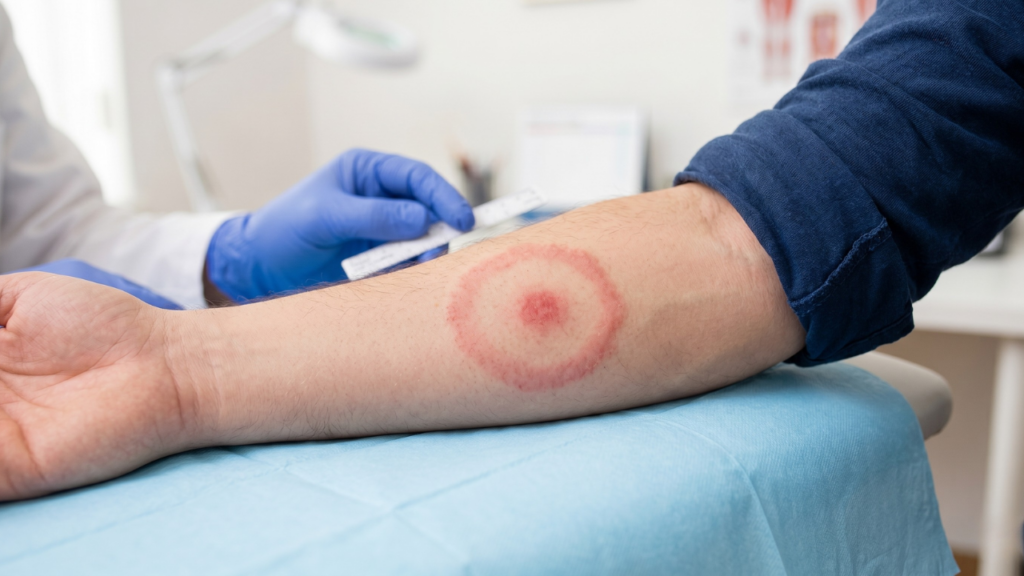
A bullseye rash after a tick bite is the most recognizable sign of Lyme disease — and if you have one, you may not need a test at all. Learn what the rash really looks …

Key Takeaways
- A Lyme disease bullseye rash — clinically called erythema migrans — is the clearest early sign of infection, appearing in roughly 70-80% of cases between 3 and 30 days after a tick bite. If you have one and live in a high-risk area like New Jersey, treatment usually starts right away.
- Lyme blood tests are unreliable in the first few weeks. Antibodies take 2-4 weeks or longer to build, so early testing misses more than half of true cases. A negative test soon after a bite doesn’t mean you’re in the clear.
- The rash changes the whole approach. With a classic bullseye, providers typically treat without waiting for a test. Without a rash, timing the test correctly matters enormously — and that’s where a quick evaluation helps you avoid both false reassurance and unnecessary worry.
Table of Contents
- First, Don’t Panic — But Pay Attention
- What a Lyme Disease Bullseye Rash Looks Like
- How Long After a Tick Bite Does the Rash Appear?
- Is a Bullseye Rash Always Lyme Disease?
- Can You Have Lyme Disease Without a Bullseye Rash?
- When to Get Tested for Lyme Disease
- Why Your Lyme Test Might Be Negative When You’re Infected
- How Lyme Disease Testing Actually Works
- Treatment: What Happens If It Is Lyme
- When to Walk Into Urgent Care
- Frequently Asked Questions
- Get Tick Bite Evaluation in Bloomfield and Cresskill
You found a tick, removed it, and now — days later — there’s a strange red mark spreading where it bit you. Or maybe you never saw a tick at all, and a circular rash just appeared on your leg after a weekend outdoors. Either way, the same question is running through your head: is this Lyme disease?
It’s a reasonable thing to worry about in New Jersey, which ranks among the top states in the country for Lyme disease. But here’s the reassuring part: the bullseye rash, while alarming to see, is the single most useful clue you can have. When it shows up in a high-risk area like ours, it tells providers nearly everything they need to know — often enough to start treatment without even running a blood test.
The confusion usually comes from the testing side. People assume a blood test will give them a fast yes-or-no answer, then get frustrated when the result is negative despite obvious symptoms, or when a doctor treats them without testing at all. This guide clears that up: what the rash actually looks like, when Lyme testing works and when it doesn’t, and when to walk into a clinic. If you’ve already dealt with the tick itself, our guides on tick bites in children andthe best tick repellents for 2026 cover removal and prevention in depth.
First, Don’t Panic — But Pay Attention
Finding a possible Lyme rash is unsettling, so start with perspective. Lyme disease is very treatable, especially when caught early — which is exactly the stage the bullseye rash represents. Spotting it is good news in a sense: it means you’ve caught a potential infection at its most curable point.
Why Early Detection Matters So Much
Lyme disease progresses in stages. Caught early, a short course of antibiotics resolves the vast majority of cases completely. Left untreated for weeks or months, it can move into joints, the nervous system, and the heart, becoming harder to treat. The rash is your early-warning system, and acting on it promptly is what keeps Lyme a minor episode rather than a drawn-out problem.
What to Do Right Now
If you’re looking at a suspicious rash after possible tick exposure:
- Take a photo with something for scale, like a coin, and note the date
- Measure it roughly, and check it again in a day to see if it’s expanding
- Note any other symptoms — fever, fatigue, headache, body aches
- Don’t wait weeks to get it evaluated if it’s growing or you feel unwell
- Don’t rush to demand a blood test assuming it will settle the question — as you’ll see, timing matters
The goal isn’t to diagnose yourself from a photo on the internet. It’s to know enough to make a smart, calm decision about when to get evaluated.
What a Lyme Disease Bullseye Rash Looks Like
The medical name for the Lyme rash is erythema migrans, and recognizing its features helps you tell it apart from ordinary bites and irritation.
Classic Features
A textbook erythema migrans rash typically shows:
- An expanding circular or oval shape that grows outward over days
- Central clearing that can create the classic “bullseye” or target appearance — a red center, a clearer ring, then an outer red border
- A large size — often several inches across, sometimes growing to a foot or more
- Warmth to the touch in some cases
- Little or no itching or pain — unlike most bug bites, it usually doesn’t itch
- A gradual expansion rather than appearing full-size immediately
The Important Caveat About the “Bullseye”
Here’s something many people don’t realize: the rash doesn’t always look like a perfect bullseye. The central-clearing target pattern is the iconic image, but plenty of erythema migrans rashes are simply solid red, expanding ovals without the classic ring. A uniformly red, growing patch can absolutely still be Lyme. Don’t rule it out just because it lacks a perfect target shape.
Where It Shows Up
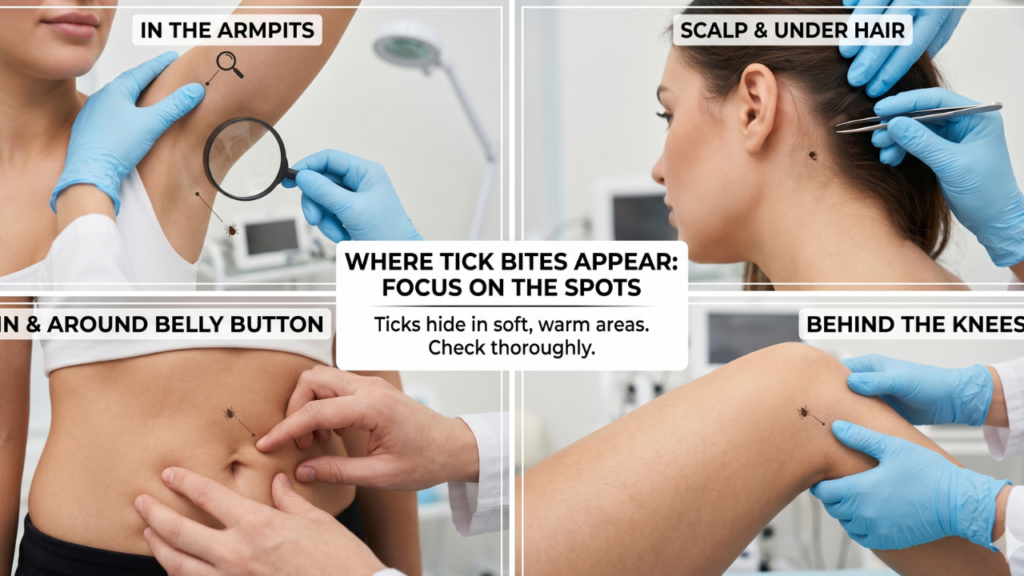
The rash appears at the site of the tick bite, which can be anywhere — but ticks favor warm, hidden areas: the backs of knees, the groin, the waistline, the armpits, the scalp and hairline. On the scalp it’s easy to miss entirely. This is part of why a thorough tick check after being outdoors matters so much.
How Long After a Tick Bite Does the Rash Appear?
Timing is one of the most useful things to understand, because it shapes both how you interpret a rash and when testing makes sense.
The 3-to-30-Day Window
Erythema migrans typically appears 3 to 30 days after the tick bite, with most rashes showing up within the first one to two weeks. This delay catches people off guard — the bite itself may have healed and been forgotten by the time the rash emerges.
Why the Delay Happens
The rash isn’t an immediate reaction to the bite. It’s a response to the Borrelia bacteria spreading outward through the skin from the bite site. That biological process takes days to produce a visible, expanding rash, which is why a mark appearing within hours of a bite is usually just normal irritation, not Lyme.
Immediate Redness vs. Erythema Migrans
A small red bump right after a tick bite is extremely common and usually harmless — a normal skin reaction to the bite, much like a mosquito bite. The features that distinguish it from a Lyme rash:
- Timing: immediate reactions appear within hours; EM appears days later
- Size: normal reactions stay small (a centimeter or two); EM keeps growing
- Behavior: normal reactions fade over days; EM expands over days
- Itch: normal bite reactions often itch; EM usually doesn’t
If a small mark appears right after removal and then shrinks, that’s reassuring. If a mark appears days later and grows, that warrants evaluation.
Is a Bullseye Rash Always Lyme Disease?
Not always — but in a high-risk area, a true expanding bullseye is treated as Lyme until proven otherwise. A few other conditions can produce target-like or circular rashes that get mistaken for erythema migrans.
Common Look-Alikes
- Ringworm — a fungal infection that produces a circular, ring-like rash, but it’s usually itchy and scaly, and it grows much more slowly than EM
- Spider or insect bite reactions — can produce a red ring around a central bite, but typically stay small and often itch or hurt
- Cellulitis — a bacterial skin infection causing spreading redness, usually warm, tender, and painful (unlike the painless EM)
- Nummular eczema — coin-shaped patches of irritated skin, typically dry and itchy
- Allergic reactions — including to the tick bite itself, usually appearing quickly and itching
The Features That Point Toward Lyme
What tilts the picture toward erythema migrans specifically:
- A history of possible tick exposure in the past month
- A rash that’s expanding over days rather than staying fixed
- Minimal itching or pain
- Living in or visiting a high-incidence area like New Jersey
- Large size relative to a typical bite reaction
In an endemic area, clinicians treat an expanding EM-type rash occurring in tick season as Lyme disease — the probability is high enough that waiting for confirmation isn’t worth the risk. The CDC’s Lyme disease testing guidance reflects this approach.
Can You Have Lyme Disease Without a Bullseye Rash?
Yes — and this is important, because relying on the rash alone gives false reassurance to the 20-30% of people who never develop one.
The Missing Rash Problem
While erythema migrans appears in roughly 70-80% of Lyme cases, that means a meaningful share of infected people never get the telltale rash, or get one in a hidden spot (like the scalp) that goes unnoticed. For these people, the first signs of Lyme are the non-specific symptoms instead.
Early Symptoms Beyond the Rash
Lyme disease in its early stage often produces flu-like symptoms:
- Fever and chills
- Fatigue
- Headache
- Muscle and joint aches
- Swollen lymph nodes
- Neck stiffness
Because these overlap with so many ordinary illnesses, they’re easy to dismiss — especially in summer, when “summer flu” gets blamed. The key context is recent potential tick exposure. Flu-like symptoms without respiratory symptoms (no cough or congestion), in someone who’s been outdoors in tick territory, deserve a closer look.
Why This Matters for Testing
The absence of a rash is precisely the situation where blood testing becomes important — but also where timing matters most. Someone with non-specific symptoms and no rash needs the test, yet testing too early gives unreliable results. The next sections explain how to navigate that.
When to Get Tested for Lyme Disease
This is the question that causes the most confusion, so here’s the clear framework providers actually use.
If You Have the Classic Rash: Often No Test Needed
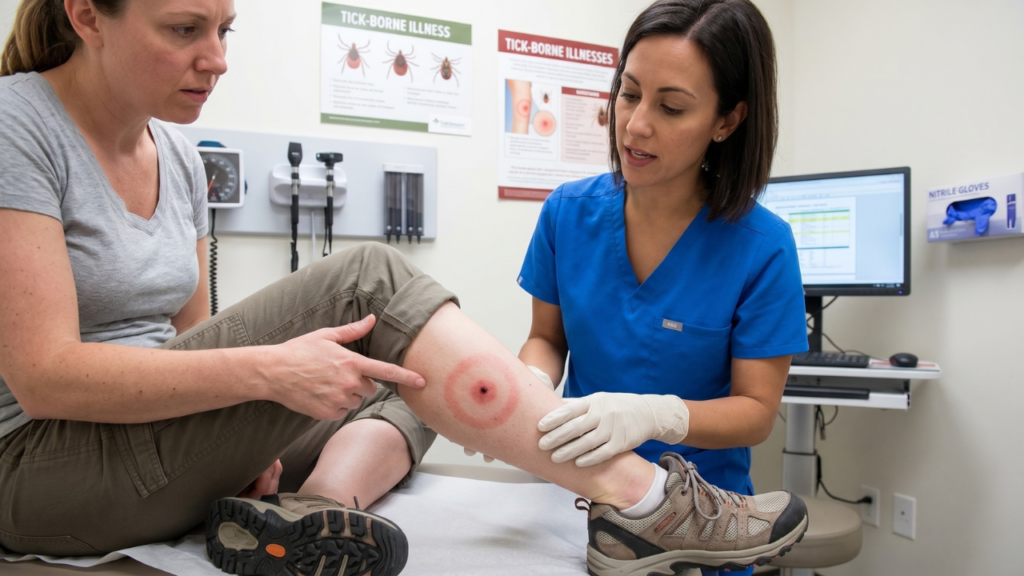
If you have a classic erythema migrans rash in an endemic area like New Jersey, testing is generally not recommended before treatment. The reason: the rash appears before your body has produced detectable antibodies, so a blood test at this stage would likely come back negative even though you’re infected. Treating based on the rash is faster and more accurate than waiting for a test that isn’t ready to be useful yet.
If You Don’t Have a Rash: Timing Is Everything
For people with possible exposure and symptoms but no rash, the timing of the test determines whether it’s worth anything:
- First few days after a bite: testing is essentially useless — antibodies haven’t developed
- 2-4 weeks after exposure or symptom onset: the earliest point testing becomes reasonably reliable
- 4-6 weeks and beyond: FDA-cleared tests have good sensitivity at this stage
- If an early test is negative but symptoms persist: a repeat test 2-6 weeks later can catch what the first missed
The Practical Takeaway
A blood test the day after a tick bite tells you almost nothing. If you’re worried and have no rash, the right move is usually a clinical evaluation to assess your risk and symptoms, with testing timed appropriately rather than rushed. A provider can help you decide whether to test now, test later, or treat based on symptoms. You can reach both A+ Urgent Care locations through the contact page to discuss timing.
[insert inside photo 3]
Why Your Lyme Test Might Be Negative When You’re Infected
The false-negative problem deserves its own explanation, because it causes real frustration and sometimes dangerous false reassurance.
How Big Is the Problem?
In the earliest stage of infection, the standard two-tier blood test catches only about 46% of confirmed cases. In other words, more than half of people with genuine early Lyme disease will get a negative result if tested too soon. That’s not a flaw in any one lab — it’s a fundamental limitation of how antibody testing works.
The Antibody Lag
Lyme blood tests don’t detect the bacteria directly. They detect your immune system’s antibody response to the bacteria. Building a detectable antibody level takes time — typically 2 to 4 weeks, sometimes longer. Test before your body has mounted that response, and there’s nothing for the test to find, regardless of whether you’re infected.
What This Means for You
A few practical implications:
- A negative test soon after a bite doesn’t rule out Lyme — it may just be too early
- Symptoms plus a negative early test is a reason to repeat testing, not to stop worrying
- The rash trumps the test — if you have classic EM, treatment proceeds regardless of test results
- Don’t let an early negative delay care if symptoms are developing
This is exactly why the clinical approach emphasizes symptoms, exposure history, and the rash over rushing to a lab — and why a knowledgeable evaluation matters more than a single test result.
How Lyme Disease Testing Actually Works
Understanding the testing process helps make sense of why timing matters and what results mean.
The Two-Tier System
The standard approach recommended by the CDC is a two-step process:
- First tier — ELISA (or EIA): a screening blood test that detects antibodies to the Lyme bacteria. It’s sensitive but can produce false positives.
- Second tier — Western blot or a second ELISA: a confirmatory test run only if the first tier is positive or equivocal, to weed out false positives.
Both steps are typically run from a single blood draw, and a result is considered positive only if both tiers agree. This two-step design balances catching real cases against avoiding false alarms.
What the Tests Can and Can’t Tell You
- They show exposure, not active infection — antibodies prove your immune system has encountered the bacteria, not that it’s currently present
- They stay positive for months to years after successful treatment, so they can’t confirm a cure or diagnose reinfection easily
- They’re unreliable early and reliable later, as covered above
A Note on Non-Standard Tests
Some labs market alternative Lyme tests that aren’t FDA-cleared. The CDC cautions that labs not accepting standard insurance may be offering tests that haven’t been validated. Stick with FDA-cleared, standard two-tier testing through a reputable provider, and be wary of unconventional tests promising certainty the established science can’t deliver.
Treatment: What Happens If It Is Lyme
The good news running through this entire topic: early Lyme disease is highly treatable, and the treatment is straightforward.
Standard Treatment
Early Lyme disease is treated with a course of oral antibiotics, typically lasting 10-21 days depending on the situation and the specific medication. Common options include:
- Doxycycline — first-line for most adults and children 8 and older
- Amoxicillin — often used for younger children and during pregnancy
- Cefuroxime — an alternative for those who can’t take the others
Most people respond well and recover fully when treated early. The rash typically begins fading within days of starting antibiotics.
The Importance of Finishing the Course
As with any antibiotic, completing the full course matters even after symptoms improve. Stopping early risks incomplete treatment and lingering infection.
What About Lingering Symptoms?
A small percentage of people experience lingering symptoms after treatment — sometimes called Post-Treatment Lyme Disease Syndrome. Most people, though, recover completely. If symptoms persist well after finishing antibiotics, follow up with your provider or a Lyme specialist for further evaluation.
The Prophylaxis Option
In some cases — a confirmed deer tick attached for 36+ hours, with treatment able to start within 72 hours of removal — a single preventive dose of doxycycline may be offered before any symptoms appear. Whether this applies depends on the specifics, which a provider can assess. Our children’s tick bite guide covers the prophylaxis criteria in more detail.
When to Walk Into Urgent Care
Knowing when to seek evaluation takes the guesswork out of an anxious situation.
Come In If You Have:
- An expanding rash after possible tick exposure, especially a bullseye or growing red patch
- Flu-like symptoms — fever, fatigue, body aches, headache — within a month of being in tick territory, particularly without cold or respiratory symptoms
- A known tick bite where the tick was attached more than 24-36 hours or was engorged
- A tick you couldn’t fully remove, or a bite site that’s getting redder and more swollen over days
- Uncertainty about timing for a Lyme test and a desire for guidance
- Worry — peace of mind is a legitimate reason to get checked
What Urgent Care Can Do
At A+ Urgent Care, a tick bite or rash evaluation can include:
- Clinical assessment of the rash and your exposure history
- A decision on whether to treat based on the rash (often the fastest path)
- Guidance on appropriate timing for Lyme testing if you don’t have a rash
- Prescription antibiotics when indicated
- Prophylactic treatment when CDC criteria are met
- Clear instructions on what symptoms to monitor and when to return
Walk-in care means you don’t wait days for a primary care appointment while a rash expands or symptoms develop — which matters when early treatment is the goal.
When to Go to the ER Instead
Most Lyme situations are urgent-care appropriate, but certain late-stage or severe symptoms warrant emergency care: facial drooping (Bell’s palsy), severe headache with neck stiffness, heart palpitations or chest pain, fainting, or signs of meningitis. These can indicate Lyme affecting the nervous system or heart and need immediate evaluation.
Frequently Asked Questions
What does a Lyme disease rash look like?
A Lyme rash (erythema migrans) is an expanding red circular or oval patch that grows over days, often reaching several inches across. It may show central clearing that creates a “bullseye” pattern, though many are simply solid red. Unlike most bug bites, it usually doesn’t itch or hurt. It appears 3-30 days after a tick bite at the bite site.
How long after a tick bite does the rash appear?
The bullseye rash typically appears 3 to 30 days after the bite, most often within the first one to two weeks. A small red mark appearing within hours of removal is usually just normal skin irritation, not Lyme — that reaction stays small and fades, while a Lyme rash appears later and expands over days.
Is a bullseye rash always Lyme disease?
Not always, but in a high-risk area like New Jersey, a true expanding bullseye is treated as Lyme until proven otherwise. Look-alikes include ringworm (itchy, scaly, slow-growing), cellulitis (painful and warm), and insect bite reactions (small, often itchy). The combination of recent tick exposure plus a painless, expanding rash points strongly toward Lyme.
Can you have Lyme disease without the bullseye rash?
Yes. The rash appears in only about 70-80% of cases, so 20-30% of infected people never develop one — or get it in a hidden spot like the scalp. For these people, early Lyme shows up as flu-like symptoms: fever, fatigue, headache, and body aches, typically without cold or respiratory symptoms.
When should I get tested for Lyme disease after a tick bite?
If you have the classic rash, testing usually isn’t needed before treatment — the rash is diagnostic in endemic areas. Without a rash, testing is unreliable in the first few days because antibodies take 2-4 weeks to develop. The earliest reliable window is 2-4 weeks after exposure, with good test sensitivity after 4-6 weeks.
Why is my Lyme test negative if I have symptoms?
Lyme tests detect antibodies, which take weeks to build. Tested too early, the standard test catches only about 46% of true cases — meaning more than half of early infections come back falsely negative. A negative test soon after a bite doesn’t rule out Lyme. If symptoms persist, a repeat test 2-6 weeks later often catches what the first missed.
Do I need antibiotics for a bullseye rash?
If you have a classic erythema migrans rash in an area where Lyme is common, treatment with antibiotics is typically recommended right away, without waiting for a blood test. Early antibiotic treatment is highly effective and resolves the large majority of cases completely. A provider confirms the rash and prescribes the appropriate course.
How accurate is the Lyme disease blood test?
It depends entirely on timing. In the first few weeks, the two-tier test misses more than half of cases. After 4-6 weeks, FDA-cleared tests have good sensitivity. The tests also stay positive for months to years after treatment, so they show exposure rather than active infection and can’t easily confirm a cure or reinfection.
What’s the difference between a tick bite reaction and a Lyme rash?
A normal tick bite reaction is small (a centimeter or two), appears within hours, often itches, and fades over days. A Lyme rash appears 3-30 days later, expands over days to several inches, usually doesn’t itch, and may show a bullseye pattern. Expansion over time is the biggest distinguishing feature.
Should I save the tick that bit me?
Yes, if you can. Placing the removed tick in a sealed bag helps a provider identify the species (deer ticks carry Lyme; dog ticks don’t) and assess your risk. While testing the tick itself isn’t routinely recommended for diagnosis, identification helps guide decisions about prophylactic treatment.
Can urgent care diagnose and treat Lyme disease?
Yes. Urgent care can evaluate a rash, assess your exposure history, prescribe antibiotics when indicated, offer prophylactic treatment when CDC criteria are met, and guide appropriate testing timing. A+ Urgent Care handles tick bite and Lyme evaluations at both Bloomfield and Cresskill locations, with walk-in availability seven days a week.
Where can I get evaluated for a tick bite or Lyme rash in NJ?
A+ Urgent Care provides same-day walk-in evaluation for tick bites and possible Lyme rashes at both Bloomfield (Essex County) and Cresskill (Bergen County) locations. Most patients are seen within 15-45 minutes. For an expanding rash or flu-like symptoms after tick exposure, walking in promptly supports early treatment — no appointment needed.
Get Tick Bite Evaluation in Bloomfield and Cresskill
A bullseye rash is alarming to discover, but it’s also the clearest early signal Lyme disease gives you — and catching it early is exactly what makes the condition so treatable.
If you have an expanding rash after possible tick exposure, the smartest move is prompt evaluation, not a rushed blood test that may not be ready to give a useful answer.
And if you have flu-like symptoms after time outdoors with no rash to point to, a clinical assessment helps you time any testing correctly instead of being misled by a too-early negative.
New Jersey’s tick season makes this a regular worry for local families. When a rash or symptoms have you concerned, walking in for evaluation gets you clear answers and, if needed, treatment that resolves Lyme disease before it has a chance to progress.
About A+ Urgent Care
Tick season keeps Northern New Jersey families on alert, and A+ Urgent Care is here for exactly those moments — the suspicious rash, the embedded tick, the fever that shows up after a weekend outdoors.
With walk-in locations in Bloomfield (Essex County) and Cresskill (Bergen County), open seven days a week, the team provides same-day evaluation, tick removal, Lyme assessment, and treatment when it’s needed.
The practice is led by Dr. Ajay Jetley, a board-certified emergency medicine physician with more than 15 years of experience caring for patients across the region. No appointment necessary — walk in during operating hours.