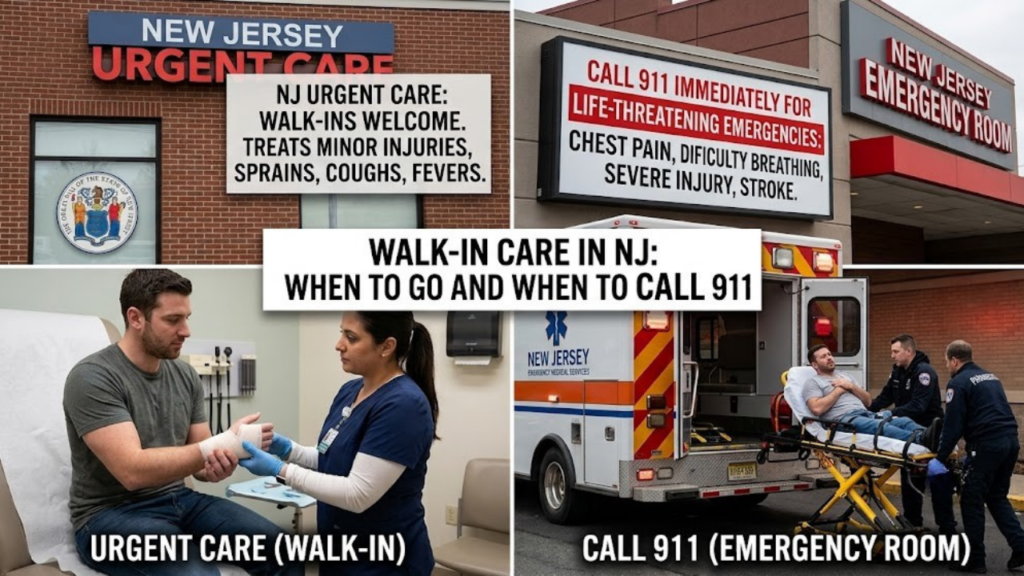
Workplace drug and alcohol testing keeps NJ businesses safe and compliant — but the rules got more complicated once cannabis became legal. Learn the main types of employer testing, how DOT and non-DOT testing differ, …


Key Takeaways
- New Jersey employers can still conduct drug and alcohol testing — pre-employment, reasonable suspicion, post-accident, and random testing for safety-sensitive and DOT-regulated roles. The state hasn’t banned workplace testing.
- Cannabis is the big exception. Under New Jersey’s CREAMMA law, a positive marijuana test alone can’t justify firing or refusing to hire someone — there generally must also be evidence of impairment. This makes cannabis fundamentally different from every other substance you test for.
- DOT testing follows federal rules that override state cannabis protections entirely. For DOT-regulated drivers, a positive marijuana test carries the full federal consequences, no impairment evidence required. Knowing which framework applies to which employee is essential.
Table of Contents
- Why Employers Test in the First Place
- The Main Types of Workplace Testing
- When Employers Can Test in NJ
- DOT vs. Non-DOT Testing: A Critical Distinction
- Testing Methods: Urine, Saliva, Hair, and Breath
- Common Drug Test Panels
- Cannabis and NJ’s CREAMMA Law: What Changed
- Medical Marijuana and Accommodation
- Building a Compliant Testing Policy
- What to Look for in a Testing Partner
- Frequently Asked Questions
- Reliable Employer Testing in Bloomfield and Cresskill
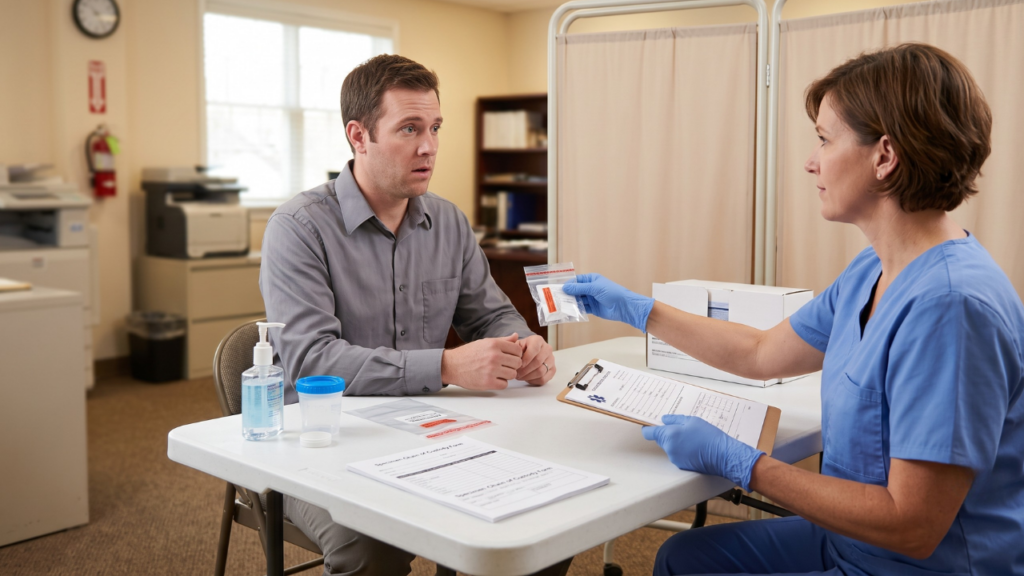
For New Jersey employers, drug and alcohol testing used to be relatively simple: set a policy, test when appropriate, and act on the results. Then cannabis became legal, and the picture got more complicated — not because testing went away, but because the rules around one particular substance changed significantly. Many business owners and HR managers are understandably unsure what they can and can’t do in 2026.
Here’s the reassuring part: workplace drug and alcohol testing is alive and well in New Jersey. Employers retain broad rights to test job applicants and employees, maintain a drug-free workplace, and keep safety-sensitive roles protected. What’s changed is mostly about cannabis, and about knowing which set of rules — state or federal — applies to a given employee.
This guide breaks it down for employers: the main types of testing, when you’re permitted to test, the crucial difference between DOT and non-DOT testing, how New Jersey’s cannabis law affects your decisions, and what to look for in a testing partner. One important note up front: this is general information to help you understand the landscape, not legal advice. A+ Urgent Care performs the testing; your specific policies and any adverse-action decisions should be developed with an employment attorney who knows your business. With that said, let’s make the picture clearer.
Why Employers Test in the First Place
Before getting into the mechanics, it helps to remember what workplace testing actually accomplishes for a business.
The Core Reasons
Employers test for several practical and legitimate reasons:
- Safety — reducing the risk of accidents, especially in roles involving vehicles, machinery, or physical labor
- Legal compliance — meeting federal requirements for DOT-regulated positions and certain industries
- Productivity and reliability — supporting a dependable workforce
- Liability reduction — limiting exposure after workplace incidents
- Workers’ compensation — some testing connects to workplace injury investigation
The Business Case
For many employers, testing is part of a broader occupational health program that keeps operations running smoothly and safely. A clear, consistently applied testing policy protects both the business and its employees, and signals that safety is taken seriously. For safety-sensitive industries, it’s not optional — it’s a regulatory requirement with real consequences for non-compliance.
Balancing Rights and Responsibilities
Modern testing is about balance: an employer’s legitimate interest in a safe, productive workplace on one side, and employees’ privacy and legal protections on the other. New Jersey law, particularly around cannabis, is largely about striking that balance. Getting it right means understanding both what you’re allowed to do and how to do it properly.
The Main Types of Workplace Testing
Employer testing isn’t one-size-fits-all. Different situations call for different testing triggers, each with its own rules.
Pre-Employment Testing
The most common type — testing job applicants after a conditional offer, before they start. It establishes a baseline and screens candidates for safety-sensitive or regulated roles. In New Jersey, pre-employment testing is permitted, with an important cannabis caveat covered later.
Reasonable Suspicion Testing
Testing based on specific, observable signs that an employee may be impaired at work — things like slurred speech, unsteadiness, the odor of alcohol, or erratic behavior. This type should always be backed by documentation: trained supervisors noting specific observations with dates, times, and details. Reasonable-suspicion testing protects both the employer and the employee when done properly.
Post-Accident Testing
Testing after a workplace accident that causes injury or property damage, to determine whether impairment played a role. This connects closely to workers’ compensation and liability, and should be tied to genuine possibility of impairment rather than used punitively.
Random Testing
Testing employees selected at random, without individualized suspicion. In New Jersey, random testing is generally reserved for safety-sensitive positions and is required for DOT-regulated roles. It’s a strong deterrent but carries the most restrictions for non-regulated positions.
Return-to-Duty and Follow-Up Testing
For employees returning to work after a violation or treatment, often part of a structured return-to-duty process — a standard component of DOT programs in particular.

When Employers Can Test in NJ
New Jersey doesn’t have a single statute that broadly prohibits workplace drug testing. Employers retain significant latitude, within certain guardrails.
What NJ Permits
New Jersey employers may generally conduct:
- Pre-employment screening after a conditional offer
- Reasonable-suspicion testing based on documented observations
- Post-accident testing tied to possible impairment
- Random testing for safety-sensitive and DOT-regulated roles
- Testing to maintain a drug-free workplace policy
The Guardrails
The main limits center on consistency, documentation, and cannabis:
- Apply policies consistently — inconsistent enforcement invites discrimination claims
- Provide written notice — applicants and employees should know the policy and procedures in advance
- Document reasonable suspicion — observations should be recorded properly
- Treat cannabis differently — the central NJ-specific rule, detailed below
- Keep results confidential — test results are sensitive records to be stored securely and separately
The Consistency Principle
One theme runs through compliant testing: consistency. Testing similar roles the same way, applying the policy uniformly, and documenting decisions all reduce legal risk. An employment attorney can help you build a policy that’s both effective and defensible — the legal side is genuinely worth professional input, since the rules are nuanced and evolving.
DOT vs. Non-DOT Testing: A Critical Distinction
If there’s one distinction every NJ employer with drivers must understand, it’s the line between DOT and non-DOT testing. They operate under entirely different rules.
DOT Testing
DOT (Department of Transportation) testing applies to employees in federally regulated, safety-sensitive positions — most notably commercial drivers who need a DOT physical. DOT testing is governed by strict federal regulations from the U.S. Department of Transportation that specify:
- The exact substances tested (a standardized federal panel)
- The collection procedures and chain of custody
- The use of certified labs and Medical Review Officers (MROs)
- The consequences of a positive result
Critically, federal DOT rules override state cannabis protections. For a DOT-regulated driver, a positive marijuana test carries full federal consequences — New Jersey’s CREAMMA protections do not apply. Federal law still classifies marijuana as prohibited for safety-sensitive transportation workers, full stop.
Non-DOT Testing
Non-DOT testing covers everyone else — employees not in federally regulated positions. Here, New Jersey state law governs, including the CREAMMA cannabis protections. Non-DOT testing gives employers more flexibility in some respects (panel choice, procedures) but comes with the state’s cannabis restrictions that DOT testing doesn’t have.
Why This Matters So Much
An employer running both DOT-regulated drivers and regular staff is essentially managing two parallel testing programs under two different rulebooks. Applying DOT rules to a non-DOT employee — or vice versa — creates compliance problems. Knowing which framework applies to each role is foundational to getting testing right.
| Feature | DOT Testing | Non-DOT Testing |
| Governed by | Federal DOT regulations | NJ state law |
| Cannabis protections | None (federal prohibition) | CREAMMA protections apply |
| Panel | Standardized federal panel | Employer’s choice (5, 10-panel, etc.) |
| Procedures | Strict federal chain of custody | More flexible |
| Applies to | Safety-sensitive federal roles | General workforce |
Testing Methods: Urine, Saliva, Hair, and Breath
Different testing methods detect different things over different windows. The right choice depends on what you’re testing for and why.
Urine Testing
The most common and widely accepted method. Urine testing detects recent-to-moderate past use and is the standard for DOT testing. It’s cost-effective, well-established, and accepted everywhere — though for cannabis specifically, it detects metabolites that can linger long after any impairment has passed (a key issue under CREAMMA).
Oral Fluid (Saliva) Testing
Saliva testing has gained significant traction in 2026, particularly in cannabis-legal states like New Jersey, because it tends to detect recent use rather than historical exposure. For employers focused on on-the-job impairment rather than off-duty use, saliva testing is often a better fit with New Jersey’s legal framework, since it aligns more closely with the impairment-focused standard the state emphasizes.
Hair Testing
Hair testing detects a longer history of use — up to about 90 days — making it useful for pre-employment screening where a broader pattern matters. It doesn’t detect very recent use well and isn’t used for DOT testing.
Breath and Alcohol Testing
For alcohol, breath testing (like a breathalyzer) measures current blood alcohol concentration and is the standard for detecting present alcohol impairment. DOT alcohol testing uses specific certified devices and procedures.
Choosing the Right Method
The best method depends on your goal: saliva for recent-use/impairment focus, urine for standard and DOT screening, hair for longer-history pre-employment checks, and breath for alcohol. A good testing partner can help you match the method to your specific needs and role types.
Common Drug Test Panels
A “panel” refers to how many substances a test screens for, following federal guidelines like those from SAMHSA that set standards for federal workplace testing programs. Employers choose panels based on their industry, risk profile, and whether the role is DOT-regulated.
The Standard Panels
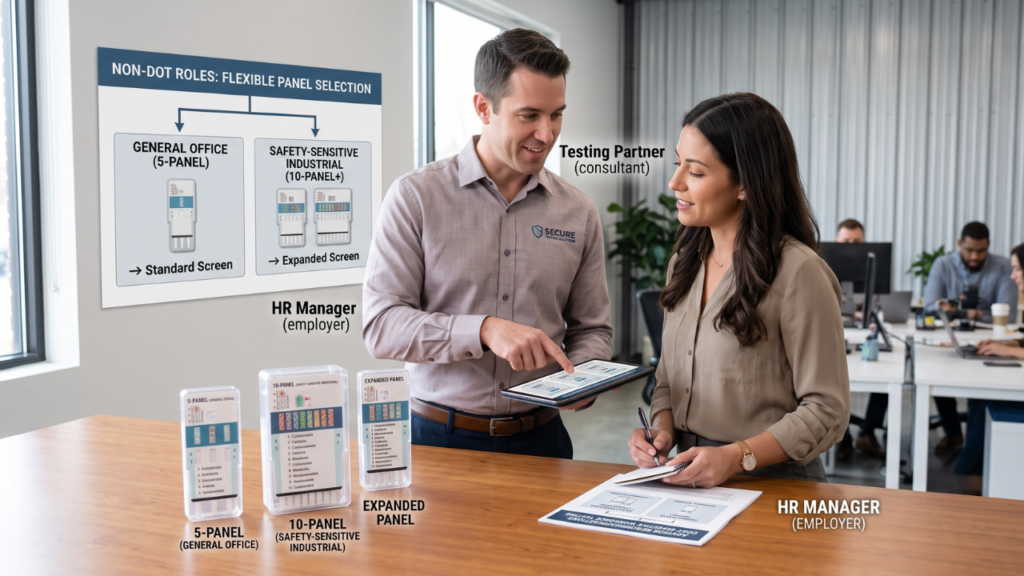
- 5-panel — the most common, screening for marijuana, cocaine, amphetamines, opioids, and PCP. This is the basis of the DOT panel.
- 10-panel — adds substances like benzodiazepines, barbiturates, methadone, and others, for a broader screen
- Expanded panels — some employers add testing for specific substances relevant to their industry, including certain prescription drugs and, increasingly, fentanyl
The DOT Panel
DOT testing uses a federally standardized panel (a 5-panel structure) with specific cutoff levels and procedures that can’t be modified. Employers don’t choose the DOT panel — it’s set by regulation.
Matching the Panel to the Role
For non-DOT roles, employers have flexibility to select the panel that fits. A general office environment might use a standard 5-panel, while a safety-sensitive industrial role might warrant a 10-panel or expanded screen. A testing partner can advise on what’s appropriate and cost-effective for your workforce.
Cannabis and NJ’s CREAMMA Law: What Changed
This is the section every New Jersey employer needs to understand, because cannabis is where the rules genuinely changed — and where the most confusion and legal risk live.
The Core Rule
Under New Jersey’s Cannabis Regulatory, Enforcement Assistance, and Marketplace Modernization Act (CREAMMA), which legalized adult recreational cannabis, employers cannot take adverse action against an employee solely because of the presence of cannabis metabolites in their system.In plain terms: a positive marijuana test, by itself, is generally not enough to fire, discipline, or refuse to hire someone.
Why a Positive Test Isn’t Enough
The reasoning comes down to how cannabis testing works. THC metabolites can remain detectable in the body for days or even weeks after use, long after any impairing effects have worn off. A standard positive test can’t distinguish between someone who used cannabis legally on their own time last weekend and someone impaired on the job today. Because New Jersey protects legal off-duty use, a test that can’t tell the difference isn’t sufficient grounds for action on its own.
The Impairment Requirement
To take adverse action related to cannabis, NJ employers generally need both a positive test and evidence of actual impairment at work. The law references a “Workplace Impairment Recognition Expert” (WIRE) — a trained individual who can document observable signs of impairment. Implementation of formal WIRE certification standards has been delayed and remains inconsistent, so in practice many employers rely on documented observations of impairment by trained supervisors alongside testing. This is an evolving area, which is exactly why professional legal guidance matters here.
What Employers Can Still Do With Cannabis
CREAMMA didn’t eliminate employer authority. Employers may still:
- Prohibit cannabis use and possession during work hours and on premises
- Prohibit employees from working while impaired
- Test after a workplace accident or on reasonable suspicion of impairment
- Maintain a drug-free workplace policy
- Take action based on documented on-the-job impairment
The Practical Approach in 2026
Because urine tests detect lingering metabolites, many NJ employers are shifting toward saliva testing (which better reflects recent use) paired with documented impairment observations. This combination aligns better with the impairment-focused standard the state emphasizes. The key takeaway: cannabis requires a different, more careful approach than any other substance — and your specific policy should be built with legal counsel.
Medical Marijuana and Accommodation
Beyond recreational cannabis, medical marijuana adds another layer employers should understand.
Protections for Medical Patients
New Jersey law, including the Compassionate Use Act (often called the Jake Honig Act), provides protections for registered medical cannabis patients against employment discrimination based on their patient status. Employers generally cannot refuse to hire or fire someone solely because they’re a registered medical marijuana patient.
The Accommodation Process
If an employee tests positive and is a registered medical patient, employers are typically required to give them an opportunity to explain the result, and to engage in a good-faith interactive process regarding reasonable accommodation. Importantly, this does not mean allowing impairment at work — employers still don’t have to permit on-the-job use or impairment, and safety-sensitive and federally regulated roles have different rules.
Where It Gets Complicated
Medical marijuana accommodation intersects with disability law and can get legally intricate quickly. Safety considerations, the specific role, federal requirements, and the individual circumstances all factor in. This is firmly in “consult an employment attorney” territory — the goal here is simply to know the obligation exists so you can seek proper guidance.
Building a Compliant Testing Policy
A well-built testing policy is your best protection — it keeps you compliant, defensible, and consistent. While the legal specifics belong with your attorney, here are the elements that generally matter.
Key Components of a Strong Policy
- Clear written policy distributed to all employees, outlining what’s tested, when, and the consequences
- Advance notice to applicants and employees before testing
- Consistent application across similar roles to avoid discrimination claims
- Proper documentation procedures, especially for reasonable-suspicion testing
- Confidential handling of results, stored securely and separately from personnel files
- A cannabis-specific approach that accounts for CREAMMA
- Clear DOT vs. non-DOT delineation for roles that fall under each
- A defined process for positive results, including any accommodation obligations
Keep It Current
New Jersey’s cannabis and employment landscape is still evolving — WIRE standards, court rulings like the Zanetich decision on private right of action, and potential legislative changes for safety-sensitive roles all mean the rules can shift. Review your policy periodically with legal counsel to keep it current.
The Role of Your Testing Provider
Your testing provider handles the operational side — accurate collection, proper chain of custody, reliable lab coordination, and timely results. The policy and legal decisions are yours (with your attorney); the testing execution is where a good occupational health partner earns its keep. A+ Urgent Care provides the testing services; pairing that with sound legal guidance gives you a complete, compliant program.
What to Look for in a Testing Partner
Choosing the right occupational health provider makes workplace testing smoother for everyone involved.
What Matters Most
- Convenience and location — accessible sites keep testing quick for your employees
- Fast turnaround — prompt results keep hiring and operations moving
- DOT-certified capability — essential if you have regulated drivers
- Range of methods and panels — flexibility to match tests to roles
- Proper procedures — reliable chain of custody and confidentiality
- Walk-in availability and good hours — minimizing employee downtime
- Additional occupational services — physicals, screenings, and injury care under one roof
The One-Stop Advantage
For many NJ employers, working with a provider that handles the full occupational health picture — drug and alcohol testing, DOT physicals, pre-employment physicals, and workers’ comp injury care — simplifies everything. One relationship, one set of locations, consistent procedures. It reduces administrative overhead and keeps your program coordinated.
Making It Easy for Employees
The easier testing is for your team — convenient locations, short waits, extended hours — the less it disrupts productivity. A provider with multiple accessible sites and walk-in availability means employees spend less time away from work. Both A+ Urgent Care locations are set up for efficient employer testing; you can reach them through the contact page to set up services.
Frequently Asked Questions
Can NJ employers still drug test employees?
Yes. New Jersey employers can conduct pre-employment, reasonable-suspicion, post-accident, and (for safety-sensitive and DOT roles) random testing. The state hasn’t banned workplace testing. The main change is around cannabis: a positive marijuana test alone generally can’t justify adverse action without evidence of impairment. Testing for other substances remains largely unrestricted.
Can NJ employers test for marijuana?
Yes, employers can test for marijuana, but they can’t take adverse action based on a positive cannabis result alone. Under CREAMMA, there generally must also be evidence of on-the-job impairment, documented by a trained individual. This makes cannabis different from other substances. DOT-regulated employees are the exception — federal rules apply, with no state cannabis protection.
What’s the difference between DOT and non-DOT drug testing?
DOT testing applies to federally regulated safety-sensitive roles (like commercial drivers) and follows strict federal rules — a standardized panel, certified labs, Medical Review Officers, and no cannabis protections. Non-DOT testing covers the general workforce, is governed by NJ state law (including CREAMMA cannabis protections), and gives employers more flexibility in panels and methods.
What types of drug tests can employers use?
Common methods include urine (most standard, used for DOT), oral fluid/saliva (increasingly favored in NJ for detecting recent use), hair (longer history, good for pre-employment), and breath testing for alcohol. Panels range from a standard 5-panel to expanded 10-panel and beyond. The right method and panel depend on the role and testing goal.
What is a reasonable suspicion drug test?
It’s a test triggered by specific, observable signs an employee may be impaired at work — slurred speech, unsteadiness, alcohol odor, or erratic behavior. It should always be supported by documentation: trained supervisors recording specific observations with dates and details. Proper documentation protects both the employer and employee and is especially important for cannabis-related suspicion.
Do NJ employers have to do post-accident testing?
For DOT-regulated roles, post-accident testing is federally required under specific circumstances. For non-DOT roles, it’s generally at the employer’s discretion as part of their policy, and should be tied to genuine possibility of impairment rather than used punitively. Post-accident testing also connects to workers’ compensation and liability considerations.
How does NJ’s cannabis law affect workplace testing?
Under CREAMMA, employers can’t take adverse action solely because of cannabis metabolites in an employee’s system — off-duty legal use is protected. Adverse action generally requires both a positive test and documented impairment at work. Employers can still prohibit use and impairment on the job and maintain a drug-free workplace. Many are shifting toward saliva testing to focus on recent use.
Are there exceptions to NJ’s cannabis protections?
Yes. DOT-regulated and other federally governed safety-sensitive positions follow federal rules, which don’t protect cannabis use. Federal contractors have carve-outs. And employers can always act on documented on-the-job impairment or use. The protections primarily cover off-duty, off-premises recreational use for non-regulated roles.
What is a WIRE and do I need one?
A Workplace Impairment Recognition Expert (WIRE) is a trained individual who can identify and document signs of cannabis impairment, referenced in NJ’s CREAMMA. Formal certification standards have been delayed and remain inconsistent, so many employers currently rely on documented impairment observations by trained supervisors. Because this is evolving, consult an employment attorney about your specific situation.
How should we handle a medical marijuana cardholder’s positive test?
New Jersey protects registered medical cannabis patients from discrimination based on patient status. If one tests positive, you’re generally expected to allow them to explain and to engage in a good-faith accommodation process — though you needn’t permit on-the-job impairment, and safety-sensitive/federal roles differ. This intersects with disability law and warrants guidance from an employment attorney.
How fast can employees get tested?
At A+ Urgent Care, employer drug and alcohol testing is available on a walk-in basis at both locations, typically with short wait times. Results turnaround depends on the test type and whether lab confirmation is needed. Setting up an account or arrangement in advance streamlines the process for your team.
Where can NJ businesses send employees for drug and alcohol testing?
A+ Urgent Care provides employer drug and alcohol testing, DOT and non-DOT, at both Bloomfield (Essex County) and Cresskill (Bergen County) locations, along with DOT physicals, pre-employment physicals, and occupational health screenings. Walk-in availability and extended hours minimize employee downtime. Contact either location to set up employer testing services.
Reliable Employer Testing in Bloomfield and Cresskill
Workplace drug and alcohol testing in New Jersey is entirely manageable once you understand the framework: employers keep broad authority to test, cannabis requires a distinct and more careful approach under CREAMMA, and DOT-regulated roles follow separate federal rules that override state protections. Getting the operational side right — reliable testing, proper procedures, fast results — while building your policy with sound legal guidance gives you a program that’s both effective and defensible.
For the testing itself, having a dependable local partner makes all the difference. Whether you need pre-employment screening, DOT testing for your drivers, reasonable-suspicion or post-accident testing, or a full occupational health program, walk-in availability and convenient locations keep your workforce moving and your business protected.
About A+ Urgent Care
A+ Urgent Care partners with New Jersey businesses to keep their workforce healthy, safe, and compliant. From two convenient locations in Bloomfield (Essex County) and Cresskill (Bergen County), open seven days a week, the team provides a full range of occupational health services: employer drug and alcohol testing, DOT and pre-employment physicals, occupational screenings, and workers’ comp injury care.
Led by Dr. Ajay Jetley, a board-certified emergency medicine physician with more than 15 years of experience, A+ Urgent Care makes workplace testing and occupational health straightforward for employers — with the convenience, speed, and reliability busy businesses need. Contact either location to set up employer services.