Washing produce helps — but with cyclospora, it isn’t a guarantee, because the parasite clings tightly and no rinse fully removes it. Learn which fruits and vegetables carry more risk, the produce-handling steps that actually …

Key Takeaways
- Washing produce lowers your cyclospora risk but doesn’t remove it — the parasite clings tightly, and no rinse, not even commercial produce washes, gets it all. Wash anyway, but don’t rely on it.
- Cooking is the only sure way to kill cyclospora. Heating produce to 158°F or higher destroys it, which is why every outbreak traces back to raw, never cooked.
- Some fruits and vegetables are higher-risk than others. Leafy greens, herbs, and soft berries are hard to wash and eaten raw; smooth, peeled, cooked, canned, or frozen options are safer.
Table of Contents
- Why Produce Safety Matters With Cyclospora
- The Hard Truth: Washing Isn’t Enough
- Why Cyclospora Is So Hard to Wash Off
- The One Method That Works Every Time
- Higher-Risk vs. Lower-Risk Produce
- How to Wash Produce the Right Way
- Whole Heads vs. Bagged: What to Buy
- Do Vinegar or Produce Washes Work?
- Kitchen Habits That Lower Your Risk
- What to Do During an Active Outbreak
- When to See a Doctor
- Frequently Asked Questions
- Get Care in Bloomfield and Cresskill
With cyclospora in the news and cases climbing across the country, a lot of families are looking at their salad bowls with new suspicion.
It’s a reasonable instinct — the parasite behind this outbreak spreads through contaminated fresh produce, and the foods most often involved are exactly the raw fruits, greens, and herbs we eat all summer. The natural question is: how do I keep my family safe without giving up fresh food entirely?
The answer involves a few things most people don’t know. The biggest one: washing produce, while genuinely worth doing, isn’t the reliable shield most of us assume it is.
Cyclospora is unusually sticky and unusually tough, and no amount of rinsing fully removes it. That sounds alarming, but it actually points toward a clear, practical set of steps that do lower your risk — and one that works every single time.
This guide covers which foods carry more risk, how to wash and handle produce properly, why cooking is your most powerful tool, and the kitchen habits that protect your whole family.
The goal isn’t to scare you off fresh produce, which remains an important part of a healthy diet — it’s to help you enjoy it more safely while this outbreak plays out. For the full picture on what cyclospora is and its symptoms, see our main guide to the cyclospora outbreak.
Why Produce Safety Matters With Cyclospora
Understanding why produce is the focus helps the prevention steps make sense.
Cyclospora Comes From Contaminated Food and Water
Cyclospora is a microscopic parasite that spreads when people consume food or water contaminated with it. In the United States, outbreaks are most often linked to fresh produce — foods that are typically eaten raw, so the parasite is never killed by cooking before it reaches your plate. The contamination happens upstream, in the field or in the water used to grow, irrigate, or process the produce, long before it arrives in your kitchen.
You Can’t See, Smell, or Taste It
Part of what makes cyclospora tricky is that contaminated produce looks, smells, and tastes completely normal. There’s no way to spot it. This is why prevention relies on safe handling habits rather than inspecting your food — you simply can’t tell by looking whether a given item carries the parasite.
The Timing Is Right for Extra Caution
Cyclospora infections cluster in the warmer months, which is also peak season for the raw produce most often involved. During an active outbreak like the one in 2026, taking a few extra precautions with fresh produce is a sensible, low-effort way to protect your household.
The Hard Truth: Washing Isn’t Enough
This is the single most important thing to understand, because it contradicts what most of us were taught about produce safety.
What the Experts Say
According to the CDC, thoroughly washing produce is important — but the agency and other health authorities are clear that washing may not fully remove cyclospora. The FDA notes that the parasite is difficult to eliminate, and that even chlorine-based produce washes used commercially are generally not effective against it. In short: a good rinse helps, but it is not a guarantee.
Why This Matters
A lot of people assume that a thorough wash makes any produce safe. With most surface dirt and some contaminants, that’s largely true. With cyclospora specifically, it isn’t. Believing a rinse fully protects you can create false confidence — which is exactly why it’s worth knowing the limits of washing and leaning on the other tools in this guide.
Wash Anyway
None of this means skip washing. Rinsing produce under running water still removes dirt, debris, and other contaminants, and it does reduce cyclospora even if it can’t eliminate it. Washing remains a worthwhile first step. It just shouldn’t be your only line of defense.
Why Cyclospora Is So Hard to Wash Off
The stickiness isn’t random — there’s a structural reason, and understanding it makes the prevention advice click.
It Has a Tough Protective Shell
Cyclospora spreads via a hardy form called an oocyst — essentially a tough-shelled structure that shields the parasite from physical and chemical attack. This shell is what lets it survive rinsing and resist the disinfectants that would kill many other germs. It’s built to endure.
It Clings to Surface Texture
Cyclospora oocysts are roughly 8 to 10 microns across — far too small to see — and they lodge in the microscopic crevices and texture of produce surfaces. Water flowing over the surface often isn’t enough to dislodge them from those tiny nooks. This is why produce with more surface texture is harder to clean than smooth produce.
The Practical Upshot
Because the parasite is both tough and sticky, the two things that actually give you certainty are heat (cooking) and choosing lower-risk foods. Washing helps at the margins; those two strategies do the heavy lifting. The rest of this guide is built around that reality.
The One Method That Works Every Time
Amid all the uncertainty about washing, there’s one reassuring, reliable fact.
Cooking Kills Cyclospora
Heat destroys the parasite. Cooking produce to an internal temperature of 158°F (70°C) or higher reliably kills cyclospora. This is the one method that works every time — and it’s why every documented cyclospora outbreak has traced back to raw produce, and never to cooked. If you can cook it, you can be confident it’s safe from this parasite.
How to Use This in Practice
You obviously won’t cook everything — a cooked strawberry isn’t most people’s idea of dessert. But during an active outbreak, it’s a useful rule of thumb: for the higher-risk items you’re able to cook, do. Sautéed greens instead of a raw salad, cooked vegetables in place of a raw platter, or simply favoring cooked dishes for a while are all easy ways to sidestep the risk entirely.
A Food Thermometer Helps
How long it takes to reach a safe temperature depends on your cooking method. A food thermometer takes the guesswork out, confirming you’ve hit 158°F or higher. For most normal cooking — sautéing, roasting, boiling, steaming until done — you’ll comfortably exceed that threshold.
Higher-Risk vs. Lower-Risk Produce
Not all produce carries the same risk. Knowing the difference lets you make smart choices without swearing off fresh food.
The Risk Comes Down to Texture and Preparation
Two things drive a food’s cyclospora risk: how easy it is to wash (texture), and whether it’s typically eaten raw. Textured, hard-to-wash foods eaten raw are higher-risk; smooth, peeled, or cooked foods are lower-risk.
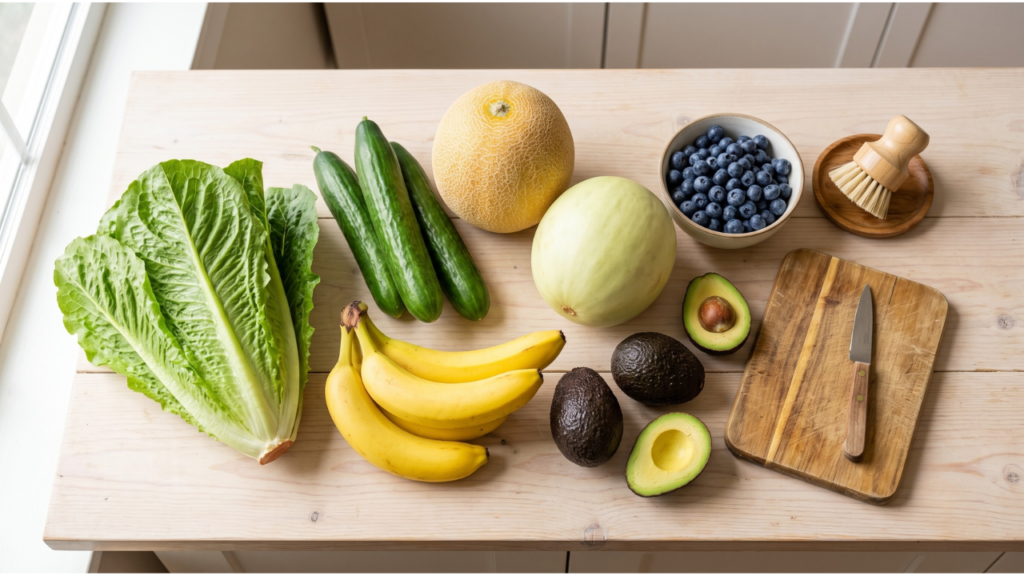
| Higher-Risk (textured, often raw) | Lower-Risk (smooth, peeled, cooked, or processed) |
| Fresh cilantro and basil | Bananas, avocados (peeled) |
| Raspberries and soft berries | Blueberries (smoother surface) |
| Leafy greens, mesclun, bagged salad | Melon flesh (after scrubbing the rind) |
| Snow peas and snap peas | Cooked vegetables |
| Pre-cut and pre-washed salad mixes | Canned fruits and vegetables |
| — | Frozen produce |
Why the Higher-Risk Foods Are Riskier
Food safety experts note that cyclospora oocysts attach easily to the hairlike projections on foods like raspberries and cilantro, and to the cut edges of leafy greens — all of which create tiny spaces for the parasite to lodge. Smooth surfaces like a blueberry’s give the parasite less to cling to. And anything with an outer covering you remove — a banana, an avocado, the outer leaves of a lettuce head — carries lower risk because you’re discarding the potentially contaminated surface.
Why Canned and Frozen Are Low-Risk
Canned produce is considered very low-risk because the canning process uses heat that kills parasites. Frozen produce is also lower-risk, since it’s typically processed and often cooked before eating. During an outbreak, these are genuinely smart swaps for higher-risk fresh items when you’re concerned.
How to Wash Produce the Right Way
Even though washing isn’t a guarantee, doing it properly still meaningfully reduces risk. Here’s the technique that helps most.
The Basic Method
- Wash your hands with soap and water first
- Rinse produce under plain, cool running water — no soap or detergent (produce is porous and can absorb residues)
- Rub or gently agitate the surface as you rinse
- Wash right before use, not before storing, to avoid promoting spoilage
The Better Method for Leafy Greens
For greens specifically, health experts suggest going beyond a quick rinse:
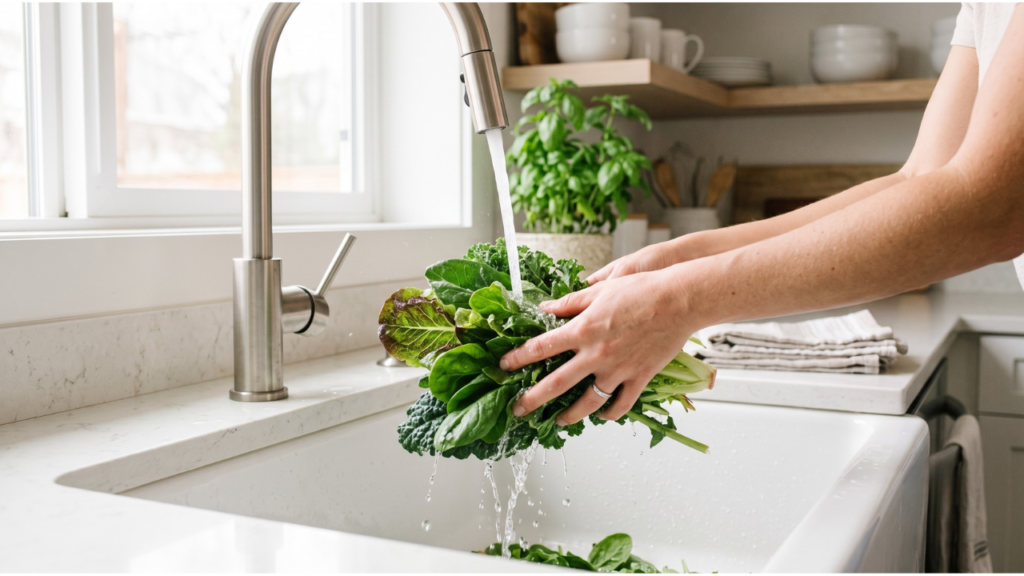
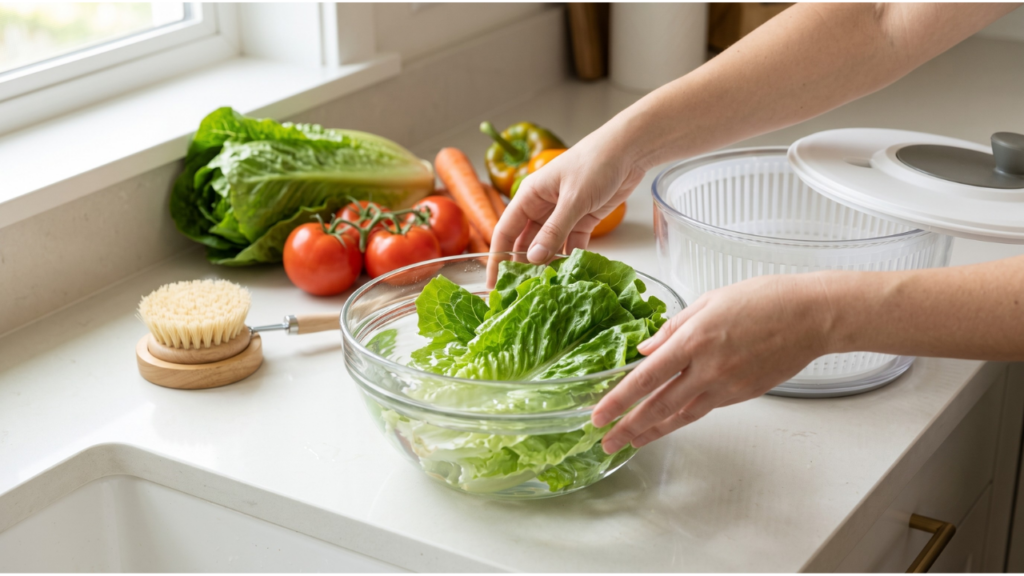
- Immerse the greens in a bowl of water and swish them gently by hand for at least a minute
- The bowl of a salad spinner works well for this
- Lift the greens out of the water rather than pouring the water back over them (so debris stays behind)
- Repeat with fresh water if needed
The immersion-and-swish approach dislodges more than water simply running over the surface.
For Firm Produce
- Scrub firm fruits and vegetables like melons, cucumbers, and squash with a clean produce brush while rinsing
- Keep the brush clean between uses
- Scrub the rind even if you won’t eat it — cutting through a contaminated rind can drag the parasite onto the flesh
Finish Up Safely
- Cut away any bruised or damaged areas with a clean knife
- Refrigerate cut, peeled, or cooked produce within two hours
Whole Heads vs. Bagged: What to Buy
One of the more specific pieces of outbreak guidance concerns how produce is packaged, and it’s worth understanding.
The Case for Whole Heads
Health officials during this outbreak have suggested buying whole heads of lettuce rather than pre-washed bagged lettuce or pre-mixed salad kits. The reasoning: in commercial washing facilities, the shared wash water can spread contamination across an entire batch of greens. A whole head you wash yourself gives you more control over its handling.
The Technique
If you buy whole heads:
- Discard the outer leaves, which are most exposed to contamination
- Wash the inner leaves thoroughly at home using the immersion method
- Don’t assume the inner leaves are automatically safe — still wash them
A Note on “Pre-Washed” Labels
There’s some nuance here. General guidance has long held that “pre-washed” bagged greens don’t strictly need re-washing. But during an active cyclospora outbreak, many health officials lean toward whole heads precisely because “pre-washed” doesn’t guarantee freedom from this particular parasite, and re-washing bagged greens is unlikely to remove it anyway. During an outbreak, favoring whole produce you prepare yourself is the more cautious choice.
Do Vinegar or Produce Washes Work?
A common question, since many people reach for these — but the honest answer is no.
Commercial Produce Washes
There’s no strong evidence that commercial produce washes reliably remove or neutralize cyclospora. The parasite’s tough oocyst shell resists many common disinfectants, and even the chlorine-based washes used in commercial settings aren’t proven effective against it. Save your money and stick with plain running water.
Vinegar and Soap
Similarly, vinegar solutions aren’t proven to reliably kill or remove cyclospora. And soap or detergent is specifically discouraged — the FDA advises washing produce with plain water only, because produce is porous and can absorb soap residues, which can cause their own digestive upset.
What This Leaves You With
The bottom line on special washes: they don’t add reliable protection against cyclospora, and some create new problems. Your genuinely effective tools remain plain-water washing (to reduce risk), cooking (to eliminate it), and smart food choices. Simplicity wins here.
Kitchen Habits That Lower Your Risk
Beyond washing individual items, a few general kitchen practices reduce your family’s overall risk of cyclospora and other foodborne illnesses.
Prevent Cross-Contamination
- Wash hands with soap and water before and after handling fresh produce
- Use clean cutting boards and utensils, and separate ones for produce versus raw meat
- Wash and sanitize surfaces that come into contact with fresh produce
- Clean the produce brush and salad spinner regularly
Store Produce Properly
- Refrigerate cut, peeled, or cooked produce within two hours
- Keep produce separate from raw meat and its juices in the fridge
- Wash and sanitize refrigerator drawers where produce is stored periodically
General Food Safety
These habits align with the standard food-safety principles — clean, separate, cook, and chill — that protect against a wide range of foodborne illnesses, not just cyclospora. Good kitchen hygiene is a year-round protection that pays off well beyond any single outbreak.
What to Do During an Active Outbreak
When an outbreak is underway and the source hasn’t been pinned down, a few extra precautions make sense.
Sensible Extra Steps
- Cook higher-risk produce when you reasonably can
- Favor lower-risk options — smooth, peeled, canned, or frozen — for a while
- Choose whole produce you prepare yourself over pre-cut and pre-washed
- Be cautious with raw salad bars and pre-made deli salads, where handling is out of your control
- Consider skipping the hardest-to-wash items (like fresh herbs and soft berries) temporarily, or cooking them
Watch for Recalls and Advisories
Because the outbreak source may eventually be identified, keep an eye on public health advisories from the CDC and FDA. If a specific product is named and you have it at home, discard it immediately — even if it looks fresh and even if you’ve already eaten some without getting sick.
Don’t Overcorrect
Here’s the balance: you don’t need to stop eating fruits and vegetables, which are important for your health, and the risk to any one person remains relatively low. The goal is reasonable caution — wash, cook when you can, choose wisely, and stay informed — not fear. A measured approach protects your family without sacrificing good nutrition.
When to See a Doctor
Even with careful prevention, infections happen. Knowing when to seek care is part of protecting your family.
Get Evaluated If You Have:
- Watery diarrhea lasting more than 48 hours, especially during an outbreak
- Diarrhea that improved and then came back (cyclospora’s characteristic relapsing pattern)
- Diarrhea with significant appetite loss, weight loss, and fatigue
- Prolonged digestive symptoms you’d otherwise wait out
Because cyclospora requires a specifically requested test and a specific antibiotic to treat, these situations warrant a visit rather than waiting it out. Our main cyclospora guide covers the symptoms and treatment in detail.
Watch for Dehydration
The main risk with any prolonged diarrheal illness is dehydration. Seek care promptly for excessive thirst, reduced or dark urine, dizziness, or weakness — and in children, no wet diapers, no tears, or unusual lethargy. Our guide on when dehydration becomes an emergency covers the warning signs and when IV fluids may be needed.
Extra Caution for Higher-Risk Groups
Older adults, young children, pregnant women, and people with weakened immune systems should be especially attentive and seek care sooner. For pregnant women in particular, both the illness and its treatment carry considerations worth discussing with a provider, which is one more reason prevention matters most for this group. For evaluation and treatment, A+ Urgent Care provides same-day walk-in care at both locations.
Frequently Asked Questions
Does washing produce remove cyclospora?
Washing reduces cyclospora but doesn’t reliably remove it. The parasite’s tough shell and its tendency to cling to produce surface texture mean that even careful rinsing — and even commercial chlorine washes — can’t fully eliminate it. Washing is still worth doing to reduce risk and remove other contaminants, but it shouldn’t be your only protection. Cooking is the only sure method.
Does cooking kill cyclospora?
Yes. Cooking produce to an internal temperature of 158°F (70°C) or higher reliably kills cyclospora. This is the one method that works every time, which is why every documented outbreak has traced to raw produce and never cooked. For higher-risk items you’re able to cook during an outbreak, cooking eliminates the risk entirely.
What foods are linked to cyclospora?
Historically, cyclospora outbreaks have been linked to fresh produce eaten raw, including leafy greens, bagged salads, fresh herbs like cilantro and basil, raspberries and other soft berries, and snow or snap peas. These are harder to wash and often eaten uncooked. Note that in any given outbreak, no food is confirmed as the source until investigators identify it.
Can vinegar or a produce wash kill cyclospora?
No. There’s no strong evidence that vinegar, soap, or commercial produce washes reliably remove or kill cyclospora — its tough oocyst shell resists common disinfectants, including the chlorine washes used commercially. The FDA recommends washing with plain cool running water and no soap, since produce is porous and can absorb residues. Cooking is the reliable method.
Which fruits and vegetables are safest during a cyclospora outbreak?
Lower-risk options include smooth-surfaced produce like blueberries, peeled items like bananas and avocados, cooked vegetables, and canned or frozen produce (which are heat-processed). Higher-risk foods are textured and usually eaten raw — leafy greens, fresh herbs, raspberries, and snap peas. No fresh produce is completely risk-free, but these lower-risk choices reduce exposure.
Should I stop eating salads and fresh produce?
No. Fresh produce is important for your health, and the risk to any one person is relatively low. Instead of avoiding produce, take precautions: wash thoroughly, cook higher-risk items when you can, favor whole produce you prepare yourself, choose lower-risk options during an outbreak, and follow any recalls. Reasonable caution beats cutting out fruits and vegetables.
How should I wash lettuce to prevent cyclospora?
For leafy greens, immerse them in a bowl of water and swish gently by hand for at least a minute — the bowl of a salad spinner works well — then lift the greens out rather than pouring the water back over them. Buying whole heads, discarding the outer leaves, and washing the inner leaves at home is more protective than relying on pre-washed bagged greens.
Is bagged, pre-washed lettuce safe during the outbreak?
“Pre-washed” doesn’t guarantee freedom from cyclospora, and re-washing bagged greens is unlikely to remove the parasite. Commercial wash water can also spread contamination across a batch. During an active outbreak, many health officials lean toward buying whole heads of lettuce, discarding the outer leaves, and washing the inner leaves yourself, rather than relying on bagged, pre-washed products.
Are frozen and canned vegetables safe from cyclospora?
Yes, these are considered low-risk. Canned produce is heat-processed during canning, which kills parasites, and frozen produce is typically processed and often cooked before eating. During an outbreak, canned and frozen options are genuinely smart swaps for higher-risk fresh items when you’re concerned about exposure.
How long after eating contaminated produce would I get sick?
Cyclospora symptoms typically begin about a week after exposure, though onset can range from 2 to 14 days. This long, variable window is part of why the illness is hard to trace — by the time you’re sick, the meal that caused it may be hard to recall. Watery diarrhea is the hallmark symptom.
When should I see a doctor after possible cyclospora exposure?
See a provider if you develop watery diarrhea lasting more than 48 hours, diarrhea that improves and relapses, or diarrhea with significant appetite loss, weight loss, and fatigue — especially during an outbreak. Cyclospora needs a specifically requested test and specific antibiotic treatment, so these symptoms warrant evaluation rather than waiting it out.
Where can I get tested and treated in NJ?
A+ Urgent Care provides walk-in evaluation for prolonged diarrheal illness at both Bloomfield (Essex County) and Cresskill (Bergen County) locations, seven days a week. Providers can assess symptoms, arrange appropriate stool testing, prescribe treatment, and manage dehydration with IV fluids if needed. For persistent or relapsing diarrhea, walking in gets you the right test and treatment.
Get Care in Bloomfield and Cresskill
Protecting your family from cyclospora comes down to a few practical truths: washing helps but isn’t foolproof, cooking is your one sure defense, and some foods are simply lower-risk than others. Put those together — wash everything well, cook higher-risk produce when you can, favor whole and lower-risk options during an outbreak, and keep good kitchen habits — and you’ve meaningfully lowered your family’s risk without giving up the fresh food that keeps everyone healthy.
And if someone does come down with the prolonged, watery diarrhea that cyclospora is known for, don’t just wait it out. Walk in for evaluation, get the right test and treatment, and stay ahead of dehydration. A little prevention plus prompt care when it’s needed is the winning combination this outbreak season.
About A+ Urgent Care
A+ Urgent Care provides walk-in medical care for families across Essex and Bergen counties, with locations in Bloomfield and Cresskill open seven days a week, including evenings and weekends. From stomach illnesses and dehydration to infections and injuries, the team provides same-day evaluation and treatment — including stool testing and on-site IV fluids — through a full range of services. Led by Dr. Ajay Jetley, a board-certified emergency medicine physician with more than 15 years of experience, A+ Urgent Care gets patients diagnosed, treated, and on the mend quickly. No appointment necessary; walk in during operating hours, and for any medical emergency, call 911.