Most poison ivy rashes clear up on their own with home care, but some need prescription treatment to prevent weeks of misery. Learn how to tell the difference, what actually stops the itching, and when …

Key Takeaways
- Most cases of poison ivy rash can be treated at home with cool compresses, calamine lotion, and over-the-counter hydrocortisone — but a rash that spreads widely, covers the face or genitals, or shows signs of infection needs medical care.
- The itching and blisters come from urushiol, an oily resin in the plant. Once you wash it off your skin, the rash itself does not spread from scratching or from the fluid inside blisters — a common myth that causes unnecessary panic.
- Urgent care can prescribe oral steroids like prednisone that drugstore products can’t match. For severe or widespread reactions, this prescription often means the difference between a few days of discomfort and three weeks of misery.
Table of Contents
- What Causes a Poison Ivy Rash?
- How Long Does a Poison Ivy Rash Last?
- How to Treat Poison Ivy at Home
- Does Poison Ivy Spread by Scratching?
- When Does Poison Ivy Need Medical Treatment?
- Can Urgent Care Prescribe Steroids for Poison Ivy?
- What Does an Infected Poison Ivy Rash Look Like?
- When Is a Poison Ivy Rash an Emergency?
- Identifying Poison Ivy, Oak, and Sumac in New Jersey
- Frequently Asked Questions
- Get Fast Poison Ivy Relief in Bloomfield and Cresskill
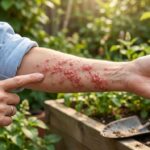
A weekend of yard work, a hike through the woods, or an afternoon clearing brush — and a day or two later, the itching starts. Then the redness. Then those telltale streaky blisters that seem to show up wherever the plant brushed against your skin. If you’ve tangled with poison ivy before, you know the routine.
The question most people face isn’t whether they have poison ivy. It’s what to do about it. Can you ride it out with calamine lotion and willpower, or is this the kind of rash that needs a prescription? Getting that answer right matters more than people think.
A mild case treated at home heals fine on its own. A severe case left to drugstore remedies can mean weeks of relentless itching, sleepless nights, and a rash that keeps you out of work.
Most poison ivy reactions land somewhere in the manageable middle. Below, we walk through what actually works at home, the warning signs that mean it’s time to see a provider, and why a quick walk-in visit for poison ivy treatment Bloomfield NJ residents trust can shorten the whole ordeal considerably.
The goal is simple: help you tell the difference between a rash you can handle yourself and one that needs more firepower.
What Causes a Poison Ivy Rash?
The rash isn’t caused by the plant touching your skin, exactly. It’s caused by a specific chemical the plant produces — and understanding that chemical explains nearly everything about how the rash behaves.
Poison ivy, poison oak, and poison sumac all contain urushiol, an oily resin found in the leaves, stems, and roots. When urushiol contacts skin, the immune system treats it as a threat and mounts an allergic response.
The medical name for the resulting rash is allergic contact dermatitis.
Why the Reaction Is Delayed
One thing that confuses people: the rash doesn’t appear immediately. Urushiol triggers a delayed hypersensitivity reaction, which means symptoms typically show up 12 to 72 hours after exposure. For some people it takes even longer — up to a week or two on the first-ever exposure.
This delay is why many patients can’t pinpoint when they got it. The Saturday gardening session feels like ancient history by the time the Monday rash appears.
Not Everyone Reacts the Same Way
Sensitivity to urushiol varies widely from person to person:
- About 85% of people develop an allergic reaction to urushiol with enough exposure
- Roughly 15% appear to be resistant, though sensitivity can develop over time
- Reactions often get stronger with repeated exposures — your second or third encounter may be worse than your first
- People who never reacted as children can suddenly develop sensitivity as adults
The amount of urushiol matters too. A light brush against a single leaf produces a milder reaction than crawling through a patch while clearing brush. Urushiol is also remarkably potent — an amount smaller than a grain of salt can trigger a rash in sensitive people.
How Urushiol Lingers
Urushiol is stubborn. It can remain active on surfaces for months or even years. This is why people get poison ivy without ever touching a plant directly — the oil transfers from contaminated tools, gloves, pet fur, or clothing. A dog that runs through a patch can carry urushiol home on its coat and pass it to anyone who pets it.
How Long Does a Poison Ivy Rash Last?
This is usually the first question patients ask, and the answer depends heavily on severity and how it’s treated.
Typical Timeline
For most uncomplicated cases:
- Days 1-3: Initial redness, itching, and swelling appear at contact sites
- Days 4-7: Blisters form, may ooze clear fluid, itching peaks
- Week 2: Blisters begin drying and crusting over
- Weeks 2-3: Rash gradually fades, skin heals
A mild to moderate poison ivy rash generally runs its course in 1-3 weeks, even without treatment. The rash isn’t dangerous in most cases — it’s just intensely uncomfortable.
Why Some Cases Last Longer
Several factors stretch the timeline:
- Severity of the reaction — larger, more intense rashes take longer to resolve
- Continued exposure — re-contact with contaminated items restarts the clock
- Scratching and secondary infection — broken skin that gets infected heals slower
- Individual healing rate — varies by age, health, and immune status
How Treatment Changes the Timeline
Here’s where medical care makes a real difference. Severe rashes treated with oral steroids often improve dramatically within a few days, with the worst itching subsiding quickly. Without that intervention, a severe reaction can drag on for the full three weeks at peak intensity. The prescription doesn’t just speed healing — it makes the waiting bearable.
For mild cases, home treatment shortens the misery without changing the overall timeline much. For severe cases, prescription treatment can cut both the intensity and the duration significantly.
How to Treat Poison Ivy at Home
For mild to moderate cases, home treatment is often all you need. The strategy is twofold: remove any remaining urushiol, then manage the itching and inflammation while your skin heals.
First Step: Wash Off the Urushiol
If you realize you’ve been exposed, wash the area as soon as possible — ideally within 10-30 minutes, though washing even hours later still helps:
- Use soap and cool water — hot water opens pores and can spread the oil
- Scrub gently but thoroughly, including under fingernails
- Wash for at least a couple of minutes to break up the oily resin
- Specialized products like Tecnu or Zanfel are formulated to remove urushiol and can help if used early
Wash anything that might be contaminated: clothing, shoes, gardening tools, phone, car steering wheel, and your pet if it was outdoors with you. Urushiol on these surfaces can re-expose you days later.
Managing the Itch and Inflammation
Once the rash develops, these measures help control symptoms:
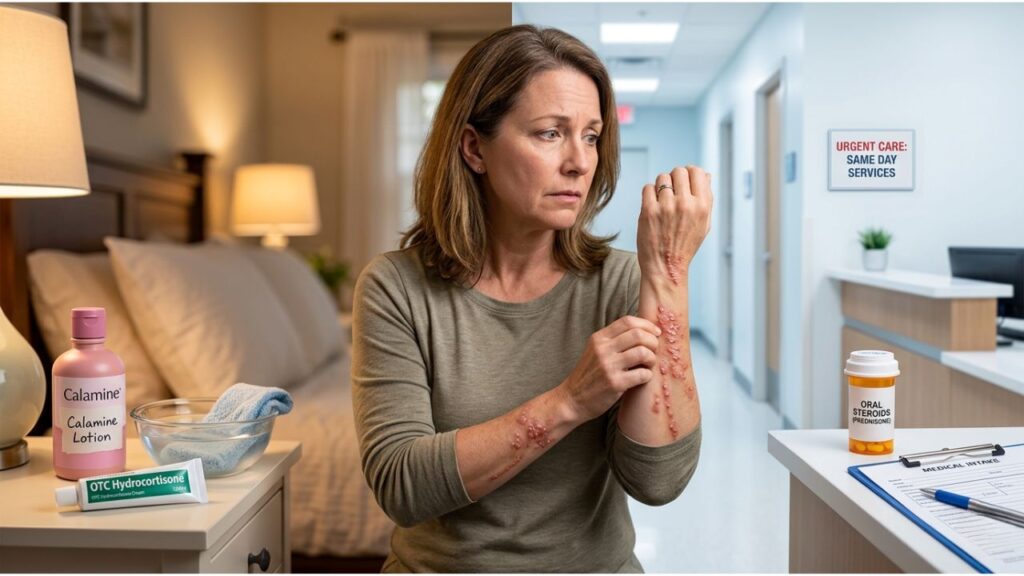
- Cool compresses — a cold, damp cloth applied for 15-30 minutes several times a day calms itching and inflammation
- Calamine lotion — soothes itching and helps dry oozing blisters
- Over-the-counter hydrocortisone cream (1%) — reduces inflammation, most effective early before blisters form
- Oral antihistamines — diphenhydramine (Benadryl) can help with itching and aids sleep; non-drowsy options like loratadine work during the day
- Colloidal oatmeal baths — products like Aveeno provide widespread relief for larger rashes
- Cool baths with baking soda — an inexpensive alternative for soothing irritated skin
What to Avoid
A few common mistakes make things worse:
- Don’t use hot water on the rash — heat intensifies itching
- Don’t apply topical antihistamine creams (like topical Benadryl) — they can cause their own allergic reaction
- Don’t break blisters open — intact blisters protect healing skin and reduce infection risk
- Don’t scratch — even though the rash won’t spread, scratching breaks skin and invites bacterial infection
If home treatment keeps your symptoms tolerable and the rash stays contained, you can usually let it run its course. The moment it stops being manageable is the moment to consider a clinic visit.
Does Poison Ivy Spread by Scratching?
This is one of the most persistent myths about poison ivy, and clearing it up relieves a lot of unnecessary worry.
The Short Answer
No. Once urushiol has been washed off your skin, the rash does not spread from scratching, and it does not spread through the fluid inside blisters. The blister fluid contains no urushiol — it’s just your body’s inflammatory response. You cannot give the rash to yourself or anyone else by touching it at that point.
Why It Looks Like It’s Spreading
If the rash doesn’t spread, why does it seem to appear in new spots days apart? A few reasons explain the illusion:
- Different skin areas absorb urushiol at different rates — thinner skin (forearms, ankles) reacts faster than thicker skin (palms, soles), so rashes appear staggered
- Varying amounts of urushiol landed on different body parts, producing reactions at different times
- Delayed reaction timing means some contact sites simply take longer to flare
- Re-exposure from contaminated clothing, tools, or pets causes genuinely new rashes that get blamed on “spreading”
So the rash that shows up on your arm Tuesday and your leg Thursday isn’t spreading — both spots were exposed at the same time and reacted on different schedules.
The Real Risk of Scratching
While scratching won’t spread the rash, it causes a different problem: bacterial infection. Fingernails carry bacteria, and broken skin gives those bacteria an entry point. A scratched-open poison ivy rash can develop a secondary skin infection that does require antibiotics — turning a self-limiting nuisance into a medical issue.
When Does Poison Ivy Need Medical Treatment?
Knowing when to stop toughing it out and see a provider saves you days of unnecessary suffering. Several scenarios warrant a walk-in visit.
Widespread or Severe Rashes
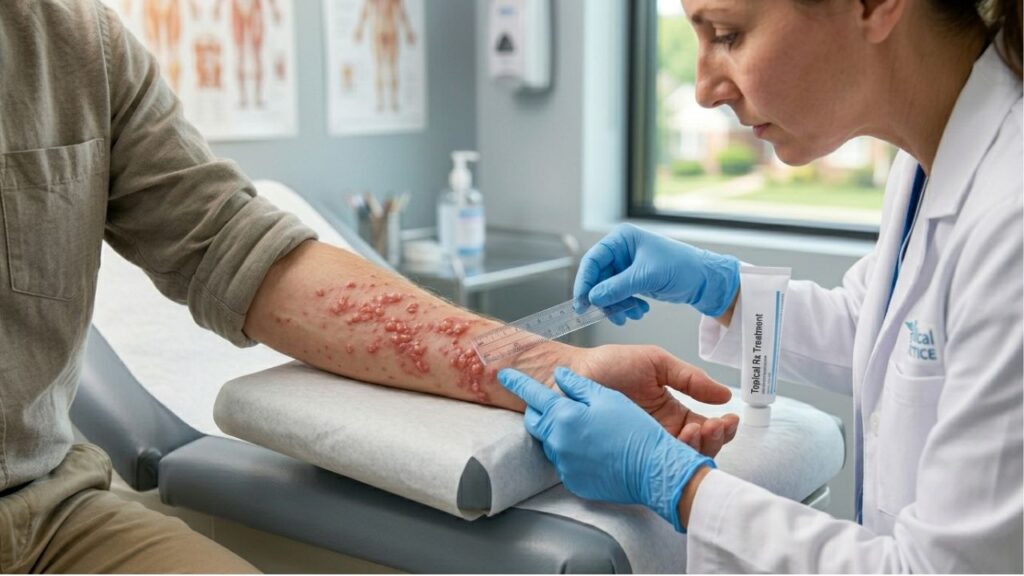
When the rash covers a large portion of your body — generally more than 10-15% of your skin, or roughly the area of your arm — home treatment often isn’t enough. Widespread reactions tend to be intensely itchy, disrupt sleep, and respond much better to prescription oral steroids than to topical products that can only treat one patch at a time.
Rashes on Sensitive Areas
Poison ivy on certain body parts deserves prompt medical attention regardless of size:
- Face and eyes — swelling near the eyes can affect vision and is uncomfortable and visible
- Genitals — extremely uncomfortable and difficult to treat with topical products
- Mouth or throat — rare, but serious; usually from burning poison ivy and inhaling the smoke
Rashes That Won’t Improve
If your rash shows no improvement after 7-10 days of diligent home care, or if it keeps getting worse rather than better, a provider visit makes sense. Persistent rashes may need prescription-strength treatment or may signal a complication like infection.
Signs of Infection
Any indication that the rash has become infected — increasing redness, warmth, pus, red streaks, or fever — needs prompt evaluation. We cover the specific warning signs in detail below.
The Quality-of-Life Factor
Sometimes the rash isn’t dangerous, but it’s making your life miserable. If the itching is keeping you up at night, interfering with work, or simply unbearable, that’s reason enough to seek treatment. You don’t have to white-knuckle your way through three weeks of misery when a prescription can provide relief in days. For walk-in clinic Essex County and walk-in clinic Bergen County residents, fast relief is often a short drive away.
Can Urgent Care Prescribe Steroids for Poison Ivy?
Yes — and this is one of the biggest reasons to choose urgent care over the drugstore aisle for a serious reaction. Prescription steroids are the single most effective treatment for moderate to severe poison ivy, and they require a clinician.
Oral Steroids (Prednisone)
For widespread or severe rashes, providers often prescribe a course of oral corticosteroids, usually prednisone. These work by calming the overactive immune response throughout the body — not just on one patch of skin.
A few important points about oral steroids for poison ivy:
- The course usually runs 10-21 days, often with a tapering dose
- Shorter courses (the standard 6-day dose packs) frequently aren’t enough — poison ivy tends to rebound when steroids stop too soon, which is why longer tapers work better
- Relief often begins within 24-48 hours, with significant improvement in itching and swelling
- A provider determines the right dose and duration based on severity and your medical history
Prescription Topical Steroids
For rashes that are significant but not widespread, a prescription-strength topical steroid (much stronger than over-the-counter hydrocortisone) may be enough.
These high-potency creams reduce inflammation in targeted areas without the systemic effects of oral steroids.
Other Treatments Urgent Care Can Provide
A walk-in visit can also address related needs:
- Steroid injections for fast relief in severe cases
- Antibiotics if the rash has become secondarily infected
- Prescription antihistamines for severe itching
- Guidance on proper wound care to prevent infection and scarring
Why Not Just Use Drugstore Products?
Over-the-counter options — calamine, 1% hydrocortisone, oral antihistamines — work well for mild cases. But, they simply aren’t strong enough for severe reactions.
A widespread rash covering your arms, legs, and torso won’t respond meaningfully to a tube of hydrocortisone cream. That’s the gap prescription treatment fills.
For severe poison ivy treatment Cresskill and Bloomfield residents need, A+ Urgent Care provides medications that aren’t available on store shelves, without the wait or cost of an emergency room.
What Does an Infected Poison Ivy Rash Look Like?
A secondary bacterial infection is the most common complication of poison ivy, almost always from scratching. Recognizing the signs early prevents a minor infection from becoming a serious one.
Warning Signs of Infection
Watch for these changes, which suggest bacteria have entered the broken skin:
- Increasing redness that expands beyond the original rash borders
- Warmth radiating from the affected area
- Pus or yellowish drainage from blisters or sores (clear fluid is normal; cloudy or yellow is not)
- Yellow or honey-colored crusting over the rash
- Increasing pain rather than the usual itching
- Red streaks extending outward from the rash
- Swollen lymph nodes near the affected area
- Fever or chills
Why Infection Happens
Poison ivy itches relentlessly, and scratching is hard to resist — especially during sleep, when you may scratch without realizing it.
Fingernails harbor bacteria like Staphylococcus and Streptococcus. When you scratch through a blister, those bacteria get introduced into the open wound, and an infection can take hold within a day or two.
What Infection Requires
A secondary skin infection typically needs antibiotics, either topical or oral depending on severity. Red streaks extending from the rash are particularly concerning — they can indicate the infection is spreading through the lymphatic system (lymphangitis) and need prompt medical attention. Don’t wait on signs of infection; this is a clear reason to walk into a clinic.
When Is a Poison Ivy Rash an Emergency?
Most poison ivy is uncomfortable but not dangerous. A small number of situations are genuine emergencies that warrant the ER rather than urgent care.
Go to the ER If You Experience:
- Difficulty breathing or swallowing — this can indicate a severe reaction, especially after inhaling smoke from burning poison ivy
- Swelling of the face, mouth, or throat that affects breathing
- Widespread swelling, particularly around the eyes that swells them shut
- Signs of a severe allergic reaction (anaphylaxis) — though rare with poison ivy, this includes dizziness, rapid heartbeat, and trouble breathing
- High fever with a spreading infection and feeling systemically ill
- Extensive rash covering most of the body with severe symptoms
Warning: Never Burn Poison Ivy, Oak or Sumac!
One scenario deserves special mention: never burn poison ivy, poison oak, or poison sumac.
Burning releases urushiol into the air attached to smoke particles.
Inhaling this smoke can cause a severe reaction in the lungs and airways — a true medical emergency that requires immediate care.
If you’ve inhaled smoke from burning brush and develop breathing difficulty, treat it as an emergency and head to the ER immediately!
When Urgent Care Is the Right Call Instead
For the vast majority of poison ivy cases — even severe, widespread, miserable ones — urgent care is the appropriate level of care.
A rash that’s intensely itchy, covers a large area, appears on your face, or shows early signs of infection can all be handled efficiently at a walk-in clinic. The ER is reserved for the rare cases involving breathing difficulty or true systemic allergic reactions.
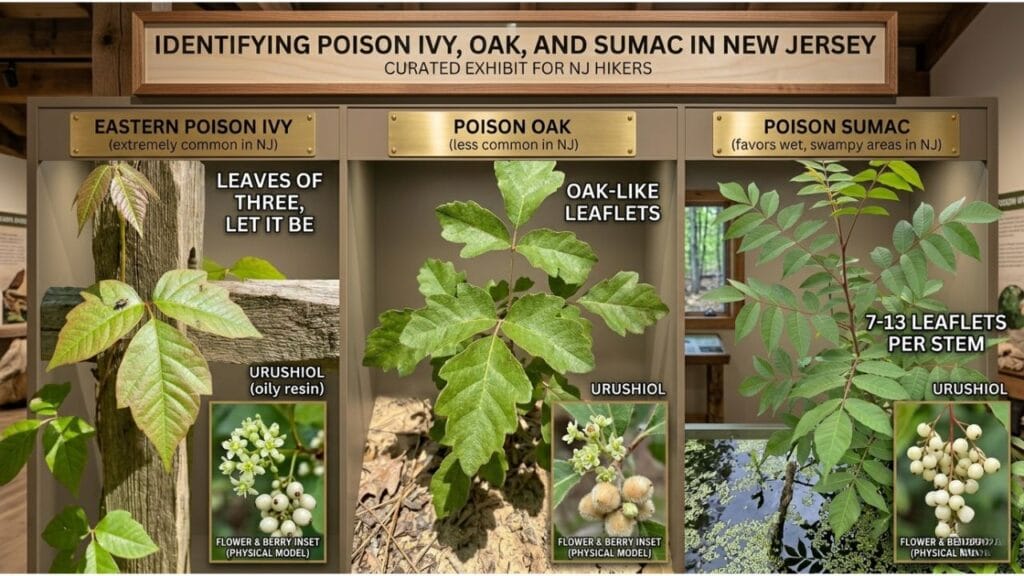
Identifying Poison Ivy, Oak, and Sumac in New Jersey
Prevention beats treatment every time. Knowing what these plants look like helps you avoid the rash in the first place — particularly relevant in New Jersey, where all three grow.
Poison Ivy
The most common culprit in our area. Remember the old saying: “Leaves of three, let it be.” Key features:
- Three leaflets per cluster, with the middle leaflet on a longer stalk
- Leaf edges that can be smooth, toothed, or lobed
- Color that shifts seasonally — reddish in spring, green in summer, red/orange in fall
- Growth habit as a low ground plant, a shrub, or a climbing vine with hairy-looking aerial roots
- Berries that are greenish-white when present
Poison Sumac
Less common but more potent, found in wet, swampy areas of New Jersey:
- 7-13 leaflets arranged in pairs along a central stem
- Smooth-edged leaves with a reddish stem
- Grows as a shrub or small tree, typically in wetlands
Poison Oak
Less common in New Jersey than poison ivy but worth recognizing:
- Leaves of three, similar to poison ivy but with lobed, oak-like edges
- Grows as a shrub or vine
Prevention Tips
When spending time outdoors in NJ:
- Wear long sleeves, long pants, and gloves when gardening, hiking, or clearing brush
- Learn to spot the plants before working in overgrown areas
- Wash up promptly after potential exposure, including tools and clothing
- Apply a barrier cream containing bentoquatam before known exposure
- Keep pets leashed on trails so they don’t carry urushiol home on their fur
Frequently Asked Questions
How long does poison ivy take to show up after exposure?
The rash typically appears 12 to 72 hours after contact with urushiol, though it can take up to a week or two on a first-ever exposure. This delay is why many people struggle to identify when and where they encountered the plant.
Is poison ivy contagious?
No. The rash cannot spread from person to person. Only urushiol — the plant’s oily resin — causes the reaction. If urushiol remains on someone’s skin or clothing, it can transfer and cause a reaction in another person, but the rash itself and the blister fluid are not contagious.
Can I get poison ivy without touching the plant?
Yes. Urushiol transfers easily from contaminated objects — gardening tools, gloves, clothing, shoes, and pet fur. The oil stays active for months or even years on surfaces.
Many people develop poison ivy after petting a dog that ran through a patch or handling tools used in an overgrown area.
How long does a poison ivy rash last?
Mild to moderate cases generally last 1-3 weeks, even without treatment. Severe cases can last longer, especially if complicated by infection or continued exposure.
Prescription oral steroids can significantly shorten both the duration and intensity of a severe reaction.
Will scratching make my poison ivy spread?
No. Once urushiol is washed off, scratching won’t spread the rash, and the blister fluid contains no urushiol. However, scratching can introduce bacteria into broken skin and cause a secondary infection that requires antibiotics, so it’s still best avoided.
When should I see a doctor for poison ivy?
Seek medical care if the rash covers a large area of your body, appears on your face or genitals, shows signs of infection (increasing redness, pus, warmth, fever), doesn’t improve after 7-10 days, or makes you so uncomfortable that home remedies aren’t cutting it. Urgent care can provide prescription treatment that drugstore products can’t match.
Can urgent care give me a steroid shot for poison ivy?
Yes. For severe reactions, urgent care providers can administer steroid injections for fast relief, prescribe oral steroids like prednisone, or provide prescription-strength topical steroids — none of which are available over the counter.
A+ Urgent Care evaluates the severity and recommends the appropriate treatment.
What’s the fastest way to get rid of poison ivy?
For mild cases, prompt washing plus consistent home care (cool compresses, calamine, hydrocortisone, antihistamines) manages symptoms while the rash heals.
For moderate to severe cases, prescription oral steroids are the fastest path to relief, often improving symptoms within 24-48 hours. There’s no instant cure, but proper treatment dramatically shortens the misery.
Where can I get same-day poison ivy treatment in Northern NJ?
A+ Urgent Care offers walk-in evaluation and same-day treatment at both Bloomfield (Essex County) and Cresskill (Bergen County) locations. Most patients are seen within 15-45 minutes and leave with a prescription sent electronically to their pharmacy. No appointment needed.
Get Fast Poison Ivy Relief in Bloomfield and Cresskill
A poison ivy rash doesn’t have to control your week. Mild cases respond well to washing, cool compresses, and over-the-counter products — and if that’s keeping you comfortable, you can let the rash heal on its own.
But when the rash spreads across your body, lands on your face, shows signs of infection, or simply itches beyond what you can stand, you don’t have to wait it out. Prescription treatment can bring relief in a day or two instead of dragging on for weeks.
If your poison ivy rash is getting worse, spreading, or keeping you up at night, walk in for evaluation. The visit is fast, the treatment works, and you’ll leave with a clear plan to get your skin — and your sleep — back to normal.
About A+ Urgent Care in Bloomfield and Cresskill
A+ Urgent Care has become a trusted name for walk-in medical care across Northern New Jersey, with clinics in Bloomfield and Cresskill serving Essex and Bergen County residents seven days a week.
Medical Director Dr. Ajay Jetley — board-certified in emergency medicine with 15+ years treating acute illness and injury — built the practice around what patients actually need: short waits, thorough evaluation, and same-day answers.
From poison ivy and rashes to infections, sprains, and pediatric care, the team handles the conditions that send most people to urgent care, without the cost or wait of an emergency room.
The Bloomfield location’s 4.8-star Google rating reflects the community’s response to that approach.